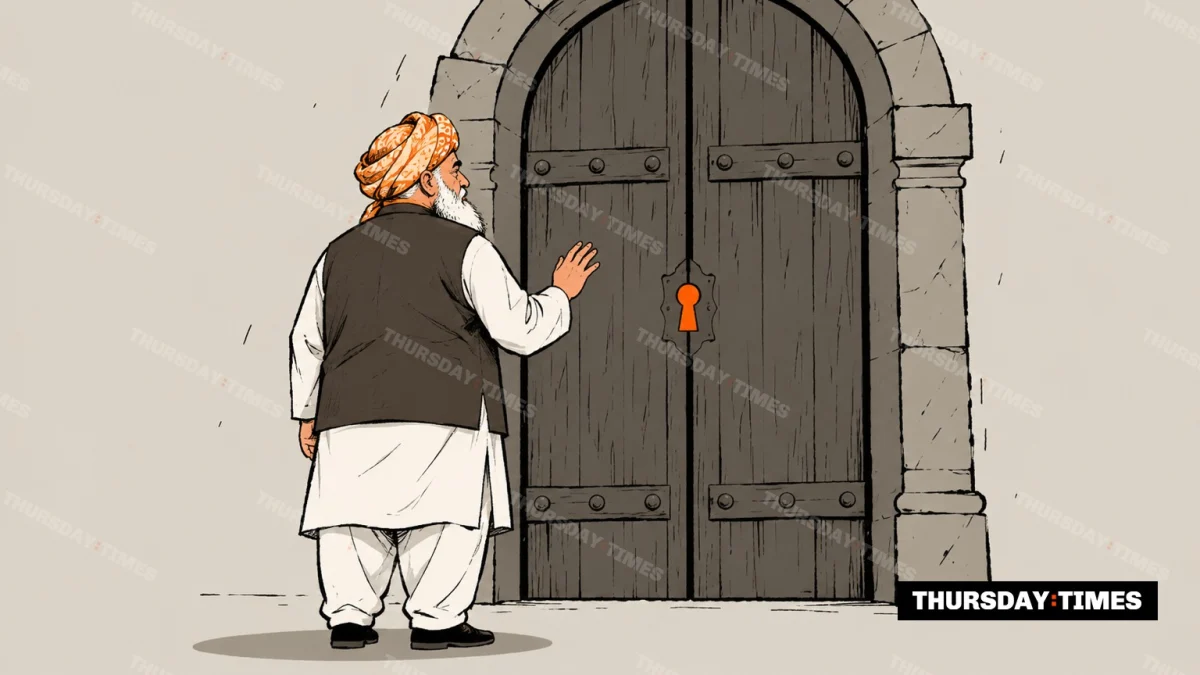
In Pakistani politics, the establishment tends to look most sinister to those standing outside its door. Proximity breeds accommodation; distance breeds denunciation. Maulana Fazlur Rehman, among the most accomplished practitioners of proximity the country has produced, now finds himself at a distance, and his voice has grown louder in proportion.
For decades, the chief of the Jamiat Ulema-e-Islam-Fazl was less a politician than a fixture of the corridors of power. His party never commanded the numbers to rule, but he rarely needed them. He had something rarer: the patience to negotiate, the instinct for which way a coalition would bend, and a gift for converting a handful of parliamentary seats into a permanent place at the table. Governments came and went; Fazlur Rehman, more often than not, remained.
It is against this history that his new vocation as the establishment’s fiercest critic must be read.
In Multan on Thursday, he called the federal government fake and politically defeated. Its leaders, he said, had no authority of their own, and powerful institutions were gathering power to themselves at the expense of civilian democracy. It was not the language of the negotiator. It was the language of the barricade.
Those who have followed Pakistani politics over the past decade will have heard these words before, from a different mouth. The charges of electoral manipulation, the talk of institutional interference, the sweeping dismissal of opponents as illegitimate, the suggestion that elected leaders are puppets of unelected power: this is the grammar of Imran Khan’s Pakistan Tehreek-e-Insaf. That Fazlur Rehman now speaks it so fluently is one of the stranger turns of recent politics.
This is the grammar of Imran Khan’s Pakistan Tehreek-e-Insaf. That Fazlur Rehman now speaks it so fluently is one of the stranger turns of recent politics.
The irony is hard to miss. It was Fazlur Rehman who stood at the head of the Pakistan Democratic Movement, the alliance that unseated Khan through a parliamentary vote of no confidence in April 2022. He was one of Khan’s most relentless adversaries. Today he echoes many of the arguments Khan’s movement has made against the order that followed, an order Fazlur Rehman himself helped bring into being.
The shift in tone has had consequences. Earlier this year, his remarks that soldiers receive salaries for doing their duty drew a storm of criticism, with many hearing in them a belittling of those who had given their lives in uniform. He rejected that reading, insisting his target was those who wield institutional power, not the soldiers who serve beneath them.
The distinction he draws is real, and it matters. Criticising a military’s leadership is not the same as diminishing the sacrifice of its dead. But a politician of his experience, one who has spent a lifetime invoking religious and national duty, ought to know how heavily his words fall. A constitutional argument does not need the graves of fallen soldiers as its rhetorical ground.
A constitutional argument does not need the graves of fallen soldiers as its rhetorical ground.
Nor can his own past be quietly set aside.
Under General Pervez Musharraf, the religious alliance in which he played a leading part, the Muttahida Majlis-e-Amal, struck the constitutional bargain that lent legitimacy to key elements of a military-led political order. In the years that followed, he moved comfortably through successive governments and shifting alliances, rarely far from influence.

When Khan fell, his party took its seats in the coalition that replaced him. Only after the February 2024 election, when JUI-F found itself outside the new federal government, did his criticism of the prevailing order sharpen into something approaching defiance.
His shifting distance from the establishment
None of this proves his concerns are insincere. Pakistan’s long history of institutional interference gives anyone, of any record, reasonable cause for complaint. A true argument does not become false because of who makes it.
But a record invites questions, and his invites an obvious one. Why has the language of resistance become so uncompromising at precisely the moment his party has lost the influence it once enjoyed?
There is a difference between defending constitutional supremacy and wielding constitutional grievance as a weapon in a contest for position. The more aggressive Fazlur Rehman’s rhetoric becomes, the harder that difference is to see.
Pakistan’s democratic troubles are not the work of unelected institutions alone. They are also sustained by politicians who welcome institutional influence when it favours them and discover its dangers only when fortune turns. Every accommodation made in good times is a brick in the wall they later rail against.
Every accommodation made in good times is a brick in the wall they later rail against.
And so the story arrives at its irony. The man who helped bring Imran Khan down now borrows Khan’s voice, condemning a system in whose corridors he spent decades bargaining for his share.
His right to challenge the establishment is beyond question. What remains open is whether the challenge marks a lasting conversion to constitutional principle, or simply another adjustment to the weather.
The true test will not come while the doors of power stay shut to him. It will come on the day they swing open again, and we see whether he walks through.
Until then, one question lingers over every speech: is Fazlur Rehman challenging the establishment itself, or only his exclusion from it?∎