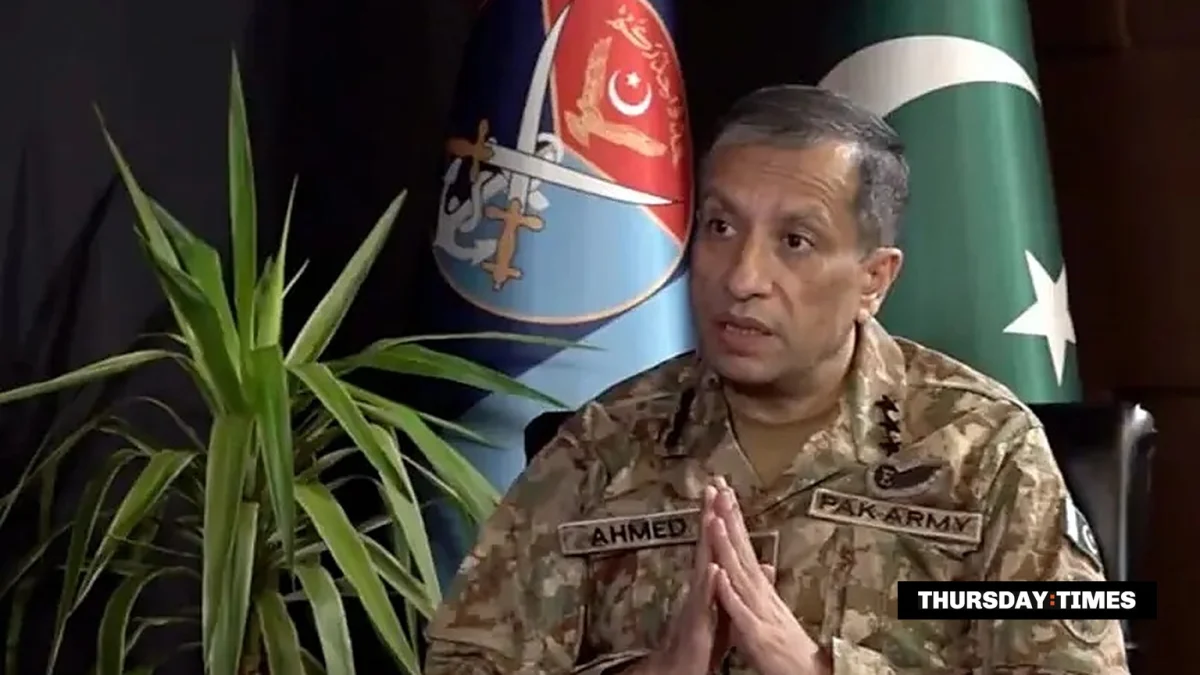
RAWALPINDI (The Thursday Times) — Pakistan is holding sustained diplomatic contact with Iran aimed at breaking what its military spokesman calls a recurring cycle of regional escalation and de-escalation, the Director General of the Inter-Services Public Relations (DG ISPR), Lieutenant General Ahmed Sharif Chaudhry, has said.
Speaking to Independent Arabia in an interview that aired on Sunday, Chaudhry described a pattern in which tensions across the region repeatedly flare and cool, driven, in his words, by “agents of chaos” who keep reigniting conflicts that calmer diplomacy had briefly dampened. “The concern about escalation is always present because we are witnessing a recurring cycle of de-escalation and escalation,” he said. “We constantly emphasise to them that this cycle is not good.”
Pakistan’s political and military leadership have kept channels open to Tehran for several months, he said, with the conversation focused squarely on restraint and preventing a wider conflagration rather than on any single flashpoint. Asked directly whether Islamabad had warned Iran over the Houthi attacks on Saudi Arabia, the DG ISPR neither confirmed nor denied that such a specific exchange had taken place, saying only that Pakistan’s engagement with Tehran was continuous and oriented toward resolving disputes through dialogue.
Chaudhry argued that widening the confrontation, whether by drawing in the Houthis more deeply or extending it to new fronts, serves only those seeking disorder and settles nothing. He said Pakistan had been pressing all sides to de-escalate since the outbreak of the US-Iran war, warning that an expanding conflict would make any negotiated settlement harder to reach and would damage the interests of every regional state, not just the parties directly involved.
The comments come as Pakistan, Saudi Arabia and Türkiye operationalise the Makkah Joint Defence Alliance, under which an attack on any one member triggers a collective response grounded in Article 51 of the UN Charter. Chaudhry was careful to frame that pact as defensive rather than provocative, saying it was “not aimed at any specific country” and that Pakistan’s preference throughout the current crisis remained de-escalation over confrontation.
He pointed to Riyadh’s multinational maritime coalition, which now covers the Bab al-Mandeb Strait and the Strait of Hormuz, as a parallel track to the diplomatic effort, noting that a Pakistani naval officer serves as the coalition’s deputy commander. The arrangement, he suggested, gives the alliance a standing presence in the waterways most exposed to spillover from any escalation involving Iran or the Houthis, without requiring new hostilities to justify it.
Chaudhry closed by returning to his central theme: that the region’s Muslim-majority states have more to lose from a widening war than any single actor has to gain from one. “This cycle is not good,” he reiterated, adding that Pakistan’s diplomacy with Tehran would continue alongside, not instead of, its defence commitments to Saudi Arabia.∎