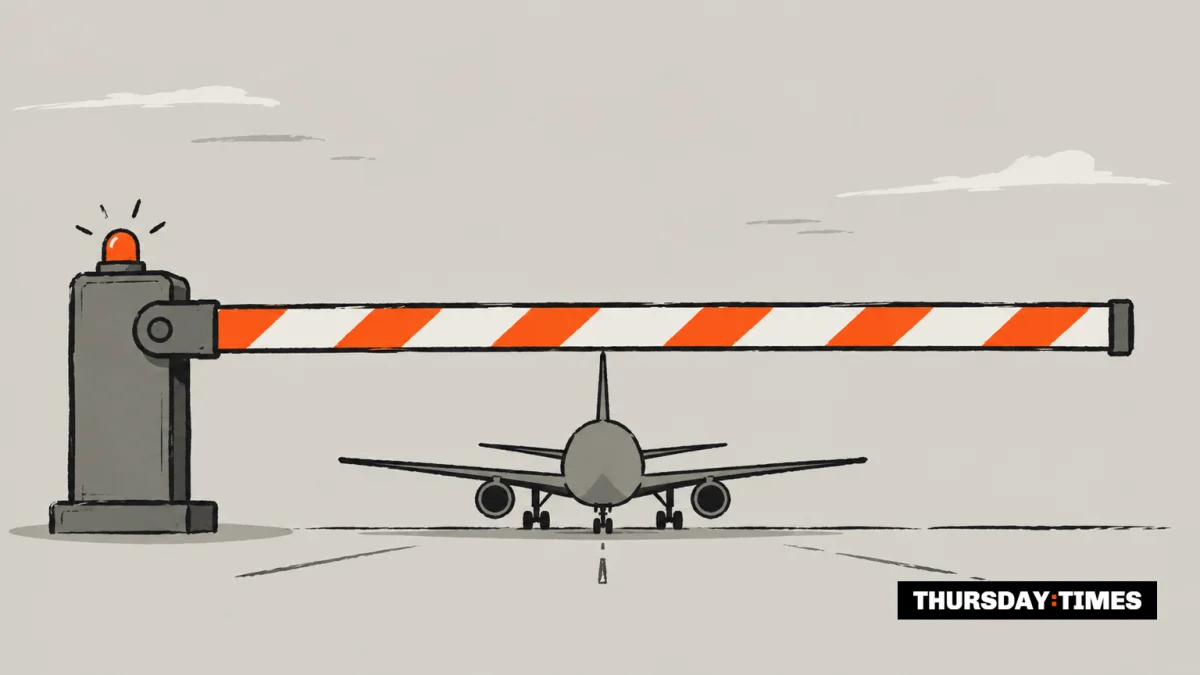
NEW DELHI (The Thursday Times) — Pakistan’s Civil Aviation Authority is due to make another call this week on whether to keep its airspace closed to Indian aircraft, a decision that has now been rubber-stamped on a rolling monthly basis for more than a year and a half. The current Notice to Airmen (NOTAM) runs until 24 October 2026, and industry trackers including TechJuice have been following the renewal cycle closely because each expiry date brings fresh uncertainty rather than any sign of resolution.
The closure dates back to 24 April 2025, when Pakistan shut its skies to Indian carriers during that year’s India-Pakistan crisis. What began as an emergency measure has since hardened into a semi-permanent feature of South Asian aviation, extended again and again without a public timeline for when, or whether, it might end.
A bill that keeps climbing
The accumulated cost to India’s aviation industry is now estimated at close to $2 billion, according to figures attributed to the Pakistan Airports Authority and reported by AVI-GO. That number reflects the cumulative toll of longer flight paths, higher fuel burn and lost efficiency across the eighteen months the ban has been in force.
The credit rating agency ICRA has warned separately that Indian aviation could absorb a further $600 million in losses in 2026 alone if the closure persists, AVI-GO reported. Unlike the cumulative $2 billion figure, that $600 million is a forward-looking estimate for a single year, underlining how the losses are not just historical but ongoing and compounding.
Air India’s case for a subsidy
The scale of the damage has pushed India’s flagship carrier to ask its own government for help. Air India has proposed what has been described as a “subsidy model” to offset the cost of rerouting around Pakistani airspace, according to Outlook Business, which reported that the airline puts its own losses at more than $591 million for every year the restrictions remain in place. The same reporting noted Pakistan’s announcement on 23 September of yet another extension of the ban, one of several such renewals that have come and gone with little fanfare beyond the industry press.
That an airline of Air India’s size is lobbying for state support to cover a single operational constraint says something about how structural the problem has become. A subsidy, if granted, would effectively mean Indian taxpayers underwriting a cost created entirely by the closure of a neighbouring country’s skies.
Why the pain is so lopsided
Pakistan’s own press has noted the imbalance in who actually suffers from the ban. The News has observed that the restrictions have hit India’s aviation sector considerably harder than Pakistan’s own carriers, and the reason is largely geographic. Indian airlines operate a dense network of long-haul routes to Europe, the Gulf and beyond that, under normal circumstances, cross Pakistani airspace as the shortest path. With that route closed, flights to destinations such as London, Frankfurt or New York must swing south over the Arabian Sea or take other detours, adding substantial flight time, fuel consumption and crew costs on each rotation.
Pakistani carriers, by contrast, have comparatively little commercial dependence on Indian airspace for their own international networks, so the reciprocal exposure is far smaller. The result is an asymmetric cost structure: one side absorbs a steadily growing bill, while the other faces comparatively little operational disruption from the same closure.
A decision renewed, never resolved
What makes the situation especially difficult for Indian carriers to plan around is the mechanism itself. Each NOTAM extension is treated as a fresh, self-contained decision rather than part of a longer-term policy, which means airlines cannot build durable route economics around either a resumption of access or a permanent rerouting strategy. Fleet deployment, crew rostering and fuel hedging all become harder to plan when the underlying assumption, access to Pakistani airspace, could change with a month’s notice in either direction.
That uncertainty, more than any single cost line, is what analysts say makes the ban so damaging. Airlines can adapt to a known constraint; they struggle to adapt to one that is renewed, rather than resolved, every few weeks. With the current NOTAM set to lapse on 24 October 2026 and a fresh renewal decision expected imminently, the aviation industry on both sides of the border will be watching Islamabad’s Civil Aviation Authority for a signal that, eighteen months on, is yet to come.∎