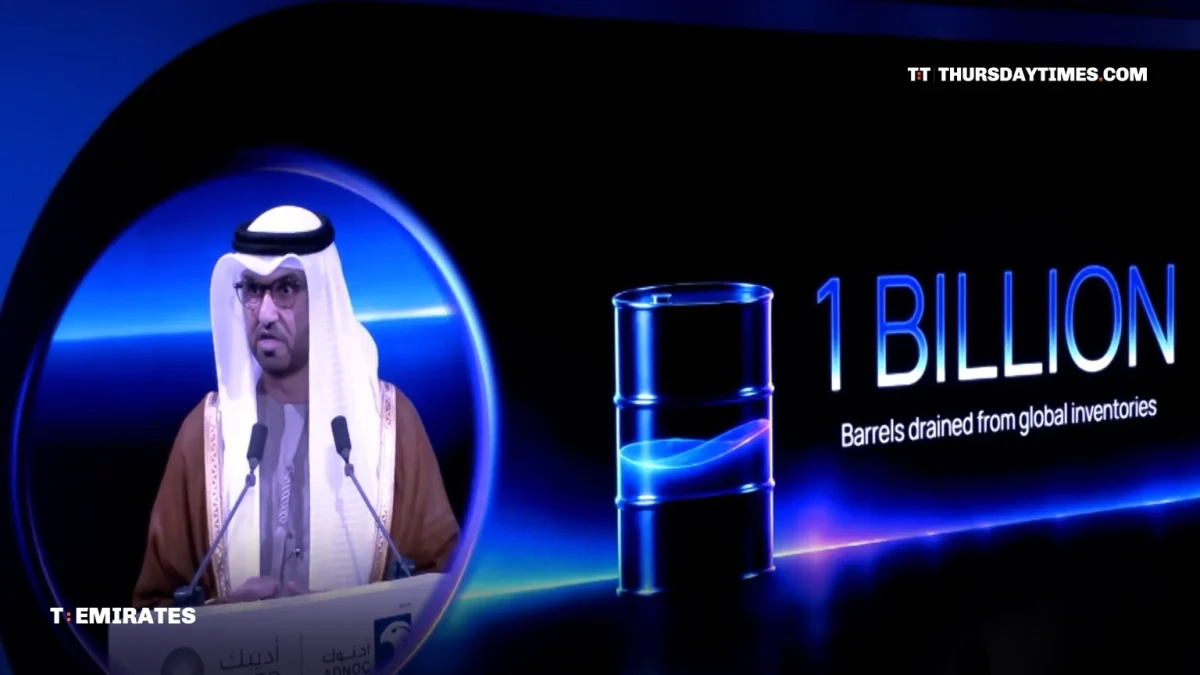
ABU DHABI (The Thursday Times) — Nearly one billion barrels have drained from global oil inventories since the disruption of the Strait of Hormuz, ADNOC chief executive Sultan Al Jaber said on Monday, warning at the opening of the ADIPEC energy conference that “the world has eroded its supply buffers”.
Al Jaber, who is also the UAE’s industry minister, said diesel stocks in some markets were at their lowest seasonal level in 35 years, and that others faced a gap of 600 billion cubic feet in liquefied natural gas supply.
Shipping and logistics, he said, made up less than 5 per cent of the cost of a barrel before the disruption. They now account for more than 30 per cent.
“Supply is only half the story. The other half is delivery,” he said. “Energy security is not only measured at the point of production. It is now also measured at the point of delivery.”
The billion-barrel figure is his own. The International Energy Agency, which adds up only the stocks it can observe, has recorded a markedly smaller fall. In October the agency forecast that global oil supply would drop by 5.8 million barrels a day in 2026 and demand by 2.6 million.
Five priorities
Al Jaber set out five steps for the industry. The first was accessible supply, with more strategic storage, larger stockpiles of products and flexible refining capacity closer to consumers. The second was routes to market. “Supply only counts when it arrives,” he said.
The third was operational intelligence, moving to energy systems that anticipate risk. The fourth was capital, with policy to build confidence, finance to accelerate it and insurance to keep trade moving. The fifth, which he called the most important, was people. “Systems don’t carry responsibility, people do,” he said.
‘You can count on the UAE’
He said ADNOC had prepared long before the crisis. “We did not write our playbook during this disruption. We wrote it years before, and at ADNOC, it did not make us immune; it made us prepared.”
The UAE, he said, had held firm under pressure. “Talent stayed. Capital stayed. Investment kept coming and the economy kept moving.” He said the country would keep pressing for dialogue and political solutions that stabilise energy flows, and closed with a message to partners: “When it counts the most, you can count on the UAE.”
ADNOC also announced a final investment decision on the Ruwais Diyab development in Abu Dhabi, its first large-scale unconventional gas project. The company said it would deliver 345 million standard cubic feet of raw gas a day from 2029, with the potential to reach up to one billion.
The four-day conference opened hours after ADNOC signed a partnership with OpenAI and G42, with OpenAI chief executive Sam Altman on stage. It runs until 5 November, though ExxonMobil and Chevron have pulled senior executives from the event over security concerns, sources said.