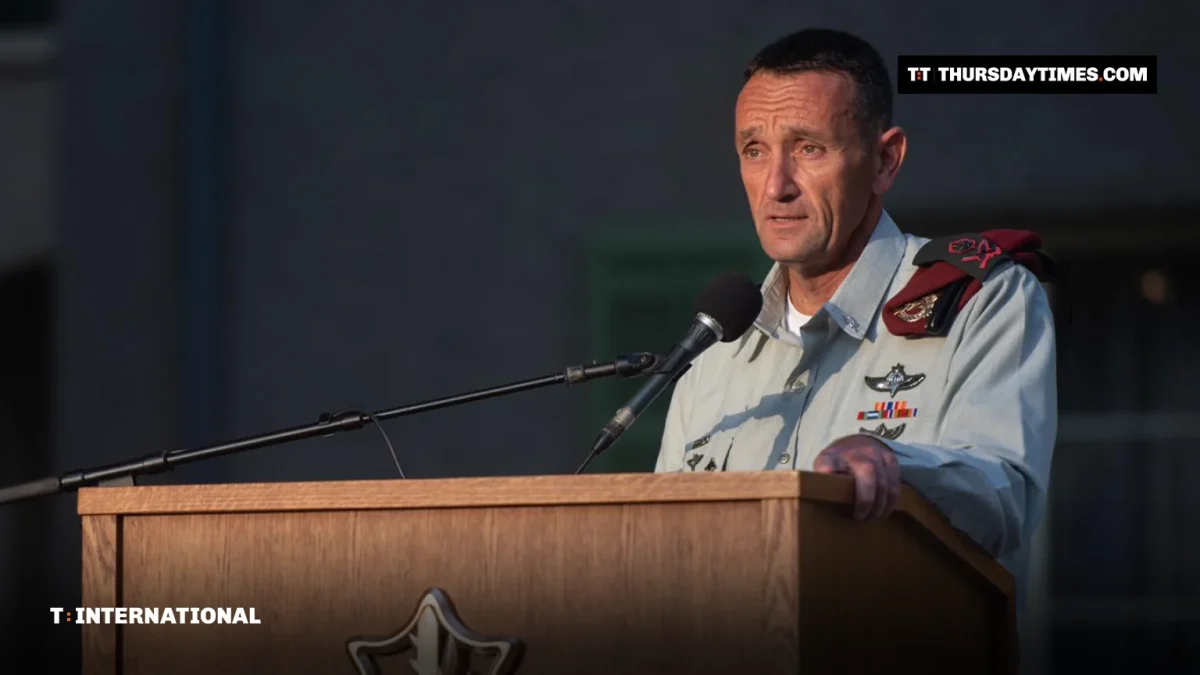
NEW YORK (The Thursday Times) — Israel’s former army chief Herzi Halevi has said the October 7 Hamas attack was a failure that “could have been prevented”, while rejecting claims of an inside job and admitting that Israeli bombs killed hostages in Gaza.
Addressing the attack publicly for the first time since he resigned in 2025, Halevi told a conference at the Museum of Jewish Heritage in New York on Sunday: “There was absolutely no betrayal. The political echelon and the country’s leadership need to state this clearly and unequivocally.”
“I know these individuals, and I cannot believe that any of my colleagues, after decades of service during which they risked their own lives, would suddenly decide to assist Hamas,” he said. Aiding Hamas would have required an extensive network, he added, “yet, even after three years, not a single such person has been found”.
‘We were not there in time’
Halevi called for a state commission of inquiry. “We must look failure in the eye in order to be able to fix things,” he said, referring to the Bibas family, whose members were abducted and killed. “I look at a photograph of Shiri Bibas and see the fear in her eyes. We were not there in time to help and save her. That is the failure.”
He said the military’s priorities before the attack were “first Iran, then Hezbollah, and only then Hamas”, because the prevailing view in the army, the Shin Bet and the political leadership was that Hamas did not want war. “Hamas invested significant effort into leading us to this assessment,” he said.
On the war in Gaza, Halevi said it took a long time to persuade political leaders to approve a ground operation, and that hostages could not have been brought home without military pressure. He also acknowledged errors. “Unfortunately, we made mistakes. Our own bombs killed hostages. Of course, this was not intentional; we did not know they were there,” he said.