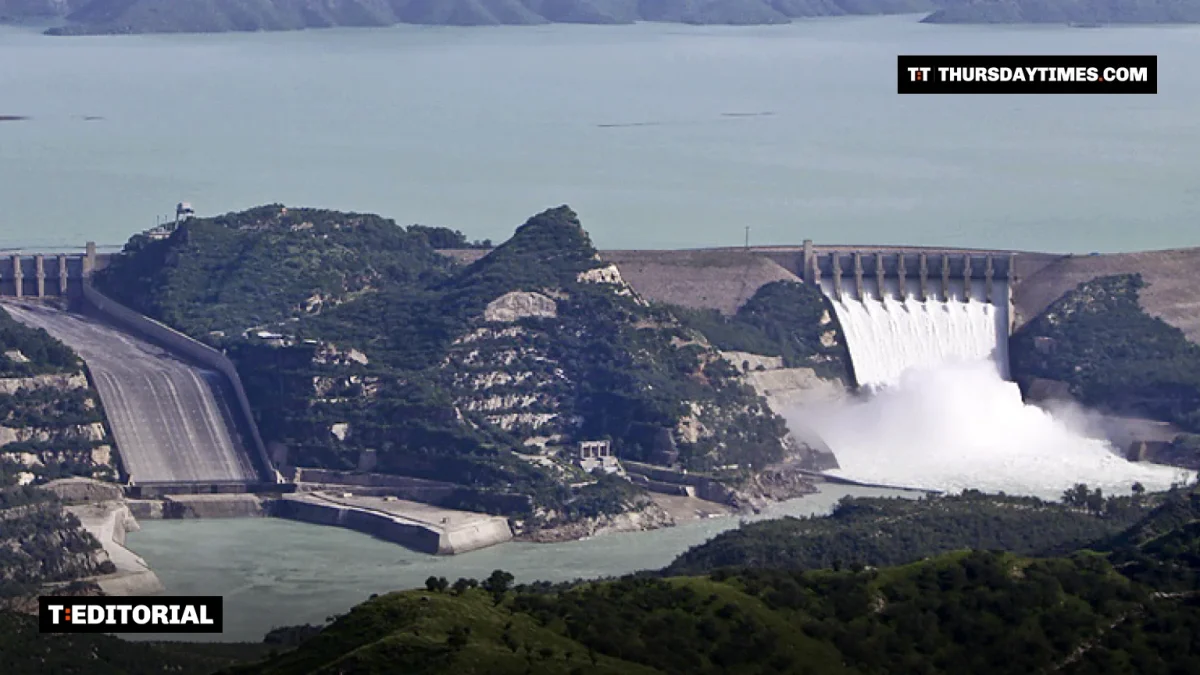
Water has now broken into the Tarbela 5th Extension twice in 15 months. On Monday, work on the 1,530-megawatt project was suspended after water surged into the site and reached the area of the power house. In August last year a temporary dam at the same project collapsed, and a government inquiry later held the contractor, the consultant and the Water and Power Development Authority responsible. Nobody was hurt on Monday, WAPDA says, and the main works are undamaged. That is a relief. It is not an answer. Pakistan needs dams, and it needs this one. That is exactly why the findings on both failures should be published in full, and why someone must be made to answer for them.
Monday at Tarbela 5
Two accounts of one accident
WAPDA’s account is specific. It says a weak rock mass collapsed during excavation of the second bench of the connecting tunnel, letting water from the intake pit flow into the tunnel and the area of the under-construction power house. “All workers were immediately evacuated safely,” it said. The intake pit has been drained, no more water is reaching the downstream work areas, and pumping out the power house has begun. It rejected reports that the T-5 tunnel had collapsed and said the main tunnel, the power house, the tailrace culvert and the switchyard were undamaged.
The district administration described something else. Deputy Commissioner Waseem Ahmed, who went to the site, said a protective bund had breached and that water had entered Tunnel 5. Work had stopped indefinitely, the administration said, and an inquiry would examine whether a structural weakness or technical fault was to blame.
These accounts may turn out to be compatible. Falling rock can open a path for water that a barrier was meant to hold back. But a federal authority and a district government should not be describing the same accident in different terms on the same day. The first thing the public is owed is a single, signed account of what failed, in what order, and what it will take to repair.
What the last inquiry found
The reason for scepticism is the record. In August 2025 a cofferdamA temporary dam built to keep water out of a construction site while permanent works are built. at the project collapsed and construction stopped. At first the talk was of high water. A three-member government committee looked at it and found otherwise. Flows, it concluded, had been within Tarbela’s historical range and well below what the structure was designed to take. It pointed instead to inadequate protection layers and filter arrangements.
Its findings on who was responsible were blunt. The contractor, it said, had proposed replacing the approved design with a rock-filled structure the contract did not allow. The consultant had conditionally accepted the deficiency without ensuring technical compliance. WAPDA had approved the change close to the completion of construction without examining its contractual validity or its technical risks. A performance report that WAPDA requested in July 2023 did not arrive until October 2024. Payments had been made for temporary rather than permanent works, which weakened the government’s ability to seek compensation. The consultant, meanwhile, issued a termination notice in May 2025 and withdrew its staff without the required notice, and WAPDA ended the consultancy.
The river was not to blame last time. The public deserves to see the evidence this time.
Those findings have reached the public through press reports. They should be available to anyone who wants to read them, with the annexes. If the system learned from them, the proof should be easy to show: who now checks the contractor’s work, what changed in the approval of design changes, and whether anyone has paid for what went wrong.
The bill so far
Tarbela 5: estimated cost
An increase of more than 285 per cent. The project was due in 2026 and is now expected by the end of June 2028.
The cost of all this falls on people who had no say in it. The estimate for the project has risen from Rs82.36 billion in 2017 to Rs317 billion, and completion has slipped from 2026 to the end of June 2028, at least two years late. The World Bank is lending $390 million and the Asian Infrastructure Investment Bank $300 million, and Pakistanis will repay both. The Planning Commission has warned that the levelised costThe average cost of each unit of electricity over a plant’s whole life, counting construction, financing and running costs. of its electricity could reach Rs27 to Rs28 a unit over 30 years, and that it could become “the country’s most expensive renewable energy project and economically unsustainable”.
Some of that rise is the rupee, which nobody at Tarbela controls. A two-year delay is not. Every month the extension stands idle is a month in which the grid goes without part of the 1.347 billion units it is meant to add each year, while interest on the loans keeps running. It is too early to say what Monday will add to the bill. WAPDA should say so itself as soon as it knows.
A wider pattern
Rise in estimated cost of major water projects
Rise over the first approved estimate. Latest figures: Tarbela 5 Rs317bn, Dasu Rs1.737tr, Diamer Basha Rs1.12tr, Mohmand Rs665.7bn.
Tarbela 5 is the most striking case but it is not alone. Dasu Stage I has gone from Rs486 billion to Rs1.737 trillion. The dam component of Diamer Basha is now put at about Rs1.12 trillion, against an approved Rs479.7 billion. Mohmand stands at Rs665.7 billion against Rs309.6 billion. The Water Resources Ministry attributes nearly 90 per cent of Dasu’s increase to things beyond the project’s control, such as currency losses, inflation, financing and security. That deserves to be taken seriously. Terrorists have killed Chinese engineers working on Dasu, and protecting those who build the country’s dams is neither optional nor cheap.
But not everything can be put down to bad luck. Planning Minister Ahsan Iqbal has complained that a revised PC-IPlanning Commission Form I, the official document that sets out a public project’s scope, cost and timetable for approval. for Diamer Basha went unsubmitted for six years while its cost multiplied. The Auditor General has recorded physical progress there of 19.95 per cent, against financial progress of 39.67 per cent and a target of 57.78 per cent. And money is short: on November 5 the Economic Coordination Committee approved Rs275 billion for six water projects, against a demand of nearly Rs450 billion for the year. In those conditions, every rupee lost to a preventable failure is taken from another dam.
Why this matters more than one project
None of this is an argument against building. India has held the Indus Waters Treaty in abeyance since April 2025, the climate is making the country’s floods and droughts harsher, and Pakistan’s storage is far too small for its population. The case for Tarbela 5, Dasu, Mohmand and Diamer Basha has never been stronger. WAPDA’s engineers and the thousands of workers on these sites do hard and often dangerous work in remote places, and they are not the ones this newspaper has in mind.
Criticising how dams are built is not opposing dams. It is the only way to get them finished.
But a national effort of this size depends on public trust, and on the trust of the lenders who pay for much of it. Both are strained when failures are explained away and reports stay in files. Those who want to discourage Pakistan from building will find no better argument than a record of projects that flood, stall and double in price. The answer is to show that the country can find out what went wrong and fix it.
What should happen now
Six steps for Tarbela 5
None of these steps is costly. All of them could be taken by a government that wants to know the answer. Parliament has a part to play as well: the standing committees on water resources and planning should call WAPDA, the contractor and the Planning Commission to explain, in public, what has been learned since August 2025. The World Bank and the Asian Infrastructure Investment Bank have their own duty to ask how their money is being protected, and to say what they are told.
Pakistan was fortunate on Monday. A worker swept away by the water was brought out alive, and the others got out in time. A second accident on the same project, 15 months after the first, is the kind of warning that a serious institution acts on before a third arrives. The dam is worth building. The way to honour that is to tell the country the truth about what happened to it.