Eleven men went to work in Kohlu district on Sunday and did not come home. Police say they were employed at the Chamalang coal mines and were travelling in two vehicles when armed men stopped them. No group has claimed responsibility, and this newspaper makes no claim of its own about who was behind it. What is clear is that eleven families have lost the people who earned for them, and that the road between a mine and a village is one of the most dangerous places a Pakistani worker can stand. Condolences have come, and they are due. What the dead are owed in addition is a state that treats the safety of remote mine labour as its own task: protected transport, a register of every worker, compensation that arrives, patrols on the coal routes, and an honest inquiry into how two vehicles were stopped.
What is known, and what is not
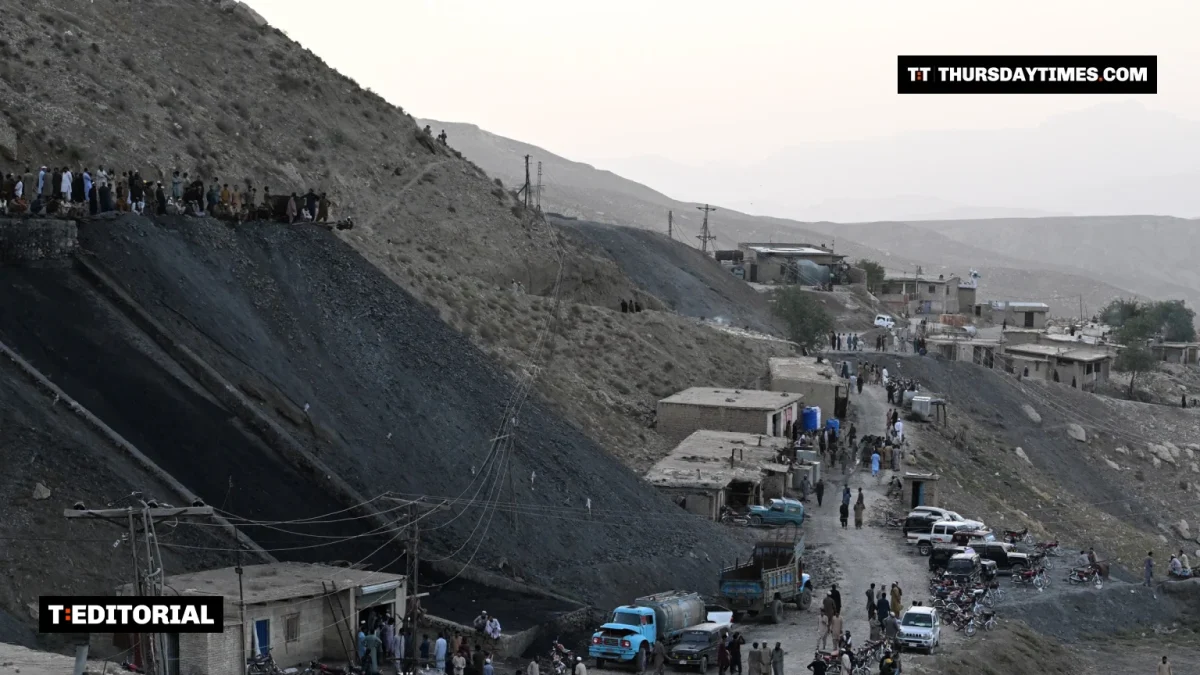
Kohlu’s Superintendent of Police, Tayyab Iqbal, said the victims worked at the Chamalang coal mines and that the attack happened in the Hosri area of Jandran tehsilA tehsil is an administrative sub-division of a district in Pakistan. A district such as Kohlu is divided into several, each with its own headquarters and revenue and police arrangements.. Two accounts of how the men died have been given, and they are not identical. SP Iqbal said armed men stopped both vehicles, took the workers to a nearby mountainous area, and killed them there. A Balochistan police spokesperson said unidentified armed men opened fire on the workers as they travelled in the two vehicles, and that all the victims were local men employed by a local mining company.
Early accounts of an attack in a remote place are often partial, and the two versions may differ only in detail. But the difference matters, because it decides which questions the state has to answer. Were the men taken from the road and killed somewhere else, or fired on where they were stopped? Police said four of the dead had been identified, three from Duki district and one from Sanjawi tehsil in Ziarat district, with the remaining seven still being identified and the names not yet released. The area was cordoned off, a search operation began, and arrangements were made to move the bodies to the DHQ HospitalThe District Headquarters Hospital, the main public hospital of a district. In Kohlu it is where the bodies of the dead were to be taken. in Kohlu.
Babar Yousafzai, the Balochistan government’s adviser for media affairs, attributed the attack to terrorists belonging to Fitna al-Hindustan, the term the state uses for terrorist groups it says are backed from India. That attribution could not be independently verified, and by Sunday evening no group had claimed the killings. Prime Minister Shehbaz Sharif said those who target innocent civilians and labourers in acts of terrorism “deserve no leniency”. President Asif Ali Zardari, Interior Minister Mohsin Naqvi, Chief Minister Sarfraz Bugti, and Punjab Chief Minister Maryam Nawaz Sharif also condemned the killings, and Bugti said those involved would be brought to justice. Our news report carries the full account.
The road is part of the workplace
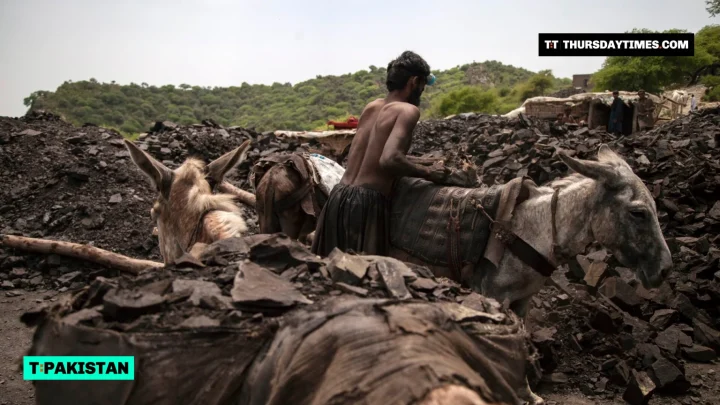
Coal is one of the main sources of work in parts of Balochistan, and it is dug in remote hills, far from the courts, hospitals, and police stations that serve a town. A miner’s working day does not begin at the pitheadThe surface area at the entrance to a mine, where workers go in and coal is brought out.. It begins with whatever vehicle takes him there, and it ends with whatever vehicle brings him back. That journey is part of the job, and it is the part that nobody inspects.
Balochistan’s miners have been through this before, in different ways. In October 2024, at least 20 coal miners were shot dead in an overnight attack on their lodgings in Duki district. On 30 July this year, a methane explosion at a coal mine in Sorange, east of Quetta, killed more than 30 workers, according to officials. The causes were different, and so were the places, but the lesson is the same. Men who work in dangerous conditions are most exposed where the state has not decided that they are its responsibility. Figures given to the National Assembly in September for deaths in mines were reported as not adding up to one clear national count, and some regions had not replied. A state that cannot count its miners will struggle to protect them.
The road between the mine and the village is part of the workplace. The state should treat it as one.
Safe transport for the men who dig
The first requirement is the plainest. A company that employs workers at a remote coalfieldAn area where coal seams lie close enough to the surface to be mined. Chamalang in Kohlu and Duki are among the coalfields of Balochistan. should be responsible for how they get there and back. In practice that would mean transport in registered vehicles with named drivers, a passenger list held by the company and shared with the district administration, and fixed times for shift changes in place of ad hoc journeys at any hour. The district police should know in advance when a group of workers is on the road and by which route. Vehicles should carry a tracking device that lets a control room see where they are and raise an alarm when one stops where it should not.
On stretches of road with a record of trouble, workers should travel together in convoy, with an escort, and not in twos and threes. The cost belongs in the price of coal. If these rules are built into the licence to operate, no honest company is undercut by a careless one, and a man’s safety does not depend on how generous his contractor feels.
A register that names every worker
In the hours after Sunday’s killings, seven of the eleven dead had still not been identified publicly. That is no criticism of the police who were working through the night. It points to a larger gap. Mine labour in Balochistan is often hired through contractors and sub-contractors, paid by the day, and written down nowhere that the state can read. A man who is not recorded cannot be counted when he dies, cannot be paid when he is hurt, and cannot be found when he is on a road at risk.
The fix is a register: the worker’s name, identity card number, home district, mine, contractor, and next of kin, filed with the provincial mines department and refreshed every month. Registration should be a condition of the licence to mine and of the permit to move coal, so that a site whose workers are not on the register does not ship. A register is also the doorway to everything else a worker is owed. A registered man can be enrolled with the EOBIThe Employees’ Old-Age Benefits Institution, a federal body that runs a pension scheme for workers in private businesses. Benefits depend on the worker having been registered., insured, and visited by an inspector. An unregistered one is nobody’s responsibility, and that is the problem.
Compensation that does not have to be chased
Four of Sunday’s dead have been traced to Duki and to Sanjawi in Ziarat. Their families will face a funeral, the loss of the household’s earnings, and, in a few weeks, offices in other districts that want papers. The state can spare them most of that. It should announce a fixed sum for each of the eleven families, pay a first instalment within days, and say when the rest will follow. It should not matter whether the employer had registered the man, because the state can recover the money from the employer afterwards. A monthly allowance for widows and for children’s schooling would do more over the years than a single payment.
The principle should reach beyond Kohlu. Families of workers killed on a mine road, in an attack, or in an accident underground should meet one desk, in their own district, with one form. The amount and the date should be published. Compensation that has to be chased through three departments is not compensation. It is a second injury.
Compensation that has to be chased is not compensation. It is a second injury.
Patrols on the coal routes
The province can also do something that does not wait on any inquiry. The provincial government, through the police and the district administration, can map the main coal routes in each coalfield district, rank their stretches by risk, and agree a patrol schedule with the companies that matches the hours when workers are on the road. A control-room number that drivers can call, a target for how quickly someone responds, and a log of every incident reported would turn a promise into something that can be checked.
No patrol can seal every mountain track, and the officers who serve in remote districts do so at risk to their own lives. The aim is not total cover but a visible, predictable rhythm that makes a road harder to use for harm and easier for a worker to trust.
An inquiry that can answer how two vehicles were stopped
Accountability begins with questions that the first reports do not answer. Where were the vehicles stopped, at what time, and how far from the nearest post? Had a threat been reported to the police or to the company before Sunday? Was the journey part of a scheduled movement, and did anyone outside the company know of it? When the alarm was raised, how long did a response take? Which of the two accounts, abduction followed by killing, or firing on the vehicles, does the physical evidence support? A mine owner said after the Duki attack of 2024 that owners had been receiving threats. An inquiry into Kohlu should find out whether warnings, where they exist, reach anyone who can act on them.
For the answers to be believed, the inquiry has to be credible. That means leadership from outside the chain of command in the district, a team with forensic skills, access to every record and witness, and a promise to publish what it finds and to brief the families before the press. An inquiry of this kind is not an accusation against the officers who responded on Sunday. It is how the state learns what happened, and how it earns the trust of the people who work in places where it is thinly present.
What the dead are owed
The men killed in Kohlu were local workers doing a hard job for a wage, in a trade that keeps families in the province alive. The first duty of the state is to say that their deaths matter, and the prime minister, the president, and the provincial leaders have said so. The second duty is the one that the statements cannot discharge, which is to make the next journey safer than this one.
That does not require a new law before it can begin. It requires protected transport, a register, compensation that arrives, patrols that keep to a schedule, and an inquiry that publishes its findings. Each can be started this month by the provincial government and the companies that profit from the coal. If the eleven are remembered for anything beyond their loss, it should be that the road to Chamalang became safer afterwards.