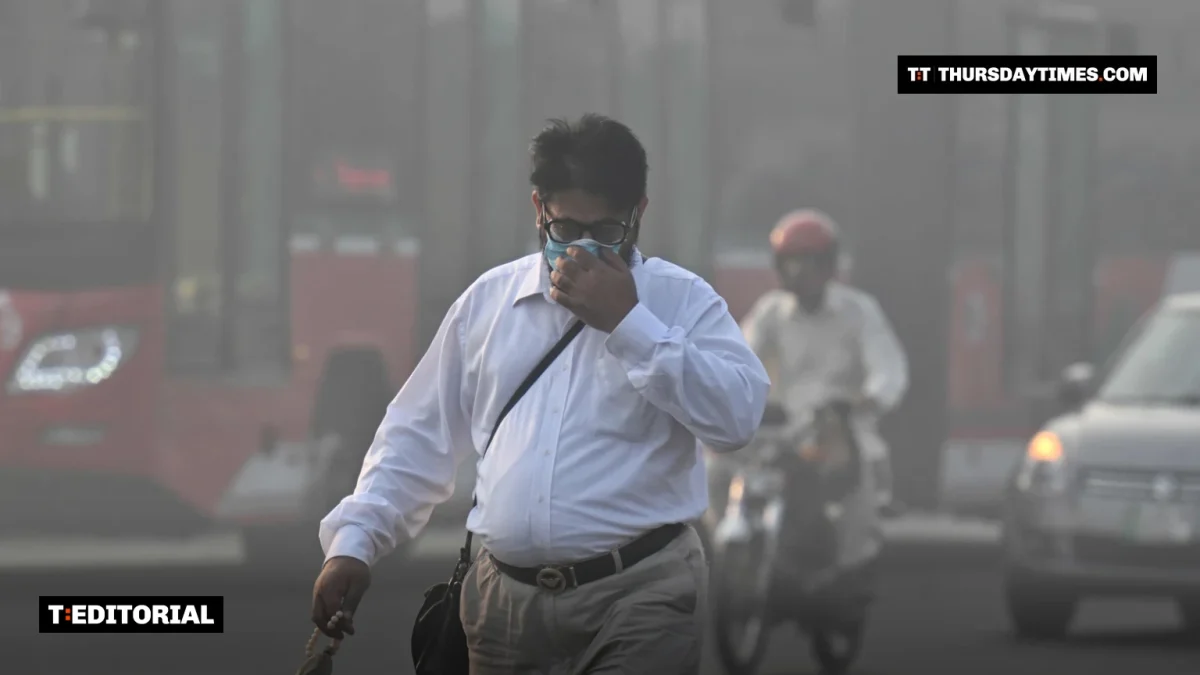
On Monday morning Lahore had the dirtiest air of any major city on earth. IQAir’s live ranking put its air quality indexA scale that turns pollution readings into one number. Above 300 is rated “hazardous”, the worst band on the scale. at 590, with an hourly reading of 647, while the next city on the list, Ulaanbaatar, stood at 177. By evening a change of wind had brought Lahore down to about 218, and the provincial government said its anti-smog operations had helped. They may have. But the city did not breathe more easily on Monday night because a plan worked. It breathed more easily because the weather changed. A province of 128 million people cannot leave its lungs to the wind.
Monday in Lahore
A season that is no longer a surprise
Nothing about this week was unexpected. Smog has returned to Punjab every autumn for a decade. In November 2024 readings in Multan passed 2,000, schools closed across the province and hospitals filled with children who could not stop coughing. Each year the government declares an emergency, deploys water sprinklers and smog guns, closes a few hundred polluting units and asks people to stay indoors. Each year the season ends when the weather allows, and the subject drops until the next October.
That cycle has to end, and it can. The science of where Lahore’s smoke comes from is better than it has ever been. The provincial government has more equipment, more monitors and more political will than any before it. What is missing is the habit of treating smog as a year-round problem with a year-round budget, judged by one test only: the air people breathe.
“The city did not breathe more easily because a plan worked. It breathed more easily because the weather changed.”
Across the border, and at home
The Punjab government says smoke from Diwali fireworks across the border added to Monday’s spike, and it had warned on Sunday that smoke from fireworks and crop burning in Indian Punjab could reach Lahore within five to 13 hours on easterly winds. That is plausible. Air does not stop at the Wagah border, and India’s own crop fires and festival smoke are well documented. Lahore and Amritsar are barely 50 kilometres apart. They share one airshed whether their governments like it or not.
But how much of Monday’s smog crossed the border has not been independently established, and the government’s own figures are a reason for care. Satellite data also showed significant crop fires inside Pakistani Punjab. The provincial environment department recorded 459 crop-fire reports between October 1 and November 4, and registered 57 police cases for burning. That is 28 per cent fewer fires than in the same period last year, a real improvement and one the department deserves credit for. It is still 459 fires.
The department says it will publish an assessment on Tuesday comparing the roles of weather, local emissions, farm fires and cross-border pollution. It should publish it in full, with its data and method, so that others can check it. If the assessment shows that most of Monday’s spike came from across the border, Pakistan will have a strong case to put to India. If it shows that most of the smoke was made at home, Punjab will know where to look. Either answer is more useful than the argument without numbers that both countries have had for years.
Where the smoke comes from
Outside the few worst days, most of what Lahore breathes is made in Lahore and the districts around it. Two inventories of the city’s PM2.5Fine particles less than 2.5 micrometres across, small enough to reach deep into the lungs and the bloodstream. They do most of the damage to health. emissions have been published in recent years. They disagree on much, but agree on the largest source.
Shares of Lahore’s PM2.5 emissions, two studies
Sources: the Urban Unit’s Lahore inventory as reported in 2023, and the Pakistan Air Quality Initiative’s national study. The studies count open burning, industry and kilns differently. Shares of the national study’s remaining sources are not shown.
The provincial inventory puts transport at about 35 per cent of the city’s fine-particle emissions, crop burning at 33 per cent and waste burning at 29 per cent. A national study published last year also puts transport at 35 per cent, but gives heavy industry 28 per cent and brick kilns 17 per cent. The Punjab environment department has disputed parts of that study. Readers will often see a much bigger number for transport, 83 per cent. That figure covers all pollutants by weight and is dominated by carbon monoxide. It is not transport’s share of the particles that do the most harm.
Two lessons follow. The first is that vehicles are the single largest source on every count, and they burn all year, not just in November. Within transport, the provincial inventory for 2020 found that heavy-duty vehicles and buses produced 55 per cent of road vehicles’ exhaust PM2.5, against 18 per cent from motorcycles. Old diesel trucks and buses, not the millions of motorcyclists, are where enforcement pays most. The second lesson is that the studies disagree because the data is thin. A province that cannot agree on how much its kilns and factories pollute cannot be sure it is regulating the right ones.
“Old diesel trucks and buses, not the millions of motorcyclists, are where enforcement pays most.”
Credit where it is due
This government has not been idle, and it should not be painted that way. On a single day last month its teams inspected 221 industrial units and 354 brick kilns, sealing seven units and four kilns. Smog guns and water-mist vehicles now work the main roads. The farm-fire count is down. Most important for the long term, Punjab has put electric buses on the roads of dozens of districts and has promised thousands more in the next few years. A city bus that does not burn diesel cleans the air every day of the year, not only on the days the cameras are watching.
The question is not whether the province is doing things. It is whether it knows which of them work. Smog guns are visible and reassuring, but there is little evidence that spraying water into the air of a large city does much to its average pollution. Sealing a kiln for a week does less than converting it to zigzag technologyA way of firing brick kilns that sends air along a zigzag path, so fuel burns more completely and far less smoke comes out of the chimney. for good. Arrests of farmers deter some, but a farmer with three weeks between rice and wheat and no affordable way to clear his field will burn it unless someone offers him a better choice.
What it costs
Smog is often discussed as a nuisance that closes schools and grounds flights. It is far worse than that. Lahore’s annual average concentration of fine particles is well over 100 micrograms per cubic metre, more than 20 times the World Health Organization’s guideline of five. National studies estimate that polluted air takes about four years off the life of the average Pakistani, and more than five years off the life of the average Lahori. Those are not November losses. They are built up over every month of every year.
Annual average PM2.5, micrograms per cubic metre
The Lahore figure is the annual average reported from the national air quality study. Daily readings in November are many times higher.
The burden falls hardest on those who can least avoid it: children walking to school along main roads, labourers who work outdoors, traffic police, rickshaw drivers and the elderly in homes without air purifiers. Government advice on hazardous days is to stay inside with the windows shut. For most of Lahore that is not a choice. Clean air is not a luxury for the middle class. It is the most basic public health service a city can provide.
A plan judged by the air
The province already has most of the pieces. What it needs is to put them in order, fund them for twelve months rather than eight weeks, and publish what they achieve. We suggest six steps.
Six steps for Punjab’s air
None of these needs a new law. Most need money, and some will cost the government political goodwill with transporters, kiln owners and farmers. They will not empty Lahore’s sky of smoke by next November. But each can be measured, and measurement is what turns an emergency into a programme. The province has an extensive network of air monitors. It should publish a simple scorecard every month: the city’s average, the number of hazardous days, and the progress on each step.
The cross-border question deserves the same seriousness. In 2024 the chief minister proposed smog diplomacy with Indian Punjab, an idea that made sense then and makes more sense now. Relations between the two countries are cold, and it would be naive to expect quick agreement. But an exchange of air-quality data and farm-fire warnings asks India for very little, and a refusal would itself tell the world something. Pakistan should make the offer in writing and make it public.
“Clean air is not a luxury for the middle class. It is the most basic public health service a city can provide.”
The test
Lahore’s weather will probably turn again this week, and the smog will thin for a while. When it does, the city will be tempted to forget, as it has been every year. The test of this government’s smog policy is not what it does on the days when the index passes 500. It is what it does in March, June and August, when no one is counting. Punjab has shown in other areas, from roads to buses to clinics, that it can deliver when it decides something matters. It should decide that the air its people breathe is one of those things, and measure itself by it.