ISLAMABAD (The Thursday Times) — When the Pakistan Minerals Investment Forum opens at the Jinnah Convention Centre on Thursday, the delegates will hear again about the size of the prize. They should ask a harder question. Last year’s forum drew more than 5,000 people from over 50 countries and ended with 16 memorandums of understanding. Since then, the country’s flagship project has been slowed, its financing has not closed, and no American company is yet operating in Balochistan. Yet some of the groundwork has moved too, from a security corridor in Chagai to a long-stalled lead and zinc mine. PMIF26 matters less for what gets signed than for whether it shows Pakistan can turn signatures into mines.
The forum, endorsed by the Special Investment Facilitation Council, was due to take place in April and was moved to November 12 and 13 because of regional developments. Its programme is noticeably more practical than last year’s. The first day is given over to financing early-stage exploration, training a mining workforce and bringing discoveries from active licences into production, with a session on antimony. The second day features a dialogue among ministers on building what the organisers call investor-ready mining jurisdictions. That choice of subject is an admission, and a sensible one, that geology has never been Pakistan’s problem.
The size of the gap
Pakistan’s mineral wealth is often put at about $8 trillion, spread over 600,000 square kilometres. It is a striking number, and it should be treated with care: an estimate of what lies underground says little about what can be extracted at a profit. Mining has historically contributed around 3 per cent of GDP. One professional body, the Institute of Cost and Management Accountants, estimates that annual mineral exports could rise from about $3 billion to $8 billion with strong governance and security.
Pakistan’s minerals, promise and present
Sources: Institute of Cost and Management Accountants; US embassy background briefing, August 2026.
The external conditions are good. Wood Mackenzie forecasts that world copper demand will grow 24 per cent to 42.7 million tonnes a year by 2035, driven by electrification, and the International Energy Agency says announced projects are still not enough to meet projected demand for copper and lithium. Washington, looking for alternatives to Chinese supply, is hunting for about 60 minerals it regards as vital. Pakistan has joined the American-led critical minerals initiative, and an embassy official said in August that the United States stood ready to finance “another Reko Diq-sized project where the feasibility is showing potential”.
Buyers, though, pay for tonnes delivered. The specialists are already asking for evidence: one rare-earth research group said ahead of the forum that shipment claims and reserve data around the forum remain unverified. The best reply would be to publish more of the geological data, drill results and export records, and let serious investors check them.
“An estimate of what lies underground says little about what can be extracted at a profit.”
Reko Diq is the test
Everything comes back to the copper and gold deposit in Chagai. Barrick Mining holds half of it; the Balochistan government holds a quarter, and three federal state-owned companies the remaining quarter. The feasibility study published in February 2025 described a mine with a 37-year life, processing 45 million tonnes of ore a year in its first phase and producing about 240,000 tonnes of copper and 297,000 ounces of gold, with first production by the end of 2028.
That timetable has moved. Barrick began a review in February this year and said in April that it would slow development and continue the review until the middle of 2027, warning that its cost and schedule estimates could change significantly. It cut its expected 2026 capital spending on its share to between $450 million and $500 million, from $600 million to $700 million. Government sources and industry insiders now say first production could slip to 2030. The company has not announced a new date. People at the project say work continues, with 700 permanent staff and about 2,000 contract workers kept on and nearly $1 billion already invested.
The financing tells the same story of progress without completion. Pakistan’s petroleum minister said in November last year that the project was close to raising $3.5 billion in debt. Large pieces have been approved, but when an American embassy official was asked in August, the answer was that costs were being recalculated and that the project would have to return to its financiers for a final package.
Reko Diq’s lenders, against a $3.5bn debt target
The Asian Development Bank figure includes a $110m guarantee for Balochistan’s equity. Approvals are not final drawdowns, and the package is still being settled. Other lenders are also involved.
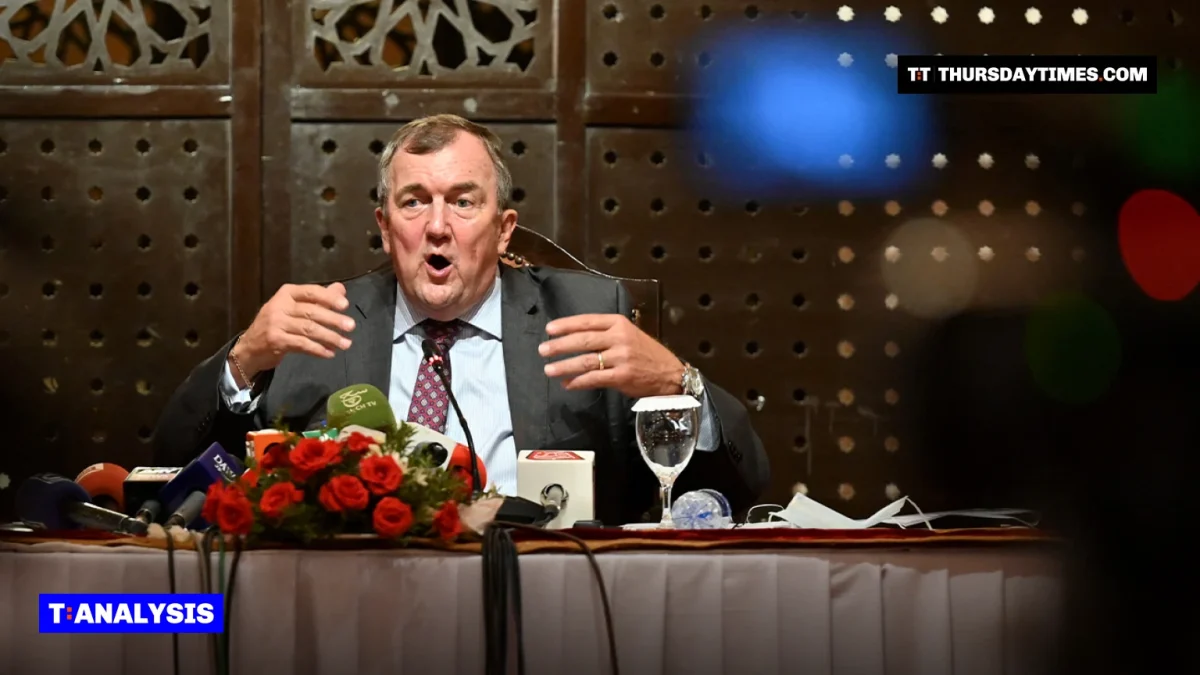
Barrick’s chairman, John Thornton, is expected in Islamabad for the forum. What he says about the review will be the most closely watched sentence of the two days. A firm signal on when full construction resumes would do more for investor sentiment than any number of new memorandums.
The railway nobody can skip
A mine in western Chagai is only as useful as the route out of it. The official planning documents are blunt: existing roads are “incapable of handling the large-scale transportation requirements”. The answer is an upgrade of 996 kilometres of the ML-3 corridorPakistan Railways’ Main Line 3, which links Rohri in Sindh with Taftan on the Iranian border. between Rohri and Taftan, proposed at Rs278.6 billion, or $995 million, over seven years to June 2033. Reko Diq Mining Company would provide $390 million in bridge financing, and the Railways Minister has said the line would carry about a million tonnes of copper a year.
The proposal also shows what remains to be done. Planning Commission reviewers recommended it but noted that no quantified cost-benefit analysis had been submitted. They asked for traffic and revenue projections, a revenue-sharing arrangement with the mine, and maintenance estimates, and they questioned whether demand justified raising capacity from two pairs of trains to 26. These are ordinary and healthy questions. They are also the kind of questions international lenders will ask, and answering them early will save time later.
Rohri to Taftan upgrade: where the money goes
Source: planning documents submitted to the Central Development Working Party.
Security is now a line in the budget
That 17 per cent is the clearest statement in any document of what terrorism costs Pakistan’s economy. Terrorists in Balochistan have repeatedly targeted infrastructure, foreigners and workers. This year they stormed a mining site belonging to a Pakistani company in Chagai and killed 10 people. Barrick’s chief executive said last month that the company wanted “some sort of security improvement” before starting a full construction schedule.
The state’s response has been substantial. The Prime Minister has ordered Frontier Corps deployed in the Rakhshan Division, home to both Saindak and Reko Diq, in what his office called a corridor for the protection of minerals, with additional wings, highway checkpoints, a surveillance grid and border posts. Railway security is to be the state’s responsibility, with the Federal Constabulary aboard the trains. For investors, this is the most important change since the last forum. An American official has said US companies understand the risks and are willing to take them, and has encouraged them to partner with Pakistani firms who know the ground.
“That 17 per cent is the clearest statement in any document of what terrorism costs Pakistan’s economy.”
Security forces can clear a corridor. Keeping it calm over a 37-year mine life also depends on what the people of Chagai see from it. Balochistan’s 25 per cent stake is the strongest argument the project has, and an embassy official has estimated it could bring the province around half a billion dollars a year once the mine is fully running. Local jobs, water and power that reach nearby towns, and visible provincial spending from that income would strengthen the case that terrorists are the enemies of Balochistan’s prosperity.
Who else is at the table
Last year’s forum was dominated by the United States and its allies, with a separate event held afterwards for Chinese investors. That balance needs handling. A Chinese state company has worked the Saindak mine for more than two decades, and it remains the proof that large-scale mining in Chagai can be done. American interest is real, but so far it consists largely of intentions: the $500 million first phase envisaged in the memorandums between US Strategic Metals and the Frontier Works Organisation in September 2025, offtake from small mines, and exploration for copper in Khyber Pakhtunkhwa and rare earths in Gilgit-Baltistan. Pakistan’s interests are served by keeping every buyer in the room.
There is at least one encouraging example of how the forum can work. The Barite-Lead-Zinc projectA mine in Khuzdar district, Balochistan, run by Pakistan Petroleum Limited in a joint venture with Bolan Mining Enterprises, with reserves of about 69 million tons. in Khuzdar, a $200 million venture, had been held up for years by lease disputes. Its operational agreement was signed at last year’s event, and the investment council says the lease issues are now resolved. It is smaller than Reko Diq and it will not change the balance of payments alone. But it shows the route from a signature to a working site, and Pakistan needs more of them.
What to watch
Four things will show whether PMIF26 has been worth the wait. The first is what Barrick says about a date for full construction. The second is whether any American company commits money to a named site, rather than signing another framework. The third is whether the government reports on what became of last year’s 16 memorandums; a simple public scorecard would be the most credible thing the organisers could release. The fourth is the railway, and whether the Rohri-Taftan scheme comes back with the numbers its reviewers asked for.
Pakistan has spent two years persuading the world that it has the minerals. That part of the argument is largely won. What the people arriving in Islamabad this week need to see is the paperwork, the rail line and the security that will get the ore to a ship.