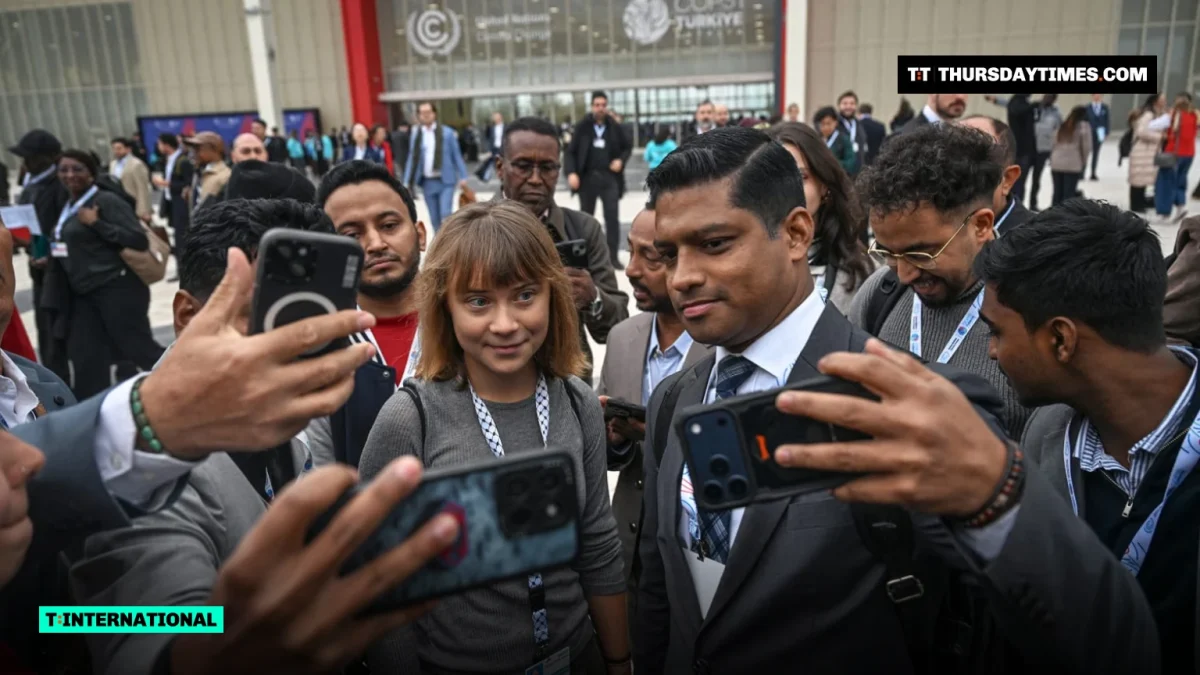
ANTALYA (The Thursday Times) — Greta Thunberg accused world governments on Thursday of failing to protect the planet, telling the COP31 climate summit in Antalya that it is “not dying, it is being killed and we know by who”, as a new analysis found that current policies put the world on course for 2.7C of warming by the end of the century.
Thunberg, 23, was speaking on the sidelines of the summit alongside activists from Nepal, Canada, and Australia. It is her first appearance at the annual UN climate talks in five years. “It is being killed by the very same people thought to come to our rescue,” she said. “No one is coming to our rescue.”
She linked rising temperatures to war and the erosion of rights. “We are heading towards a future of more genocides and more ecocides and the complete compromise of our basic rights and where basic necessities become luxuries,” she said.
The activists also urged Turkey to end energy shipments to Israel over the war in Gaza, which Thunberg called a genocide. Israel denies the accusation.
On course for 2.7C
Her remarks came after the Climate Action Tracker, an independent scientific project, released its annual global update at the summit. It said collective climate action had stalled for the fifth year in a row and warned that the world was heading for “irrecoverable overshoot” of the 1.5C limit unless governments cut emissions rapidly and stopped supporting the fossil fuel industry.
With the policies in place today, warming would reach 2.7C by 2100, slightly up from 2.6C in last year’s update, the tracker said. If governments met their 2030 and 2035 targets, warming would still be 2.6C. Even if every pledge and net-zero target were met, the world would warm by 1.9C.
“The stark choice for governments is to either continue to support the fossil fuel industry, which would consign humanity to insurmountable economic damages, rising mortality from heat and climate-driven diseases and disasters that they are unable to adapt to, or pivot to the solutions which are available and cheaper than ever,” said Bill Hare, chief executive of Climate Analytics, one of the tracker’s partner organisations.
The tracker also found signs of progress. Clean electricity met all of the growth in global power demand in 2025, China and India are installing renewables at a record pace, electric vehicle sales have hit new highs, and deforestation in Brazil’s Amazon has fallen sharply. Niklas Höhne of the NewClimate Institute, another partner, said the closure of the Strait of Hormuz had exposed the world’s vulnerability to geopolitical shocks and made the case for renewables stronger than ever.
Vulnerable nations plead for help
Thursday was the second and final day of leaders’ speeches at the two-week summit, which Turkey and Australia are jointly presiding over. Britain’s prime minister, Andy Burnham, the only G7 leader to attend, said the climate crisis was “upon us all now, devastating lives and livelihoods everywhere”.
Mali’s prime minister, Abdoulaye Maiga, said the countries that had contributed least to climate change should not bear the brunt or be burdened by debt. “Our planet is sick, it is very sick,” he said. The vice-president of Seychelles, Alix Sebastien Pillay, said his country’s survival was at stake. Palestinian Prime Minister Mohammad Mustafa drew a standing ovation as he described the environmental damage of the war in Gaza.
The United States did not send a delegation. President Donald Trump has withdrawn the country from the UN climate framework.
Earlier, UN Secretary-General Antonio Guterres called for a near-zero benchmark for methane from oil and gas as philanthropic groups pledged $480 million to cut fast-acting pollutants. Prime Minister Shehbaz Sharif has told the summit that water must never be weaponised and that Pakistan needs $138 billion for clean power by 2035.