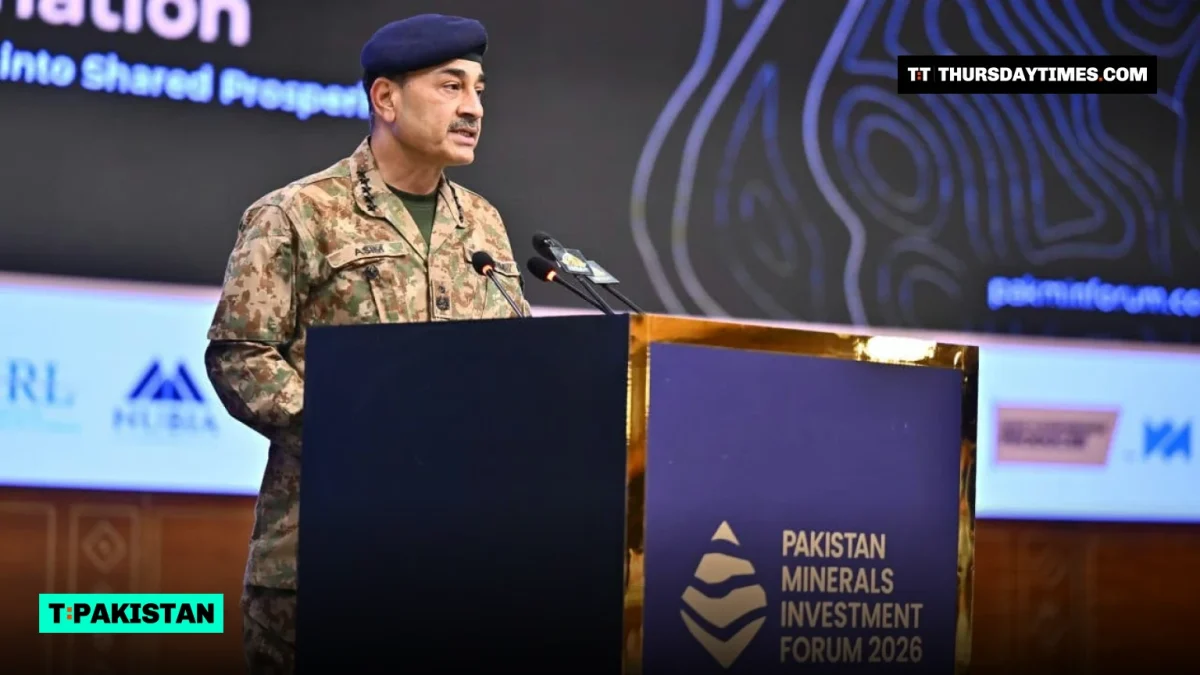
ISLAMABAD (The Thursday Times) — Field Marshal Syed Asim Munir, the Chief of Army Staff and Chief of Defence Forces, said on Friday that Pakistan wants to become a competitive and attractive destination for long-term mineral investment, and that the security of mines, miners, investors, industries, and mining projects will be guaranteed.
Addressing the second and final day of the Pakistan Minerals Investment Forum 2026 at the Jinnah Convention Centre in Islamabad, he said every possible step was being taken to secure the mining sector as a whole. “We are taking, and will continue to take, every possible measure to ensure the security of the entire mining ecosystem,” he said.
Security for the whole sector
The protection would cover mines, miners, investments, industries, projects, and the people who work in the sector, he said. His pledge followed similar promises on the forum’s opening day, when Balochistan Chief Minister Sarfraz Bugti offered investors a secure environment and a one-window operation, and Khyber Pakhtunkhwa Governor Faisal Karim Kundi promised security and a one-window facilitation system (read more).
Beyond raw exports
Turning Pakistan’s mineral wealth into economic opportunity was a collective national goal, Field Marshal Munir said. “Our objective is not merely to export raw materials, but to develop the entire value chain, from extraction to refining and manufacturing,” he said.
He said Pakistan wanted long-term international partnerships that would create lasting economic value not only for the country but also for its investment and trade partners.
Stressing the development of mineral-rich regions, he said the benefits of the sector must reach local communities, and that people living in those areas should see a real improvement in their lives through jobs, economic opportunities, and development linked to mining projects.
Field Marshal Munir called the people of Pakistan the country’s greatest strength, describing them as hardworking, brave, and determined. “Our resources provide opportunities, while our people are the source of strength and determination needed to achieve results,” he said.
Calling for practical steps to develop the sector, he said: “We must move from potential to production, from promises to action, and from raw exports to value-added growth.”
Prime Minister Shehbaz Sharif, who also addressed the forum on Friday, made the same case for processing at home. He said Pakistan did not want its minerals extracted only as raw material and sent abroad, and urged investors to mine, process, and manufacture in the country, with refineries, smelters, and cable and conductor factories built around Reko Diq and other projects in the Tethyan belt, before exporting finished goods.
What the forum produced
The two-day forum drew government officials, mining companies, and investors from more than 60 countries, as Pakistan pitched mineral reserves that officials put at about $8 trillion (read more). On the opening day, Deputy Prime Minister Ishaq Dar told investors that the Special Investment Facilitation Council was working across federal and provincial governments to clear obstacles through a single window, and that Pakistan wanted to move from exporting raw minerals to refining and manufacturing them at home.
Punjab Chief Minister Maryam Nawaz said the province’s revenue from mines and minerals had risen from Rs10 billion to Rs40 billion in two and a half years.
Canada’s Ivanhoe Mines signed a memorandum with Mari Energies on Thursday to explore for copper and gold in Balochistan’s Chagai district, home to Reko Diq (read more). On Friday, Mari Energies announced a new porphyry copper discovery at its East Siah Diq site in Chagai, about 50 kilometres east of Reko Diq, after some 25,000 metres of drilling, though the company said the find did not yet amount to a formally established mineral resource. Another company, NRL, told the forum it had identified copper-gold mineralisation at eight discoveries in the district.