LAHORE (The Thursday Times) — Lahore was again ranked the world’s most polluted city on Saturday, a day after wind and drizzle brought brief relief, as Punjab widened its crackdown on the crop-stubble fires officials blame for much of the region’s winter smog.
The city’s air quality index reached 244 early on Saturday morning, in the “very unhealthy” range, according to monitoring data. Readings varied sharply across the city. Multan Road recorded 500, while Canal Road, Allama Iqbal Town, and Gulberg were all close to 270 or higher.
The reading put Lahore back at the top of the global list a day after rain and wind briefly cleared its air and Delhi overtook it as the world’s most polluted city.
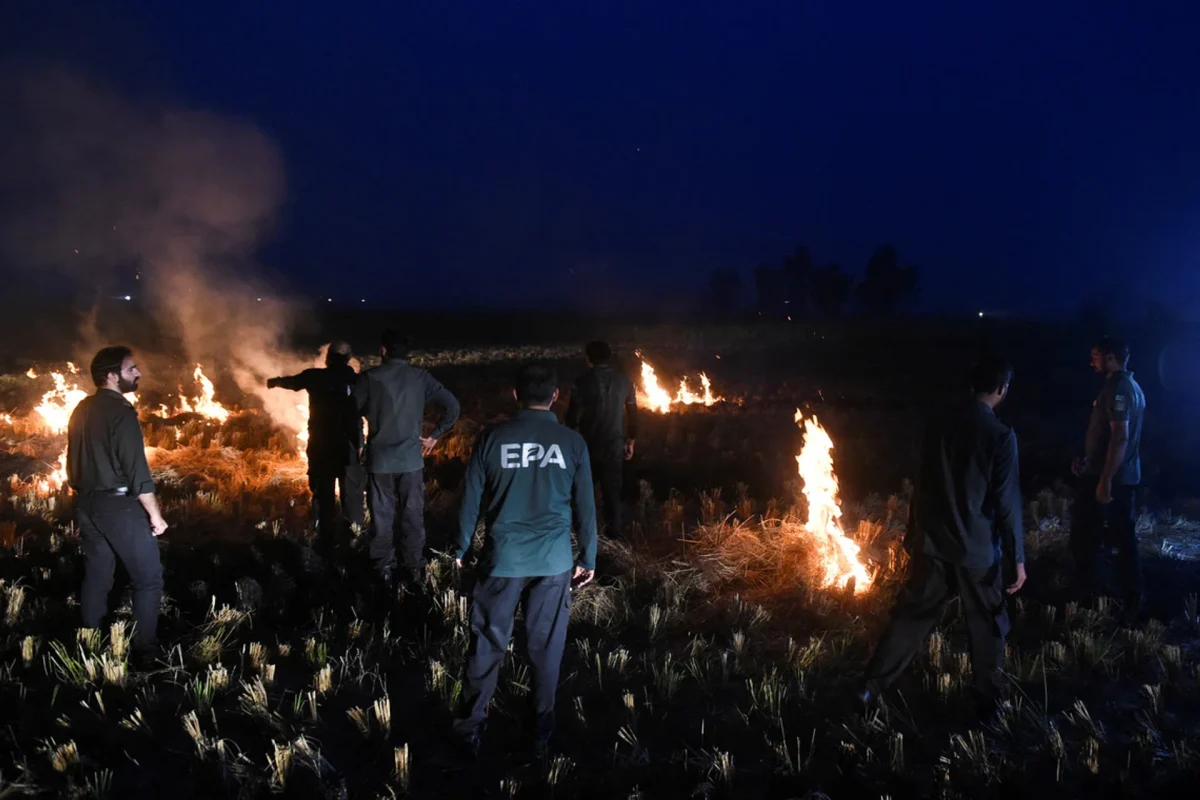
Punjab has this year formed a 750-member Environmental Protection Force, organised in 67 rapid-response units across the province’s main rice-growing districts, said Silwat Saeed, who heads Punjab’s Environment Protection and Climate Change Department. Officials describe it as the first force in Pakistan dedicated to fighting pollution. Its teams aim to reach a reported field fire within 10 to 15 minutes, and also patrol paddy areas for signs of burning.
In a single 24-hour period this week, the department received 679 reports of field fires across Punjab and put out 650 of them, it said. “We receive complaints through multiple channels and respond to them in the shortest possible time,” said Ashfaq Hussain, a deputy director of the force.
Farmers who burn stubble face fines of Rs15,000 per acre, said Muhammad Farooq, an assistant director of the Punjab Agriculture Department. Those who do not pay can be prosecuted and face up to six months in jail. The government has also handed out more than 10,000 super seeders, machines that let farmers sow wheat straight into the rice stubble, paying 60% of their cost.
Farmers in the region commonly set leftover rice residue alight after the October harvest to clear fields quickly for wheat. The smoke adds to industrial emissions, vehicle exhaust, and construction dust that settle under cold winter air and push pollution to hazardous levels.
Punjab officials say the campaign is working. Satellites have detected less burned area in Pakistan and India so far this season than the historical average, and smog-related throat hospitalisations in October were 69% of the level a year earlier, according to health department data cited by Abdullah Nayyar, director general of the Punjab Environment Protection Department.
Many residents say they have yet to notice the difference, and patients with breathing problems have crowded hospital corridors in Lahore in recent days. One farmer who switched to a subsidised super seeder said his wheat yield had risen, but others still see burning as the cheapest and fastest way to clear a field.
Pakistan and India have each accused the other of worsening the air in recent years. Saeed said the challenge was huge for both countries and that Pakistan had raised it with Indian officials at international forums.