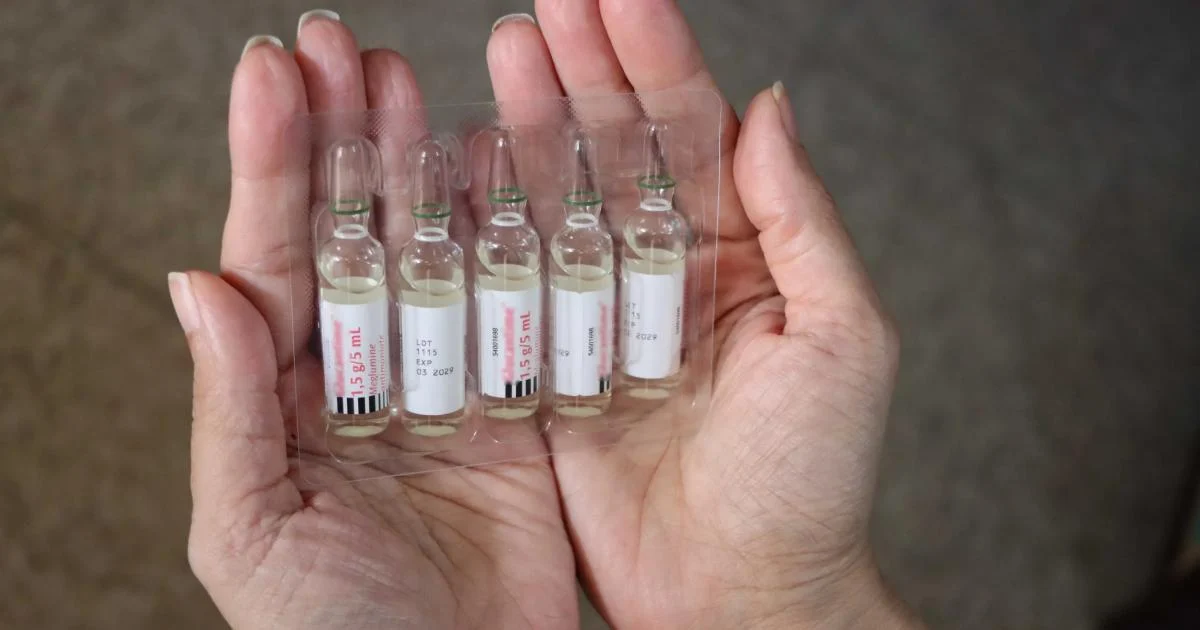
PESHAWAR (The Thursday Times) — Unicef has handed Khyber Pakhtunkhwa’s health department 75,000 injections of Glucantime, the main drug used to treat cutaneous leishmaniasis, for about 15,000 reported patients across the province, according to a statement issued in Peshawar on Saturday.
The consignment, valued at Rs48 million, was handed over by Dr Inamullah Khan, who leads Unicef’s health team in the province, to Dr Naeem Awan, the director general of health services in Khyber Pakhtunkhwa. Dr Fazal, the director of health services for the province’s merged districts, also attended.
Cutaneous leishmaniasis is spread by the bite of infected sand flies. It causes open sores on the skin that can take months to heal and often leave permanent scars, usually on the face, arms, and legs. The statement said the disease falls hardest on poor communities with little access to health care, particularly women and children.
A drug Pakistan has to import
Glucantime, a brand of meglumine antimoniate, is imported, and the province has struggled with shortages of the drug in past outbreaks. Speaking at the handover, Dr Awan acknowledged the difficulties of procuring the medicine overseas and said the department was looking at ways to fund supplies from its own resources so that treatment would not depend on donated stock.
He thanked Unicef for its support to the provincial health department, both in its regular programmes and during emergencies.
Unicef said last month that it had delivered the 75,000 vials to support the treatment of children and families caught up in the outbreak in Khyber Pakhtunkhwa. At that point, more than 10,500 cases had been reported in the province since January, more than 4,400 of them in children under 16. The medicines have a three-year shelf life and will be given out through selected health facilities, so that they can also be used in future outbreaks.
“The leishmaniasis outbreak in Khyber Pakhtunkhwa has affected thousands of children, many of whom face pain, stigma and the risk of long-term complications if left untreated,” Pernille Ironside, Unicef’s representative in Pakistan, said at the time.
The handover follows Japan’s $4.3 million grant, channelled through Unicef, for polio vaccine for Pakistan’s 2027 campaigns. Seven of the country’s nine polio cases this year have been found in Khyber Pakhtunkhwa.