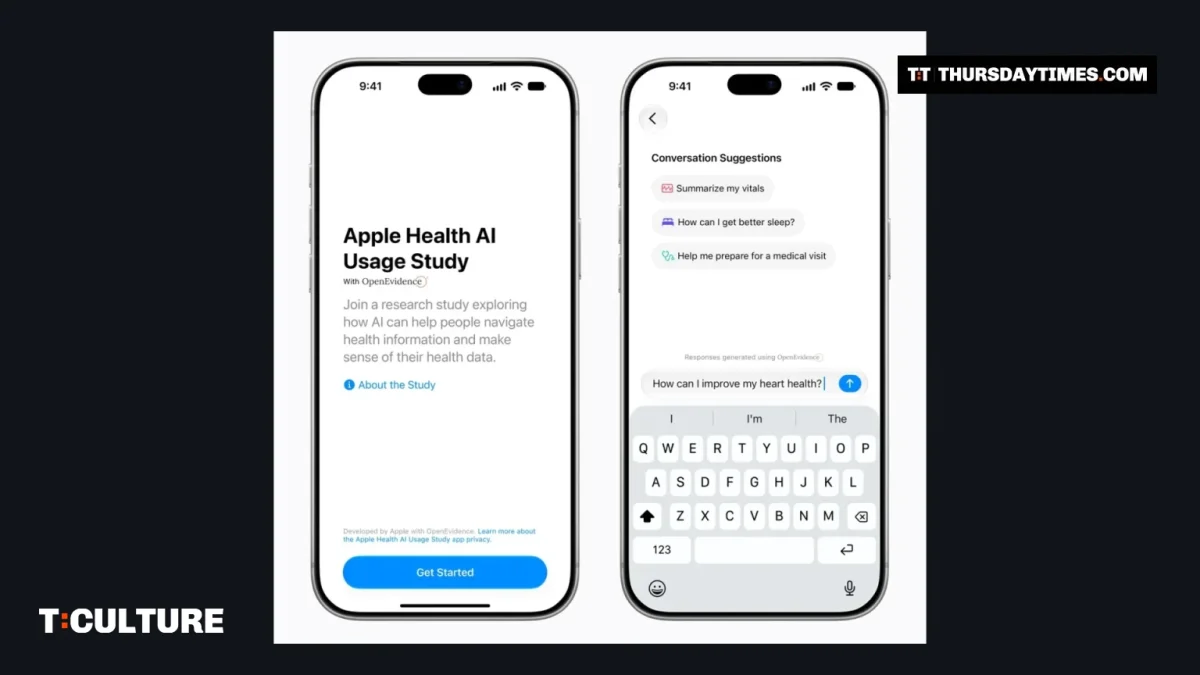
CUPERTINO (The Thursday Times) — Apple has launched a research study into how people use conversational AI tools for health questions, working with the clinical AI platform OpenEvidence and recruiting up to 200,000 volunteers in the United States.
The Apple Health AI Usage Study is run through a dedicated study app. Apple said it will examine what drives trust in health AI, the quality of the responses, how well users understand them, and the health actions people take afterwards. Participants can ask everyday health questions and see answers that link to peer-reviewed clinical citations, and the study will also explore whether AI can help people prepare for visits to their own doctors.
OpenEvidence says its answers draw on established medical sources including the New England Journal of Medicine, the Journal of the American Medical Association, and Nature. Participants can choose to share HealthKit data such as resting heart rate, activity, sleep, or lab results to see how personal data changes the relevance of the answers.
“Health is deeply personal, and conducting a dedicated research study is the most thoughtful way to understand how people engage with, comprehend, and evaluate health AI in everyday life,” said Sumbul Desai, Apple’s vice president of Health and Fitness. Apple acknowledged that tools powered by large language models may at times give responses that are incomplete or unclear.
The company says study data will not be used to train AI models, that sharing HealthKit metrics or survey answers is optional, and that the app has safety guardrails designed to detect certain concerning questions and suggest following up with a provider or other resources.
The study is open to people aged 21 and older in the United States who have an Apple Intelligence-enabled iPhone, meaning an iPhone 15 Pro or later, running iOS 26 or later.