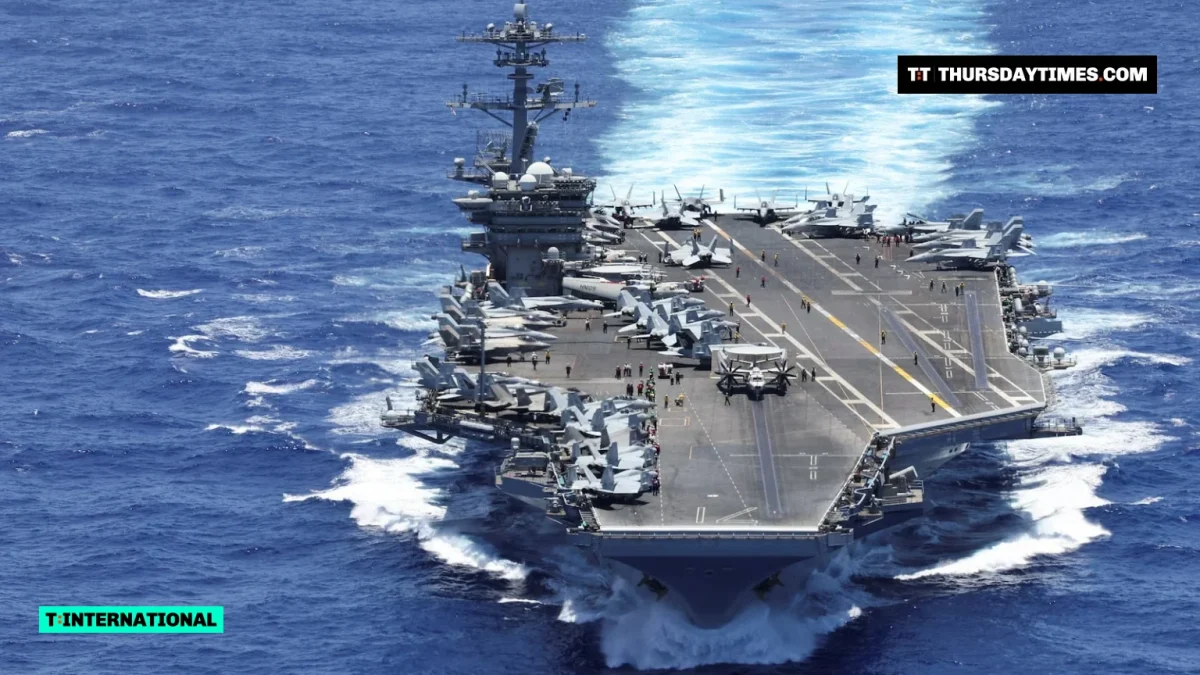
WASHINGTON (The Thursday Times) — A third US aircraft carrier has arrived in the Middle East, a US official said on Monday, as diplomacy to end the war with Iran remains stalled and Tehran steps up its threats against American forces and Gulf states.
The USS Theodore Roosevelt entered the area covered by US Central Command on Sunday 15 November, the official said, joining the USS George Washington and the USS George H.W. Bush, which are both operating in the Arabian Sea. The Pentagon and Central Command have not formally confirmed the arrival. The three carriers are part of a larger force of more than 20 Navy vessels backing the US blockade of Iranian ports, which began on 13 April.
It is the first time since the Iraq war that the Pentagon has had three carriers in the region, according to a US official. The Roosevelt was originally due to replace the Bush, but the Bush’s deployment has been extended through the holidays, so the crowded line-up is expected to be temporary.
Mixed signals from Washington
The Trump administration has sent mixed messages on whether the war will resume. Last week, after meeting Qatar’s prime minister at the White House, President Donald Trump said further strikes on Iran were “quite unlikely” and that the military side of the war was effectively over, though he added that US forces remained “locked and loaded”. Secretary of State Marco Rubio has said economic pressure on Iran is working, which makes a return to large-scale military operations unnecessary.
The US and Iran agreed a two-week ceasefire in April and announced a broader memorandum of understanding in June, which collapsed in early July. Mediators from Pakistan and Qatar have been trying since then to keep the two sides from returning to full-scale fighting.
Tehran steps up its threats
Iran’s deputy foreign minister Kazem Gharibabadi said his country “will not wait for the US to attack first”, and accused Washington of using diplomacy to buy time for another attack. Iran’s Revolutionary Guards said they fired six drones at a US early-warning radar at Bahrain’s Riffa air base; Bahrain’s military said all of the projectiles were intercepted. The Guards also claimed that six vessels had caught fire and sunk in the Strait of Hormuz since Sunday, a claim that could not be independently verified, while a tanker leaving the strait was hit by an unidentified projectile on Monday.
Iran and Oman say they are close to agreeing a joint plan for shipping through the strait, and Foreign Minister Abbas Araghchi is due in Muscat on Tuesday. UN Secretary-General Antonio Guterres called on Monday for an end to the “neither peace nor war” situation between Iran and the United States, saying a serious diplomatic process of negotiation was needed.