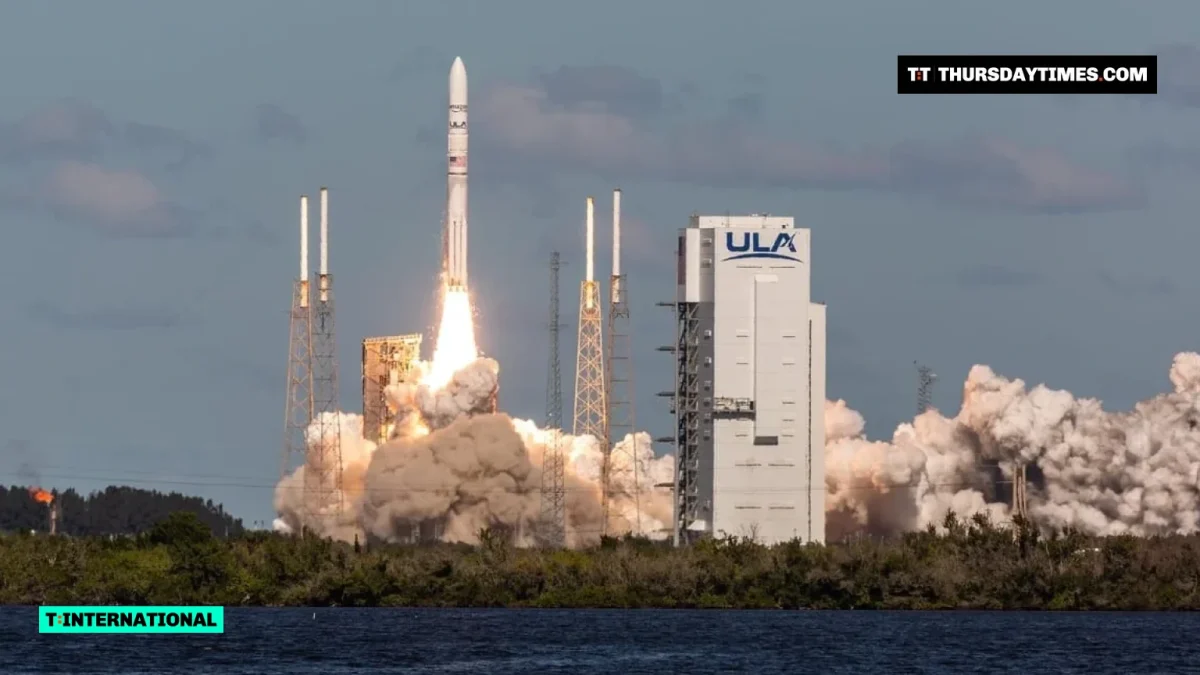
CAPE CANAVERAL (The Thursday Times) — A United Launch Alliance Vulcan rocket failed about 10 minutes into its flight on Sunday, destroying all 40 Amazon Leo broadband satellites it was carrying and dealing a heavy blow to Amazon’s plan to build a rival to SpaceX’s Starlink network.
The rocket lifted off from Space Launch Complex-41 at Cape Canaveral Space Force Station in Florida. In a statement, ULA said data received by its launch director confirmed the vehicle suffered an anomaly and failed to deliver the Amazon mission to orbit. The company said it did not yet have specific data on what went wrong.
It was Vulcan’s first flight in nine months, after a solid rocket booster anomaly in February, and the first of 38 Vulcan launches that Amazon has contracted. It was also the first Vulcan to fly with six solid rocket boosters.
The failure appeared to come after the second stage, which carried the satellites, separated from the first stage, whose BE-4 engines are built by Blue Origin. It is not yet clear whether those engines played any part. Blue Origin modified the engines it delivers to ULA after a launch-pad explosion of its own New Glenn rocket in May, which investigators traced to the engine.
A lengthy technical investigation is expected to keep Vulcan off the market for months. The setback comes as US launch capacity is already stretched: other rockets have suffered mishaps, and SpaceX is no longer taking bookings for Falcon 9, the world’s busiest rocket, ahead of its looming retirement.
The Pentagon had not yet cleared Vulcan to resume national security launches, pending its performance on the Amazon mission. Vulcan’s last two flights, including a February mission for the US Space Force, did deliver their payloads, but the boosters had been under scrutiny after problems on both.
Amazon is racing to put its Leo constellation in orbit against Starlink, which has more than 11,000 satellites and millions of customers. The New Glenn explosion in May came just days before that rocket was due to launch Amazon Leo satellites, and the company has relied on third-party launch providers, several of which have faced groundings or failures.