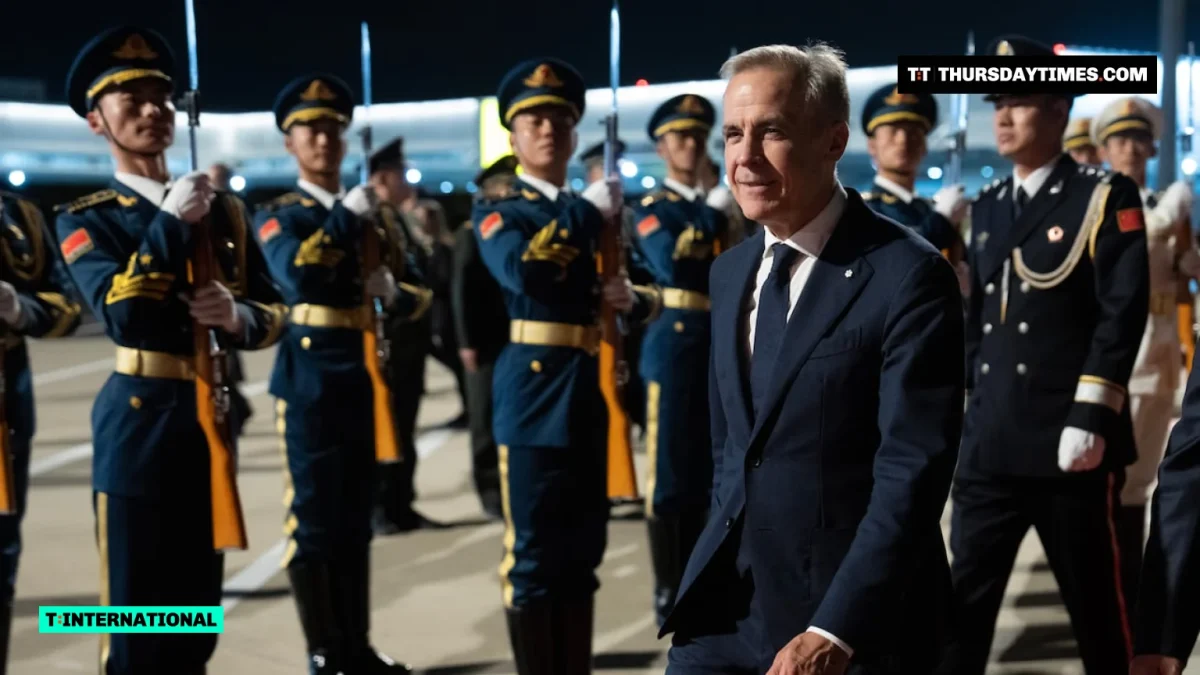
SHENZHEN (The Thursday Times) — Canada and China agreed on Tuesday to widen tariff relief for each other’s exports after Prime Minister Mark Carney met President Xi Jinping in Shenzhen, a day before the Asia-Pacific Economic Cooperation (APEC) leaders’ meeting that China is hosting.
Under the deal, set out in a statement from the Canadian prime minister’s office, China will extend and expand tariff relief for about C$400 million of Canadian exports, including C$116 million of frozen pork cuts and C$285 million of fish and seafood. The seafood covered includes certain frozen cold-water shrimp and prawns, geoduck, sea cucumber, and Greenland halibut. The expansion builds on a two-year extension of relief for canola meal, peas, lobster, and crab announced earlier this month, and Ottawa says relief on certain products now runs until at least 31 December 2028.
In exchange, Canada will extend by two years its duty-remission measures for some Chinese steel and aluminium products, which were due to expire at the end of 2026. It will also add 32 steel and aluminium tariff items for which Canadian supply is insufficient or unavailable.
More than tariffs
The leaders also announced a string of exchanges and business links. Air Canada will start flights from Vancouver to Guangzhou in May 2027, and Canada will put up C$850,000 in scholarships so 850 Canadian students can study at Chinese universities. It will also give C$8 million to the China Council for International Cooperation on Environment and Development. Ottawa plans a trade mission to China and a Canada-China Year of e-Commerce in 2027, and the two sides will set up a CEO roundtable. Five Canadian arts and culture companies signed commercial agreements worth more than C$15 million, and the University of Ottawa and Shanghai International Studies University agreed to develop a dual-degree programme.
Carney spoke of “greater predictability and stability” in ties with Beijing, while Xi said cooperation would “benefit not only our two countries but also Asia-Pacific and the world”. In the statement, Carney said Canada and China “have recalibrated our relationship to the benefit of citizens in both countries”. Ottawa says it has restored market access for more than 90 per cent of the trade previously hit by tariffs, worth nearly C$7.5 billion in exports, and Canadian exports to China have risen about 40 per cent since the leaders met in Beijing in January.
The rapprochement comes as both countries look to cut their reliance on the United States under US President Donald Trump’s tariffs. On Monday Carney said Canada could turn to Chinese carmakers if talks with Washington fail. In January, Canada cut its 100 per cent tariff on Chinese electric vehicles to 6.1 per cent for up to 49,000 vehicles, and the prime minister’s office says 16,211 Chinese EVs have been imported since March. BYD has begun selling cars in Canada, and Geely said in October that it expects to start next year.
The closer ties have critics in Canada, who point to risks to security and values. Canadian intelligence believes China interfered in at least two federal elections, which Beijing denies. Carney said before leaving that he would raise foreign interference with Xi. Xi hosts the APEC leaders’ meeting on Wednesday and Thursday.