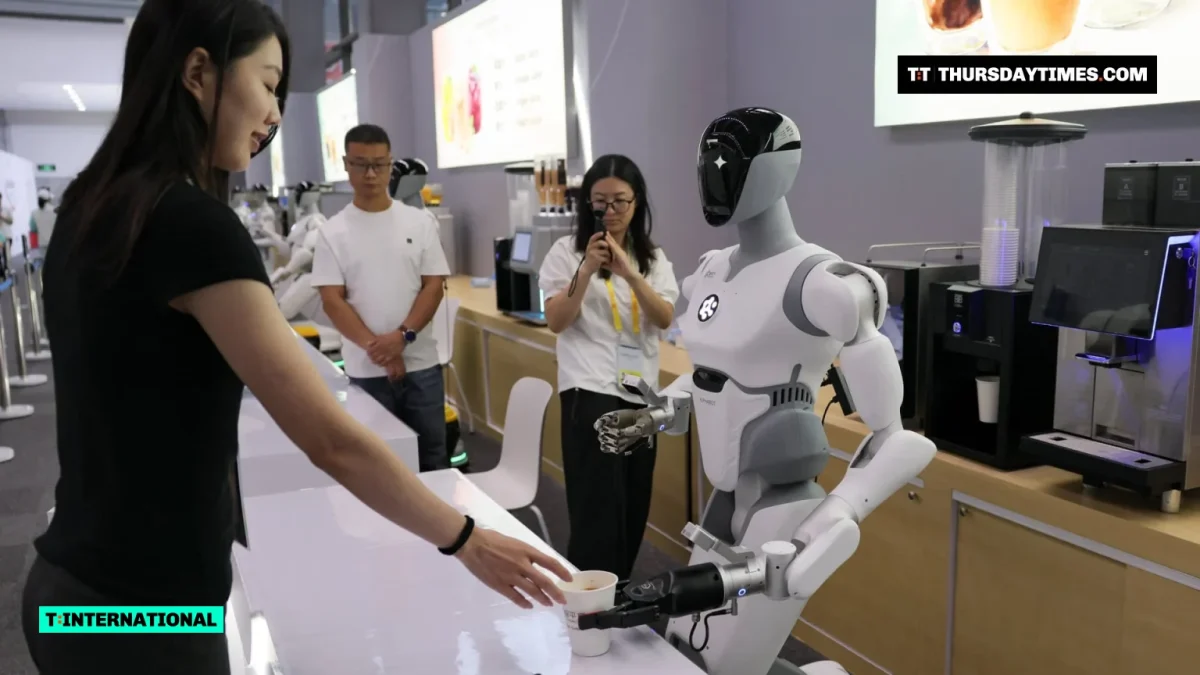
SHENZHEN (The Thursday Times) — Humanoid robots are pouring coffee and serving ice cream to journalists in Shenzhen, where China is putting its technology on show as it hosts the Asia-Pacific Economic Cooperation (APEC) leaders’ meeting, which opens on Wednesday.
At the summit’s media centre, reporters can also try an extended-reality virtual studio, smart glasses, an AI photo booth, and a lightweight live-streaming device, according to official Chinese coverage of the venue. One service robot hands over water or candy and takes away rubbish in response to a person’s gestures. A photo display charts Shenzhen’s growth from sparsely populated marshland, calling it “a miracle in the history of world development created by the Chinese people”.
The city as the message
The theme runs through the city. Skyscrapers across the skyline have been lit in cyan, violet, green, scarlet, and gold, flashing the words “Apec 2026” in a light show that drew crowds on Sunday and Monday evenings. “It’s so great that the summit will take place in Shenzhen,” one local man, who did not give his name, said. “I feel very proud.”
Astrid Nordin, a professor at King’s College London, said President Xi Jinping “wants people to go home Chinamaxxing”. “Shenzhen is itself part of the message,” she said. “It’s a showcase of Chinese technological and economic achievements, and of China’s claim that it offers opportunities for prosperity in a world increasingly characterised by uncertainty and conflict.”
A tightly run summit
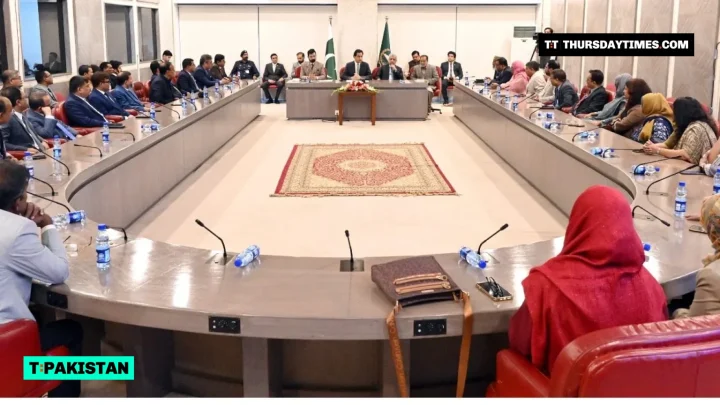
The gathering is also being closely managed. Reports citing people familiar with the arrangements say it will be one of the most tightly controlled in the organisation’s history, with leaders travelling to a state guesthouse beside Shenzhen’s tiger safari park to meet Xi. Diplomats have reportedly complained that the format “seems designed to reduce the free-flowing discussion characteristic of prior editions”. China’s foreign ministry has said it looks forward to “practical results in key areas such as trade, connectivity, digital economy, AI and so on”.
What is at stake
Xi has already announced a trade deal with Canada’s prime minister, Mark Carney, extending tariff relief on both sides. The most important meeting is expected to be between Xi and US President Donald Trump, who are due to cover trade and artificial intelligence. On Monday the Trump administration said it would further restrict China’s access to advanced AI chips, tightening licences, a move that could strain the tariff truce the two leaders first agreed last year.
Christopher Adams, a senior adviser at the law firm Covington who worked on trade talks with China under the Obama and first Trump administrations, said the truce “may increasingly look like a ceasefire in a war where major combat operations remain on hold but skirmishes are escalating”. He said he saw no pressure to announce a further extension in Shenzhen, and that one would be “an upside surprise”.
Xi, Trump, and Russian President Vladimir Putin are also due to hold a three-way summit in Shenzhen on Thursday. Kevork Oskanian, a Russia specialist at the University of Exeter, said it “provides the appearance of China shaping the world order as an equal to the United States”, but that agreement on substantial issues is unlikely.