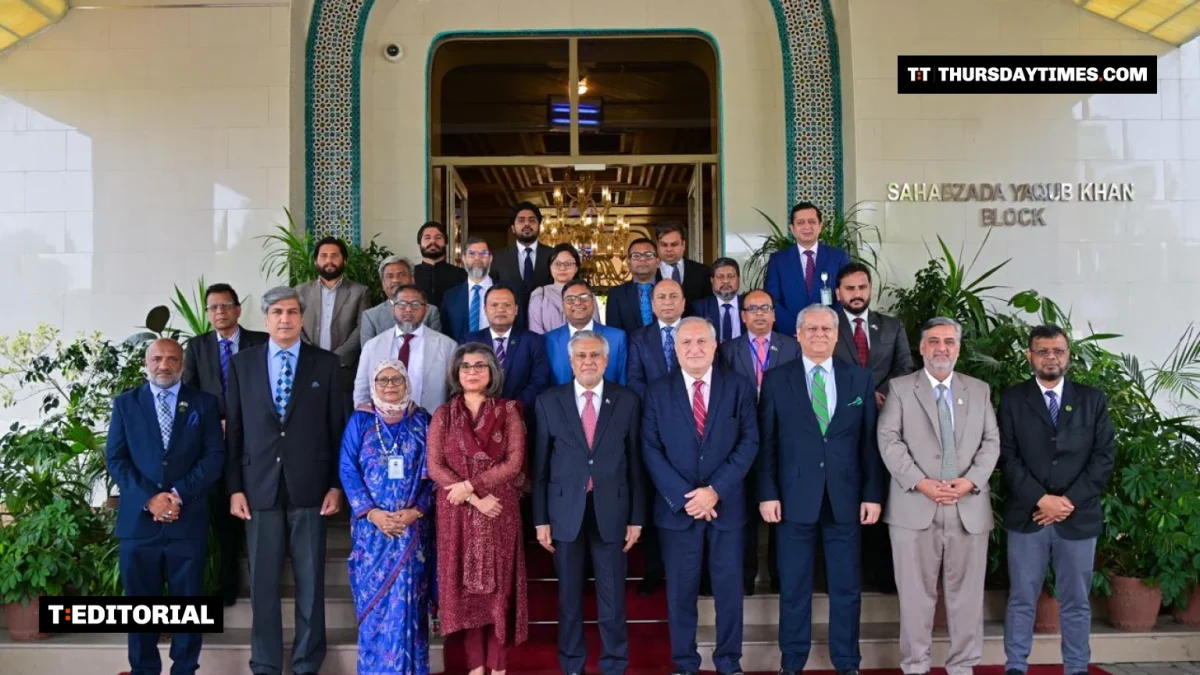
When a Pakistani foreign minister tells 35 senior Bangladeshi civil servants that he wants a relationship with greater depth and substance, the sentence is easy to say and hard to deliver. This week, Ishaq Dar said it in Islamabad, and he was not the first to say it. The two countries have spent more than a year exchanging warm words, and the harder test is whether the next year produces flights that fill, cargo that moves, students who stay for degrees, and traders who no longer need a Gulf stopover to meet. Goodwill is a start. A plan is what keeps it.
What has already been built
It is worth beginning with what exists, because the record is better than the mood suggests. In August 2025 Dar made the highest-level Pakistani visit to Dhaka in years, and the two governments signed a set of agreements, among them a visa waiver for holders of diplomatic and official passports and an agreement to set up a joint working group on trade. The long-dormant Joint Economic CommissionA standing government-to-government body that reviews trade, investment, and cooperation between two countries. Pakistan and Bangladesh had not held a session for about two decades before the one in Dhaka in October 2025. met again in Dhaka in October 2025, for the first time in nearly two decades, and Pakistan used it to offer Bangladeshi exporters access to Karachi Port.
The links on the ground followed. A direct sea route between Karachi and Chattogram has been running since 2024. On 29 January 2026, Biman Bangladesh Airlines flew the first direct passenger service between Dhaka and Karachi since 2012, with the inaugural flight sold out and two services a week at the start. Pakistani teams are in Dhaka this month: the national football side beat Bangladesh in the SAFF Championship semi-final on 14 November and played the final there on 17 November, losing 2-1 to India after leading at half-time.
On education, the Knowledge CorridorA Pakistan-Bangladesh programme launched in August 2025. It offers 500 fully funded scholarships to Bangladeshi students over five years, with a quarter set aside for medicine, plus training for Bangladeshi civil servants. is the clearest example of a promise turning into a routine. Pakistan committed 500 fully funded scholarships over five years. By May, 74 Bangladeshi students had begun their studies under it, and Dar said this week that 170 had joined Pakistani universities this year. The senior officials in Islamabad are part of the same programme, taking an executive leadership course run by the National School of Public Policy. The Speaker of the National Assembly briefed them on how Parliament works. That sort of exchange does more to build trust than any joint statement.
Warm words cost nothing. A flight that sells out twice a week is evidence.
The trade gap is the first thing to fix
Trade is where the relationship is most visibly lopsided, and that matters for its health. In the financial year to June 2025, Pakistan exported about $787 million of goods to Bangladesh and imported about $78 million. The year before, the figures were about $661 million and $57 million. Exports grew by around 19 per cent and imports by around 38 per cent, so the direction is right. The size of the gap is the problem: Pakistan sells roughly ten times what it buys.
Pakistan-Bangladesh goods trade, $ million
Bars are scaled to the largest figure, Pakistan’s FY2024-25 exports. Source: official Pakistani trade data for FY2023-24 and FY2024-25, financial years ending 30 June. Figures are rounded and cover goods only.
A trading relationship in which one side buys a tenth of what it sells will not hold the affection of the other for long. Bangladesh has said plainly where it sees room, and Pakistan should treat the list as a to-do list. Bangladesh’s deputy high commissioner in Karachi named jute, pharmaceuticals, leather goods, garments, agriculture, and information technology among the sectors with potential. Pakistan buys much of its raw jute from Bangladesh already, and higher duties on finished jute goods are the sort of barrier a trade working group exists to look at. Slow pharmaceutical registration is another. If Pakistani cotton and yarn are to keep supplying Bangladesh’s big garment sector, Pakistani buyers should be seen to buy back.
The ambition is there. Pakistan’s federation of chambers has spoken of lifting exports to Bangladesh towards $3 billion, and Pakistani business leaders have described potential well beyond that. The sensible way to reach it is not a slogan but a schedule: a preferential trade arrangement, negotiated by the joint working group, that lists a few hundred products on each side and cuts tariffs on them first. Start with items both sides already trade, and widen it as trust grows. A deal that gives Bangladeshi exporters a visible gain will be easier to defend in Dhaka than one that only promises Pakistani sales.
Roads in the sky and on the sea
Connectivity is the cheapest form of diplomacy, because travellers and traders vote with their tickets. The Biman route is a good start, but it is a single airline, from one Bangladeshi city to one Pakistani one, at twice a week. Pakistan has good reasons to want more. Karachi, Lahore, and Islamabad are home to the universities, hospitals, and wholesale markets that Bangladeshi students, patients, and buyers want to reach. A Pakistani carrier on the route would double the choice and the competition. Services to Chattogram and Sylhet, and from Lahore and Islamabad, would follow if the first two are full.
Cargo deserves the same attention. Since 2024, direct shipping between Karachi and Chattogram has reduced the need for transhipment through third ports, and Pakistan has offered Karachi Port as a route for Bangladeshi exports to the Gulf, Central Asia, and China. An offer on paper is not a freight service. What is needed is a regular schedule, published rates, and a customs agreement that treats Bangladeshi goods in transit fairly. Port and customs agencies on both sides should meet quarterly and publish what they decide.
A relationship with a plan to move people and cargo is a relationship that survives a change of government.
Visas are the next door to open
The August 2025 waiver for diplomatic and official passports was a symbolic first step, and it did what it was meant to do. The problem is that officials are not the people who build trade. Businesspeople, students, doctors, journalists, and families are. For them, a visa remains a form, a fee, and a wait.
The next stage should be modest and workable. A multi-year business visa for registered traders and chambers of commerce would be the first. A fast, fixed-fee route for students with offers from recognised universities would be the second. A clear medical visa for patients and attendants would be the third. An electronic application system on both sides, with decisions in days and not weeks, would make all three real. None of this needs a treaty. It needs both interior ministries and both foreign ministries to agree on the paperwork and to publish the timelines.
Students and civil servants are the long game
The Knowledge Corridor is the part of the relationship most likely to last, because people who study together remember it for decades. A Bangladeshi civil servant who has spent a few weeks in a Pakistani classroom has met Pakistani colleagues, seen how institutions work, and will have an address book that outlasts any minister.
Four steps would make it grow. First, exchanges should run both ways: Pakistani civil servants and academics should spend time in Dhaka, and Bangladeshi institutions have things to teach, from microfinance to rural health outreach and disaster preparedness. Second, universities should sign direct partnerships, with joint degrees and credit transfer. Third, alumni should be tracked, networked, and invited back. Fourth, the scholarship quota, which was set at 500 over five years, should be reviewed once the first cohorts graduate. If the programme works, it deserves to be larger.
Cricket, culture, and ordinary affection
Few things carry between the two countries as easily as a game. Bangladesh’s cricketers won a Test series in Pakistan in 2024, and Pakistan’s footballers have just played two matches in Dhaka. Regular fixtures matter: cricket tours, women’s matches, youth teams, and the kind of club-level exchange that grows fans. Both boards should agree a calendar that runs several years ahead, and both broadcasters should show each other’s leagues.
Culture works in the same way. Language, food, music, and film move easily across the Bay of Bengal. Nazrul and Iqbal are both read in both places. Festivals, book fairs, and film weeks, held in Dhaka and Lahore, cost little and are remembered. The aim is to put ordinary people in contact, so that each country is known by more than the news about it.
A wider region, a looser frame
Both countries were founding members of the South Asian Association for Regional Cooperation, and Bangladesh, as the proposer of the idea, has a special claim on it. The grouping has not held a summit since 2014. Dar said in April, at the Antalya Diplomacy Forum, that Pakistan would pursue practical cooperation in trade, travel, and tourism with its neighbours regardless of that stalemate, and he named Bangladesh among them. That is a reasonable approach. A SAARCThe South Asian Association for Regional Cooperation, founded in 1985 by seven countries, including Pakistan and Bangladesh. Its summits have been stalled since 2014. that cannot meet should not prevent two members from building what they can.
Bilateral links also make the wider frame easier to rebuild later. If Pakistan and Bangladesh have a working trade agreement, daily flights, and a student pipeline, they will bring something real to any future regional table, whether SAARC returns or a looser arrangement takes its place. Both gain as well from joint work on shared problems: floods, cyclones, heat, and the effects of rising seas on deltas. Pakistan and Bangladesh are on the front line of climate change, and Dar listed climate resilience among the areas where he sees scope for cooperation. Pooling flood forecasting and sharing what works in disaster response is exactly the kind of low-cost step that pays back.
Respect is the foundation
None of this asks either country to forget its past. The events of 1971 are real, and each people holds its own memory of them. A relationship worth having is one that leaves room for honesty about history without making it the only subject. What can be built now is for the next generation to judge.
It also asks Pakistan for restraint. Bangladesh is a sovereign, confident country with its own politics, and a new government elected this year. Its choices at home are for its own citizens to make. Pakistan’s role is to be a dependable neighbour and a good partner to whoever Bangladesh’s voters choose, and to be consistent about it, so that no one in Dhaka has reason to wonder whether Pakistani goodwill depends on who is in office. Dar said as much when he spoke of mutual respect, sovereign goodwill, and trust. Those words have to govern the details.
A short list for the next 12 months
The test of a good opening is what follows. A short list will do. Sign a preferential trade arrangement through the joint working group, with tariff cuts that benefit Bangladeshi jute, pharmaceuticals, and leather goods alongside Pakistani exports. Bring a second airline onto the Dhaka route and add a second city on each side. Publish a regular Karachi-Chattogram shipping schedule. Introduce multi-year business visas and a fast route for students and patients. Grow the Knowledge Corridor with exchanges in both directions. Agree a multi-year cricket and football calendar. And hold the next Joint Economic Commission on schedule, not after another long pause.
What is left is the unglamorous part: timetables, tariff lines, visa forms, and follow-up meetings. That is where relationships are made in the end. A partnership between two countries of more than 400 million people, who share a faith, a history, and a region, does not need grand gestures. It needs consistent attention, and Pakistan is the one that said it wanted more. It should be the first to deliver.