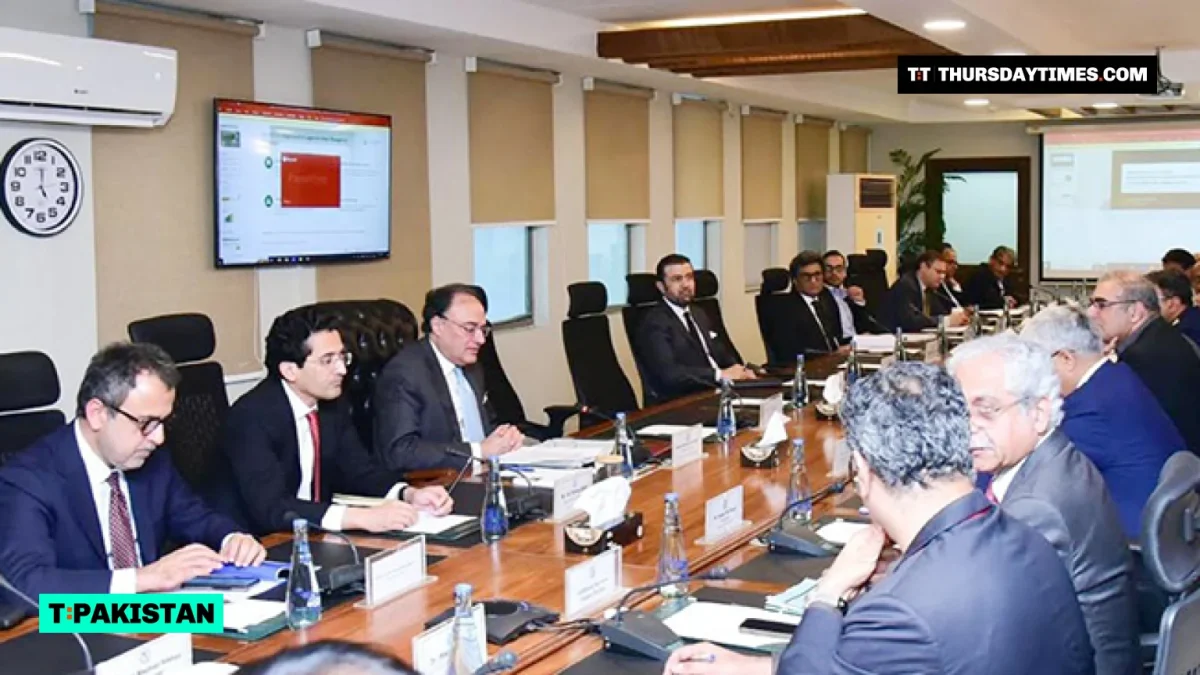
KARACHI (The Thursday Times) — Finance Minister Muhammad Aurangzeb on Saturday invited the mutual fund industry to submit tax proposals, saying the government was willing to address the tax and regulatory issues it faces in order to widen the investor base.
He was speaking at a ceremony in Karachi marking the silver jubilee of the Mutual Funds Association of Pakistan (MUFAP). He said young people from the millennial and Generation Z groups accounted for 60 to 70 per cent of the increase in investors at the Pakistan Stock Exchange (PSX), and that the fund industry could draw on that experience.
To reach first-time investors, Aurangzeb said, funds could improve their products, simplify the opening of accounts, accept payments through Raast, and offer guidance in Urdu. He also called for infrastructure bonds and sukuk to channel domestic savings into toll roads, power transmission networks, and water schemes, saying long-term rupee financing could reduce reliance on external borrowing.
Six priorities
The minister set out six priorities for moving from economic stabilisation to sustainable growth. The first was to make macroeconomic stability durable, protect purchasing power, and reduce the risk of recurring crises. The second was to turn that stability into responsible growth that creates jobs and raises incomes, and the third was to continue structural reforms that make the economy more efficient, competitive, and resilient.
The fourth was to shift from aid to trade and investment by expanding exports and attracting capital. The fifth was to widen access to finance for underserved households, farmers, small and medium-sized businesses, women, and young people, and the sixth was to prepare the country for the digital economy through innovation and skills for emerging jobs. He said the private sector was the engine of the economy and the government provided the enabling environment, adding that access to finance had been made easier for agriculture, housing, and small and medium-sized businesses.
The industry in numbers
According to MUFAP data, the industry’s assets under management stood at Rs4.72 trillion at the end of September, with 1.94 million individual investor accounts. Shariah-compliant funds made up about half of open-end fund assets, and pension fund assets stood at Rs162.9 billion.
MUFAP chairman Shahzad Dada called for targeted tax incentives for small savers and wider access to contributory pensions. Securities and Exchange Commission of Pakistan Commissioner Muhammad Ali Farid Khwaja urged private-sector employers to introduce a voluntary pension system. “When a family thinks about saving, we want mutual funds to come to mind,” said MUFAP Chief Executive Officer Mashmooma Zehra Majeed.
The market backdrop
The benchmark KSE-100 index closed on Friday at 177,664 points, up 281 points, or 0.16 per cent, on the week, according to brokerage Arif Habib. Brokerages said investors stayed cautious amid geopolitical uncertainty, domestic political tensions, and profit-taking.
Topline Securities said investors were also watching for the International Monetary Fund’s Executive Board meeting, expected on 11 December, to consider Pakistan’s fourth review under the Extended Fund Facility and third review under the Resilience and Sustainability Facility. Approval could pave the way for combined disbursements of $1.21 billion.