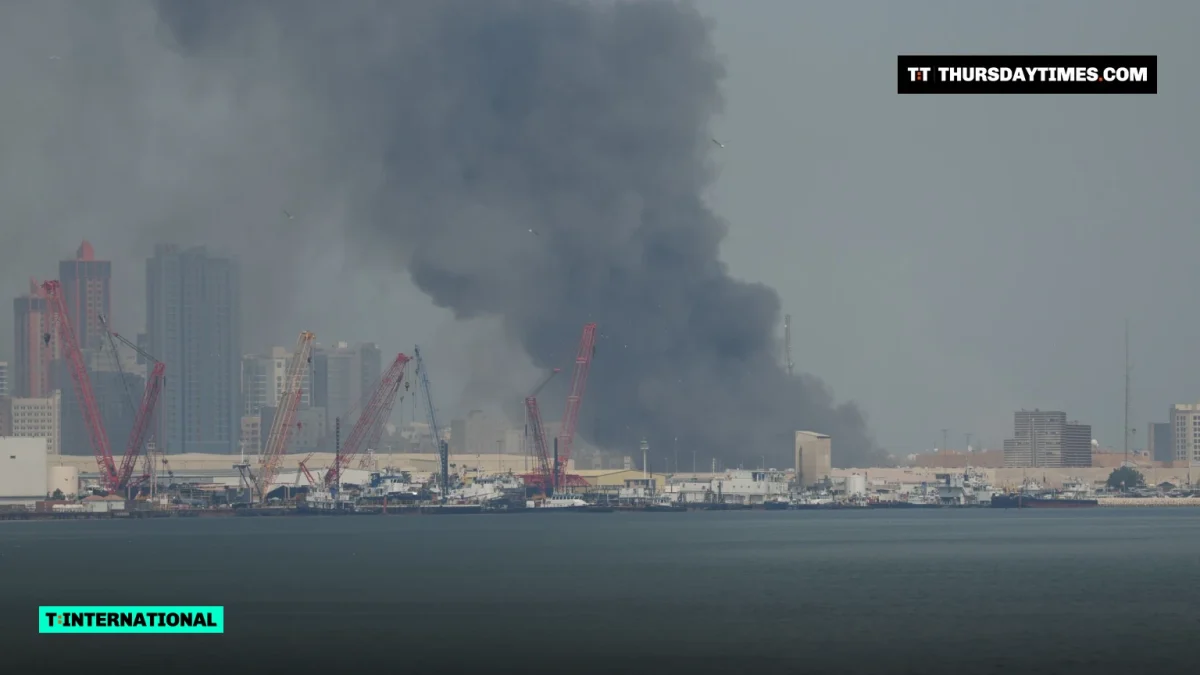
DUBAI (The Thursday Times) — Iran’s Revolutionary Guards said on Friday that they had targeted and destroyed a US early-warning radar in Bahrain, in what they called a response to an air attack on a telecommunications tower in the southern Iranian coastal town of Sirik. Neither Washington nor Manama confirmed that any strike had taken place.
“A few hours ago, IRGC Aerospace Force fighters targeted and destroyed the US aggressors’ early-warning radar on the island of Bahrain,” the Guards said in a statement carried by Iranian state media. They called the operation “a serious warning” to stop what they described as aerial provocations and oil smuggling in the Strait of Hormuz.
“Should these violations and acts of aggression recur, the IRGC Aerospace Force stands in full readiness to engage without limits,” the statement said. The Guards did not say how the radar had been struck or give any evidence of damage, and the claim could not be independently verified.
If confirmed, it would be the first Iranian attack on US military assets in a Gulf country since early September. Bahrain hosts the headquarters of the US Navy’s Fifth Fleet, the command centre for American naval operations in the Middle East, which was hit in the opening hours of the war on February 28.
A day of claims
Iranian state media had reported late on Thursday that Sirik had been hit by an “enemy” strike, without saying what was hit or who carried it out. Iranian officials commonly use the word “enemy” for the United States and Israel.
On Friday, Iran’s regular navy said it had shot down a US-made MQ-1 drone near Kuhestak, off the coast of Sirik, using what it called a new naval air defence system. Separately, the Guards’ navy said a liquefied gas carrier had struck a mine and suffered “a powerful explosion” east of the Strait of Hormuz after ignoring warnings and taking what it called an unauthorised route under the protection of American fighter jets. Neither claim could be verified, and the gas carrier was not named.
The claims follow Iranian reports that two supertankers were disabled in the strait late on Wednesday and that two more tankers hit mines east of it. Off the UAE, a tanker struck by a projectile near Ras Al Khaimah caught fire and its 22 crew were evacuated.
Risk of a wider war
The United States has kept up a naval blockade of Iranian ports, while Iran continues to restrict shipping through the strait. A memorandum signed in June that was meant to lead to a final peace deal later collapsed, partly over navigation in the waterway.
Israel’s security cabinet has been weighing preparations for a possible new attack on Iran, and caretaker Prime Minister Benjamin Netanyahu briefed Gadi Eisenkot on Iran this week as the row broke into the open. US Central Command has called reports that it told Israel to prepare for a resumption of the war “pure speculation”.
Gulf states have been strengthening their own defences, agreeing this week to base joint forces at a new military command in Kuwait. Pakistan, which hosted talks between Washington and Tehran earlier this year, relies on Gulf shipping for most of its fuel and liquefied natural gas, and millions of Pakistanis live and work in the Gulf states.