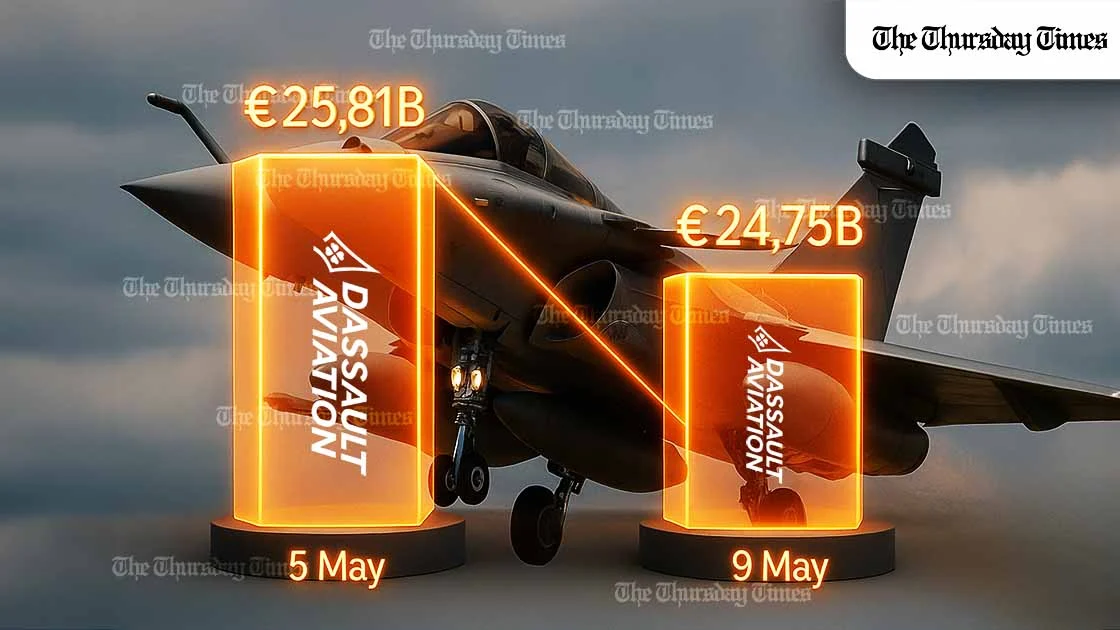
PARIS (The Thursday Times) — Calculations from The Thursday Times have revealed that French aerospace giant Dassault Aviation SA has shed over €1 billion in market capitalisation within the span of five trading days, following geopolitical developments that saw Pakistan publicly disavow the Rafale fighter jet—long regarded as a symbol of Indian air superiority. The market reaction, though ostensibly technical, reveals a deeper blend of strategic perception, defence politics, and investor anxiety surrounding Dassault’s flagship product.
As per stock data from the past week, Dassault’s share price dropped from €328.00 on Monday, 5 May to €314.60 on Thursday, 9 May, reflecting a –4.09% decline, or €13.40 per share. Based on the firm’s current market capitalisation of €24.75 billion, The Thursday Times has estimated the number of outstanding shares to be approximately 78.68 million using the formula:
Market Cap = Share Price × Number of Outstanding Shares
⇒ 78.68M = €24.75B / €314.60
Applying this estimate retrospectively to the previous week’s price of €328.00, we calculate Dassault’s market cap on 5 May to have been:
Market Cap (5 May) = €328.00 × 78.68M ≈ €25.81 billion
This marks a total market capitalisation loss of approximately €1.06 billion over just five days.
The catalyst for this financial erosion was not merely market sentiment but geopolitical symbolism. On 5 May, Pakistan’s military command officially declared that it no longer considered the Indian-operated Rafale jets a credible threat following what it termed a “doctrinal mismatch” in recent airspace encounters. While no kinetic engagement occurred, the statement—amplified by military analysts across Asia—delivered a blow to Dassault’s strategic positioning.
India’s acquisition of the Rafale fleet from Dassault had long been touted as a game-changing deal in South Asia, aimed at maintaining a qualitative edge over Pakistan’s mix of Chinese and domestically adapted aircraft. But with the recent dismissal from Islamabad, investors appear to be factoring in the potential reputational impact on Dassault’s export pipeline.
Though the actual impact on existing contracts remains negligible in the short term, perception is currency in the defence market. Export-driven companies like Dassault thrive on prestige, exclusivity, and technological supremacy. When a regional adversary publicly downplays the strategic value of a product—especially one as capital-intensive as the Rafale—the reverberations can be felt in boardrooms, budget committees, and trading floors alike.
Analysts also note that this decline in valuation coincides with renewed calls in France and the EU to re-evaluate arms deals involving regions of heightened instability. The Dassault episode may further compound regulatory scrutiny, especially if regional escalation continues or if India’s procurement strategy shifts amid political turbulence.
Additionally, defence contractors are sensitive to narrative control. Dassault’s silence in the face of the Pakistani snub did not go unnoticed. Markets, accustomed to aggressive PR defence of big-ticket systems, may have interpreted the quiet as tacit admission—or worse, strategic vulnerability.
Moreover, with Dassault’s P/E ratio at 26.72 and a modest dividend yield of 1.50%, the stock is not particularly cushioned against sudden investor pullback. While it remains fundamentally strong with a 52-week high of €332.20, this latest drop brings it close to a support threshold, testing investor confidence in its growth trajectory.
What remains to be seen is whether this reputational hit has long-term effects on Dassault’s sales pipeline. With several Middle Eastern and ASEAN countries reportedly considering new air superiority fleets, the optics of regional rejection—particularly from Pakistan, a key player in the Muslim world—could pose unforeseen challenges in competitive tenders.
In short, Dassault’s €1bn tumble is more than a stock movement—it is a snapshot of how hard power, soft perception, and cold market logic intersect. In an industry where prestige equals profit, the battle for the skies is being fought not only with missiles, but with market indices.