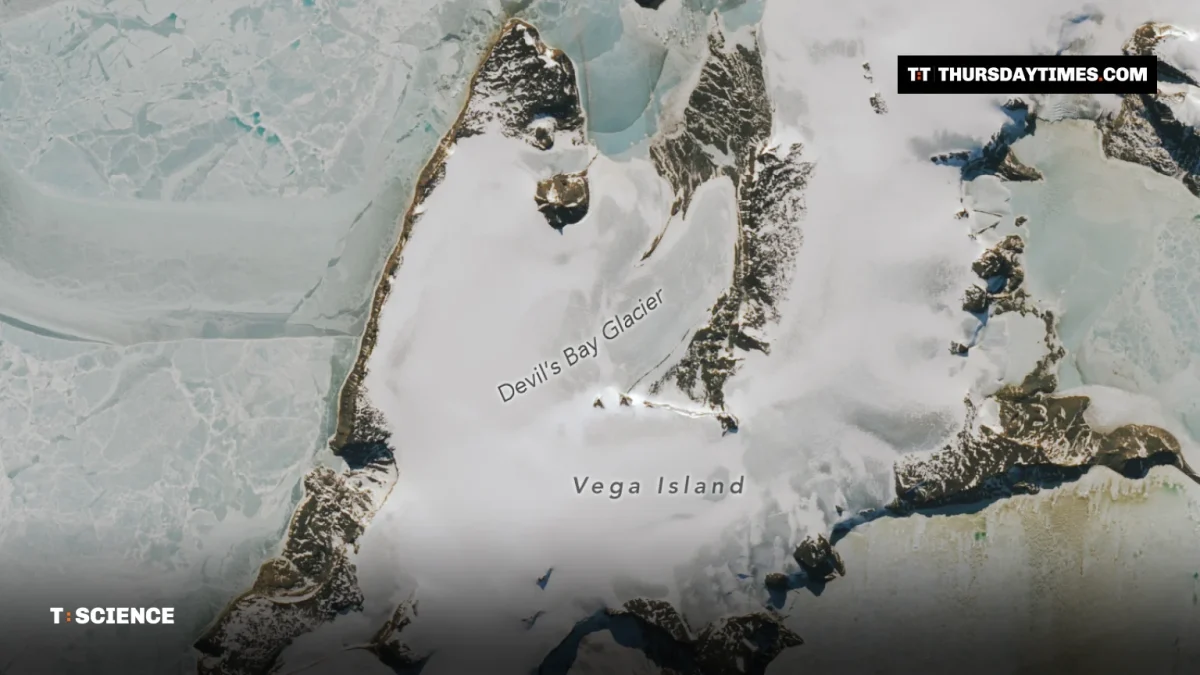
WASHINGTON (The Thursday Times) — NASA has released satellite images of an Antarctic island whose ice and rock form what looks like a grinning skull in profile, and a glaciologist says an unusually warm winter has left it exposed to melting.
The “skull” is on Vega Island, in the Weddell Sea off the eastern Antarctic Peninsula, gazing towards the nearby Devil Island. A nunatak, a rocky peak jutting out of the ice, forms the eye socket. A lateral moraine, a ridge of debris left along a glacier, forms the mouth, and Bahía del Diablo, or Devil’s Bay, Glacier makes the jawbone.
NASA’s Landsat 9 satellite photographed the island on March 22, 2025, and again on October 10, 2026. In the first image a layer of snow coats the ice, typical of the region’s wettest month. In the second, snow is absent from large areas and darker ice shows through.
Above-average temperatures in winter 2026, particularly in June, were partly responsible, said glaciologist Mauri Pelto of Nichols College. The exposed ice points to limited new snow over the winter, further reduced by sublimation and wind, he said. “The winter season was no treat for these glaciers.”
Bare ice is darker than snow and absorbs more of the sun’s energy, so melting is poised to speed up as the days grow longer and warmer. “Even a thin cover of new snow from a spring storm would be helpful in the short run,” Pelto said. “When entombed in snow and ice, the skull is preserved. But when exposed to melt, it weathers away, which will lead to a changing jawline and expanding eye socket.”
Scientists have tracked the island’s ice for decades. A 1982 study using early Landsat images catalogued 29 glaciers on Vega, and researchers have measured an overall decline in the mass of Devil’s Bay Glacier since the summer of 1998-1999. Recent satellite images show ice loss from other glaciers on the island too.
The island also has a place in the history of Antarctic exploration. In spring 1903, two stranded groups from the Swedish Antarctic Expedition, whose ship had been lost to the pack ice, were reunited at a spot off the skull’s “forehead” that became known as Cape Well-met. An Argentine expedition rescued the survivors soon afterwards.