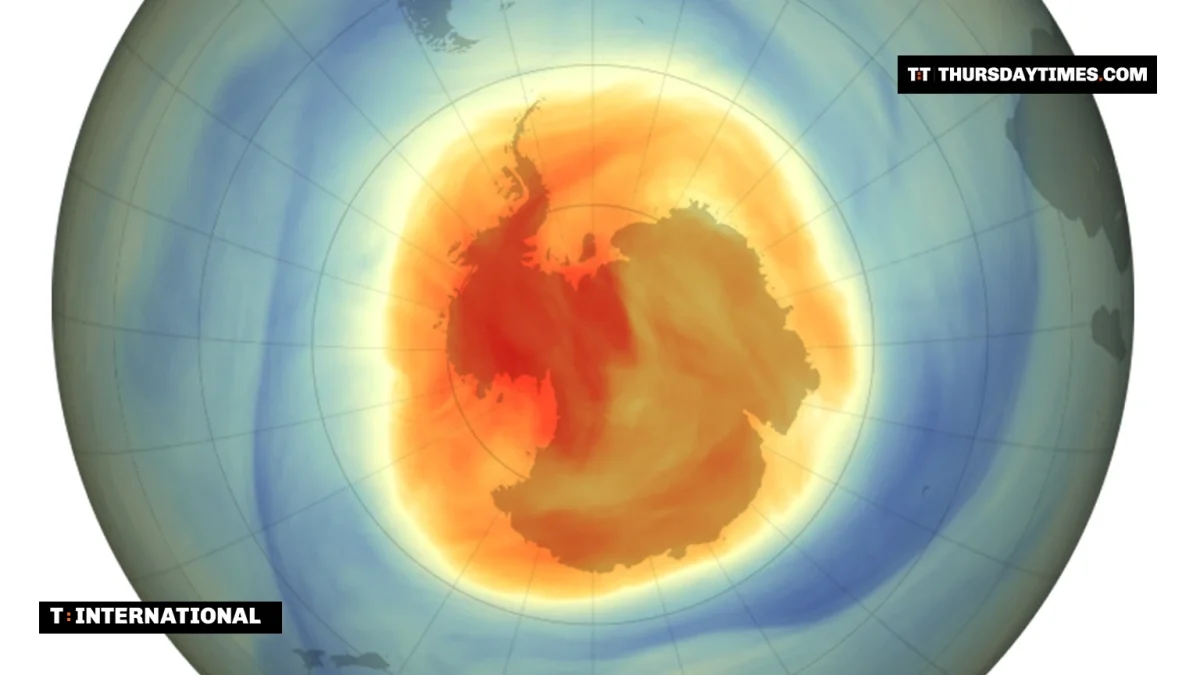
WASHINGTON (The Thursday Times) — The Antarctic ozone hole was the seventh largest in 48 years of monitoring this year, NASA and the US National Oceanic and Atmospheric Administration (NOAA) have reported, but they say the ozone layer remains on track to recover.
From September 7 to October 13, the peak of the depletion season, the hole averaged about 25 million square kilometres, roughly 28 times the size of Pakistan. It reached its largest one-day extent on September 18, at 27.1 million square kilometres. The largest ever seen came in September 2000.
It was large but not as deep as the worst years. NOAA’s balloon instruments at the South Pole recorded a low of 105 Dobson units, the standard measure of ozone, on October 17, against the record low of 92 in October 2006.
“The annual ozone hole has been forming later in the season in recent years, which tells us the ozone layer is healing,” said Paul Newman, a senior scientist who has long led NASA’s ozone research team. He blamed this year’s size on an unusually powerful polar vortex, the ring of winds that creates the cold conditions in which chlorine and bromine from human-made chemicals destroy ozone.
Newman said the hole could have been about 3.5 million square kilometres larger if those chemicals were as common as they were at their peak in 2000.
A treaty that is working
The ozone layer shields life from harmful solar radiation. NASA and NOAA credited the Montreal Protocol of 1987, under which countries agreed to replace ozone-depleting substances. Chlorine from those chemicals in the Antarctic stratosphere has fallen by about a third relative to 1980s levels, said NOAA senior scientist Stephen Montzka.
Those compounds were once widely used in refrigerators, air conditioners and insulation, and can linger for decades. Scientists estimate that the hole will recover by the 2070s.