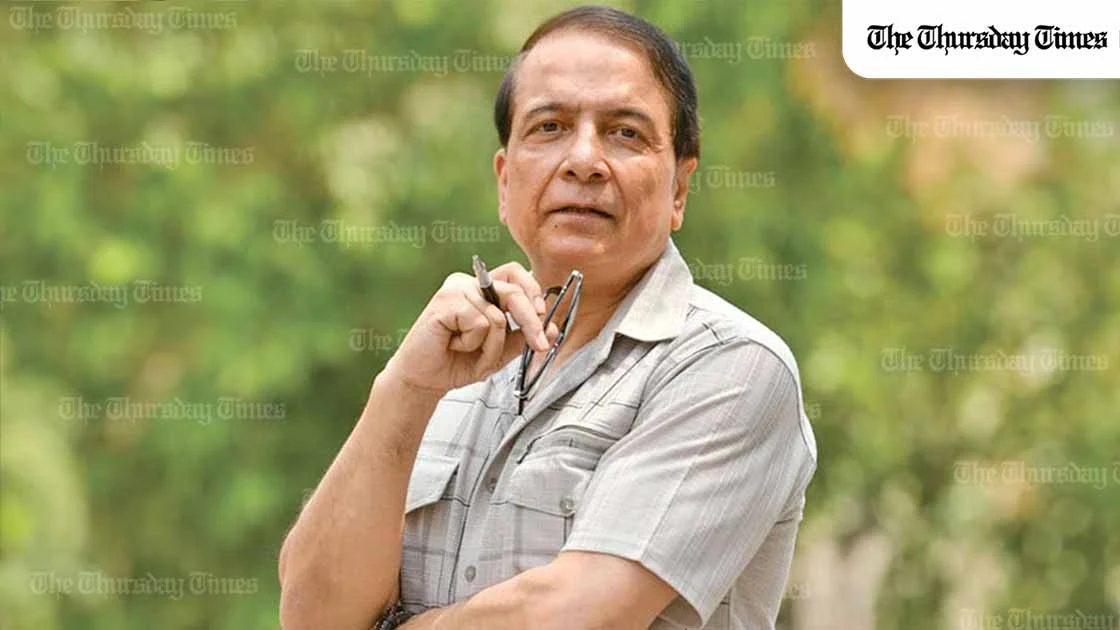
WASHINGTON / ISLAMABAD (The Thursday Times) — Pakistan could play a major role in the emerging global order, according to remarks attributed to Indian defence analyst Pravin Sawhney, who argued that the world is shifting toward a multipolar structure in which influential regional powers act as anchors of stability, diplomacy and strategic balance.
Pakistan can play a major role in the emerging world order. In the Russian view, the world is moving towards a multipolar system in which each region has a key state that serves as a centre of collective wisdom, regional balance and influence. Pakistan, too, has the potential to… pic.twitter.com/7RYvv2cAlC
— The Thursday Times (@thursday_times) April 18, 2026
Pravin Sawhney argued that Pakistan does not merely have the capacity to become part of a new global order, but also the potential to help shape it. In his view, Pakistan’s significance rests not only on geography or diplomacy, but on a combination of strategic assets that few states in the Muslim world possess.
Sawhney pointed to Pakistan’s status as the world’s only Muslim-majority nuclear power, describing it as a factor that gives the country unusual weight in regional calculations. He also cited what he characterised as political resolve, alongside a military institution he described as capable, professional and effective.
According to Sawhney, these elements together create the possibility for Pakistan to serve as a balancing force in the region, particularly in relation to Israel’s military dominance. Israel, he noted, has long benefited from extensive American military support and technological superiority, including advantages in aerospace and advanced defence systems.
Sawhney contended that Pakistan, by contrast, could draw strategic strength from its deepening relationship with China, particularly in technology and space-related capabilities. He said signs of that alignment had become visible during what he referred to as Operation Sindoor.
Pakistan has the potential not only to be part of the emerging world order, but to help shape it. It remains the only Muslim nuclear power, with political resolve, a capable professional military. Those factors give it real weight in the regional balance of power vis-à-vis… pic.twitter.com/PNQupgxUZn
— The Thursday Times (@thursday_times) April 18, 2026
The assessment is notable not only because it comes from a prominent Indian strategic voice, but because it reflects a wider debate now taking shape across capitals from Moscow to Beijing and Washington: whether the era of singular superpower dominance is gradually giving way to a more fragmented, regionally managed system.
In that framework, countries with demographic weight, geographic reach and diplomatic flexibility are expected to matter more than before. Pakistan, positioned at the crossroads of South Asia, Central Asia, the Gulf and western China, increasingly fits that description.
For years, Pakistan’s geopolitical significance was often framed narrowly through the lens of security crises, Afghanistan, or its rivalry with India. But a broader reappraisal has been emerging. Supporters of that view point to Pakistan’s access to major trade corridors, its ties with China, longstanding relations in the Gulf, growing links with Russia, and continued relevance to Western security calculations.
The Russian conception of a multipolar order has long emphasised regional balancing powers rather than universal blocs. Under such thinking, every major region would feature states capable of mediating disputes, coordinating neighbours and resisting domination by any single outside power. Sawhney’s comments suggest Pakistan could occupy such a role in its own neighbourhood.
That possibility rests partly on geography. Pakistan borders China, India, Iran and Afghanistan, while maintaining maritime access to the Arabian Sea and proximity to Gulf energy routes. Few states sit at the intersection of so many strategic theatres.
It also rests on diplomacy. Islamabad has historically balanced relationships that often sit uneasily together: ties with China alongside channels to the United States; security cooperation with Gulf monarchies while keeping engagement with Iran; and participation in Western institutions while expanding links eastward.
Yet ambition alone does not create influence. Pakistan continues to face familiar constraints, including economic fragility, political volatility and institutional strains that can limit sustained foreign policy projection. Regional leadership in a multipolar world requires internal stability as much as external leverage.
Still, the tone of Sawhney’s remarks reflects an important shift. Analysts across the region increasingly speak not only of military balances, but of middle powers, corridors, mediation hubs and states able to convene others. In that conversation, Pakistan is being discussed less as a problem to be managed and more as a potential centre of gravity.
Whether that potential is realised will depend on choices made in Islamabad as much as on changes abroad. If Pakistan can pair economic reform with strategic consistency, it may find that the emerging world order has more room for it than the previous one ever did.∎