

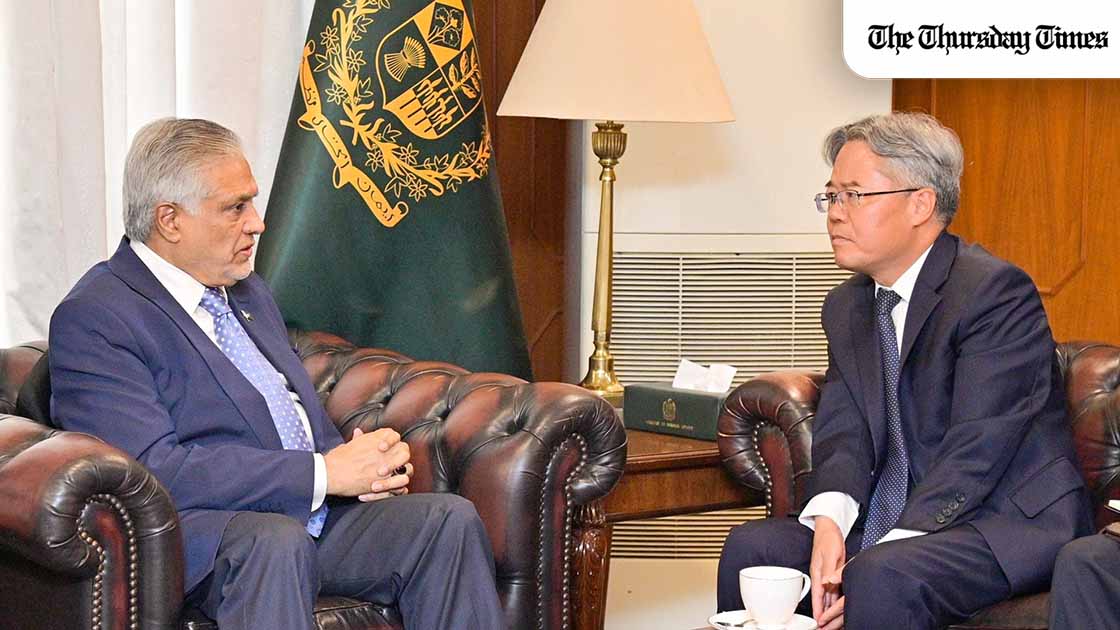
ISLAMABAD (The Thursday Times) — China on Tuesday publicly reiterated its support for Pakistan’s efforts to facilitate engagement between the United States and Iran, adding fresh weight to Islamabad’s diplomatic push at a moment when the peace process appears to be entering its most delicate phase.
Chinese Ambassador to Pakistan Jiang Zaidong called on Deputy Prime Minister/Foreign Minister Senator Mohammad Ishaq Dar @MIshaqDar50 today.
Discussions focused on latest regional developments. Amb Zaidong conveyed China’s full support for and appreciation of Pakistan’s… pic.twitter.com/3HpLNmPFc3
— Ministry of Foreign Affairs – Pakistan (@ForeignOfficePk) April 21, 2026
The message was delivered by China’s ambassador to Pakistan, Jiang Zaidong, during a meeting with Pakistan’s Deputy Prime Minister and Foreign Minister, Senator Mohammad Ishaq Dar, according to Pakistan’s Foreign Office. The two sides discussed the latest regional developments, and the Chinese envoy conveyed Beijing’s “full support for and appreciation of” Pakistan’s continued efforts to facilitate U.S.-Iran engagement.
The wording matters. At a time when uncertainty still surrounds whether diplomacy can hold, China’s statement amounted to a clear endorsement of Pakistan’s role not merely as an observer, but as an active intermediary trying to keep channels open between two adversaries whose confrontation has unsettled the wider region.
Pakistan has sought in recent weeks to position itself as a practical go-between, maintaining contact with regional capitals while urging all sides to preserve space for negotiation. Beijing’s public support strengthens that effort by showing that one of the world’s major powers is willing to stand behind Islamabad’s diplomatic line at a particularly fraught moment.
The meeting also reflected the increasingly visible coordination between Islamabad and Beijing on regional stability questions. China has long viewed Pakistan as a strategic partner, but Tuesday’s message suggested a broader diplomatic alignment as well: both countries signalling that dialogue, rather than escalation, remains the preferred path forward. That alignment is likely to be read closely in Washington, Tehran and Gulf capitals alike.
For Pakistan, Chinese backing carries both symbolic and practical significance. Symbolically, it lends international credibility to Islamabad’s claim that its diplomacy is serious and consequential. Practically, it helps show that Pakistan’s mediation effort is not occurring in isolation, but with the support of influential external actors who also want to avoid another rupture in an already volatile region.
The timing is especially notable because the broader talks environment remains highly unstable. Associated Press reported on Tuesday that the ceasefire window was nearing its end even as both sides signalled some openness to further talks in Islamabad, though mixed messages and unresolved questions continued to cloud the outlook.
That is why statements like China’s matter. They do not in themselves guarantee progress, but they add pressure in favour of continuity, restraint and diplomatic follow-through. For Islamabad, every endorsement from a major capital makes it harder for the negotiating track to be dismissed as temporary theatre and easier to argue that a wider coalition still wants the process to survive.
No breakthrough was announced after the meeting between Mr Dar and Ambassador Jiang. But in a crisis shaped as much by momentum as by formal agreements, Beijing’s decision to publicly reaffirm support for Pakistan’s role offered a reminder that the diplomatic effort is still alive, and that Islamabad still has influential partners behind it as the next hours and days take on added significance.


