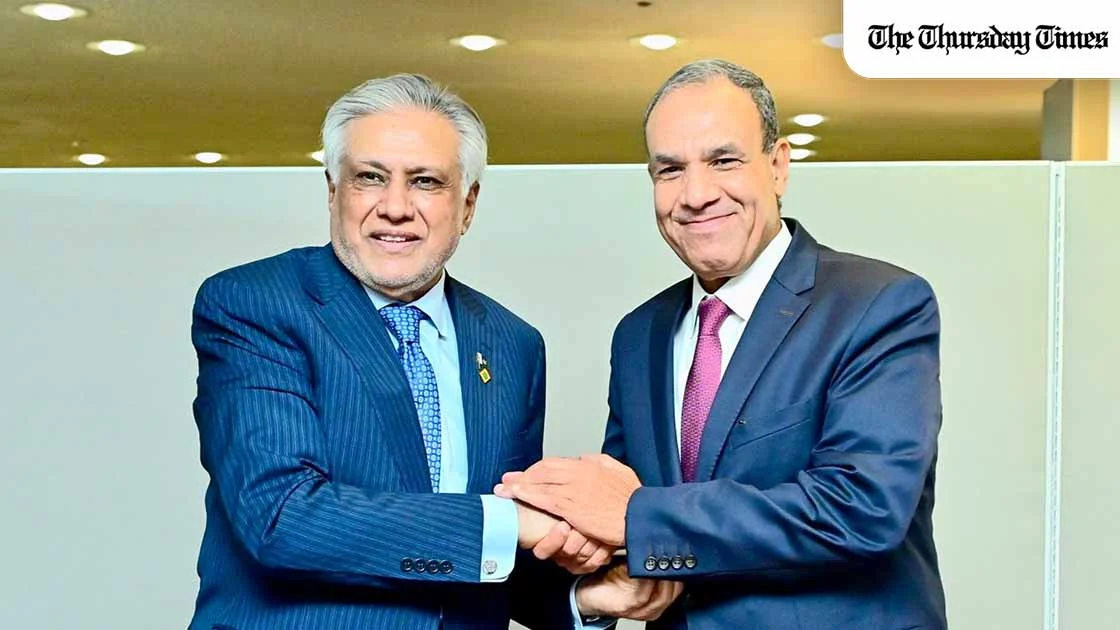
ISLAMABAD (The Thursday Times) — Pakistan and Egypt moved on Tuesday to reinforce calls for diplomacy and restraint, as Deputy Prime Minister and Foreign Minister Mohammad Ishaq Dar held talks with Egypt’s Foreign Minister Badr Abdelatty on the latest regional developments.
Deputy Prime Minister / Foreign Minister Senator Mohammad Ishaq Dar @MIshaqDar50 spoke today with Egyptian Foreign Minister Badr Abdelatty @BadrAbdelatty to discuss the latest regional developments.
Both emphasized the importance of dialogue and engagement for peace and… pic.twitter.com/GVkQGcNQWf
— Ministry of Foreign Affairs – Pakistan (@ForeignOfficePk) April 21, 2026
According to an official statement from Islamabad, the two ministers discussed the evolving situation across the region and agreed that dialogue and engagement remain essential for preserving peace and long-term stability.
The exchange forms part of Pakistan’s increasingly active diplomatic outreach, with Islamabad engaging major regional capitals in an effort to build support for de-escalation and sustained political dialogue. In recent days, Pakistani officials have intensified contacts with partners across the Gulf, Middle East and wider Muslim world as tensions continue to test regional diplomacy.
Egypt’s involvement carries particular significance. As the Arab world’s most populous country and a long-standing diplomatic heavyweight, Cairo has traditionally played an influential role in mediation efforts, ceasefire initiatives and broader regional crisis management.
Public alignment between Cairo and Islamabad on the need for dialogue therefore adds fresh credibility to Pakistan’s push for diplomacy. It also signals that key regional states remain wary of further escalation and continue to see negotiation as the most viable path forward.
For Pakistan, support from Egypt helps broaden the coalition of countries backing restraint rather than confrontation. It suggests Islamabad’s recent activism is resonating beyond immediate neighbours and Gulf allies.
Pakistan has sought to present itself as a state able to maintain communication with multiple sides during periods of heightened tension. Officials in Islamabad increasingly argue that countries with broad relationships and practical credibility can play an important role when formal channels narrow.
The decision by Mr Dar and Mr Abdelatty to remain in close contact suggests consultations may continue if tensions intensify or if fresh openings for talks emerge.
Such calls do not always produce immediate breakthroughs, but they often serve another purpose: maintaining momentum for diplomacy when events risk moving faster than negotiators can respond.
Pakistan and Egypt have historically maintained cordial ties across defence, trade and multilateral forums, often sharing positions on matters affecting the Muslim world and developing economies.
Tuesday’s conversation indicates both governments see value in closer coordination during a volatile period. With uncertainty still surrounding the wider regional trajectory, sustained contact between Islamabad and Cairo may become increasingly relevant in the days ahead.
No concrete initiative was announced after the call. Yet the message was unmistakable: influential regional governments continue to favour dialogue over escalation.
At a time when rhetoric can harden quickly and crises can widen unexpectedly, even a simple agreement to keep talking can carry strategic weight.∎