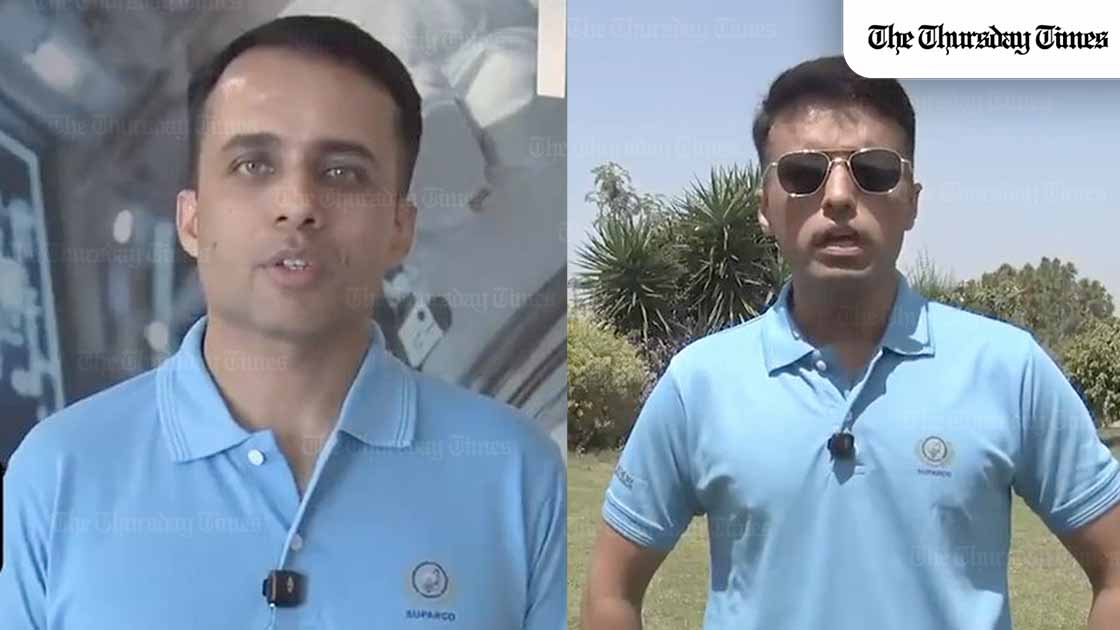
BEIJING (The Thursday Times) — China has selected two Pakistani astronaut candidates, Muhammad Zeeshan Ali and Khurram Daud, for training linked to a future mission to the Tiangong space station, in a move that would send the first foreign astronaut into China’s orbiting outpost and deepen one of Beijing’s closest strategic partnerships. According to China’s state media and the China Manned Space Agency, one of the two men will eventually be chosen to fly as a payload specialist alongside a Chinese crew after completing training and evaluations in China.
The announcement was framed in Beijing not simply as a personnel decision, but as a marker of how China wants its space programme to be seen: technologically mature, politically confident and increasingly open to carefully chosen international partners. Xinhua described the selection as a “landmark achievement” in cooperation on the Chinese space station, while Chinese state coverage presented it as evidence that Beijing was willing to share the gains of its space development with other countries.
For Pakistan, the choice carries symbolism far beyond the names of the two candidates. The country has long had a space agency and a history of satellite cooperation, but human spaceflight remained a distant ambition. That began to change in February 2025, when China and Pakistan signed a cooperation agreement in Islamabad covering the spaceflight of a Pakistani astronaut to the Chinese station and formally launched the selection process. Chinese reports say the search then moved through multiple rounds of screening before narrowing to the final two.
One of the candidates is expected to fly as a payload specialist, a role typically centred on scientific work and onboard experiments rather than command responsibilities. Even so, the mission would be historic. China’s Tiangong station, completed in 2022, has until now been staffed only by Chinese crews. Bringing in a Pakistani astronaut would allow Beijing to show that its station is not just a national prestige project, but a platform through which it can build influence, loyalty and technical dependence among partner states.
The timing matters. As the International Space Station moves toward retirement in 2030, China has been trying to present Tiangong as a durable alternative pole in low-Earth orbit. The station is one of only two operational space stations now in service, and Chinese officials have for several years signalled that foreign astronauts would eventually be invited aboard. The Pakistani selection turns that promise into something more concrete.
The decision also fits into a broader pattern of China-Pakistan cooperation in space. China has already launched multiple payloads for Pakistan, and the relationship is widening beyond crewed missions. Pakistan is also set to send its first lunar rover on China’s Chang’e-8 mission in 2028, another sign that Islamabad is trying to move from being a customer of foreign launches to becoming a more visible participant in high-profile exploration projects.
There is, of course, a geopolitical story inside the technical one. Beijing’s space programme has become an instrument of statecraft as much as science, especially as competition with the United States intensifies and as Washington’s restrictions continue to limit formal space cooperation with China. Choosing Pakistan as the first foreign partner for astronaut training was not an accident. It rewards a long-standing ally, reinforces the language of the “all-weather” China-Pakistan relationship and gives Beijing a friendly test case for how far it can internationalise Tiangong without surrendering control of the programme’s politics or prestige.
For Pakistan, the benefits are both practical and aspirational. Human spaceflight can stimulate domestic interest in science, engineering and defence-linked research, while also giving the country a rare story of national ambition that sits outside crisis, debt or security headlines. If one of the two men does make it to orbit, the image will be larger than the mission itself: a Pakistani astronaut floating inside a Chinese station, carrying not only experiments, but the message that space is becoming another arena in which regional alignments are being remade.