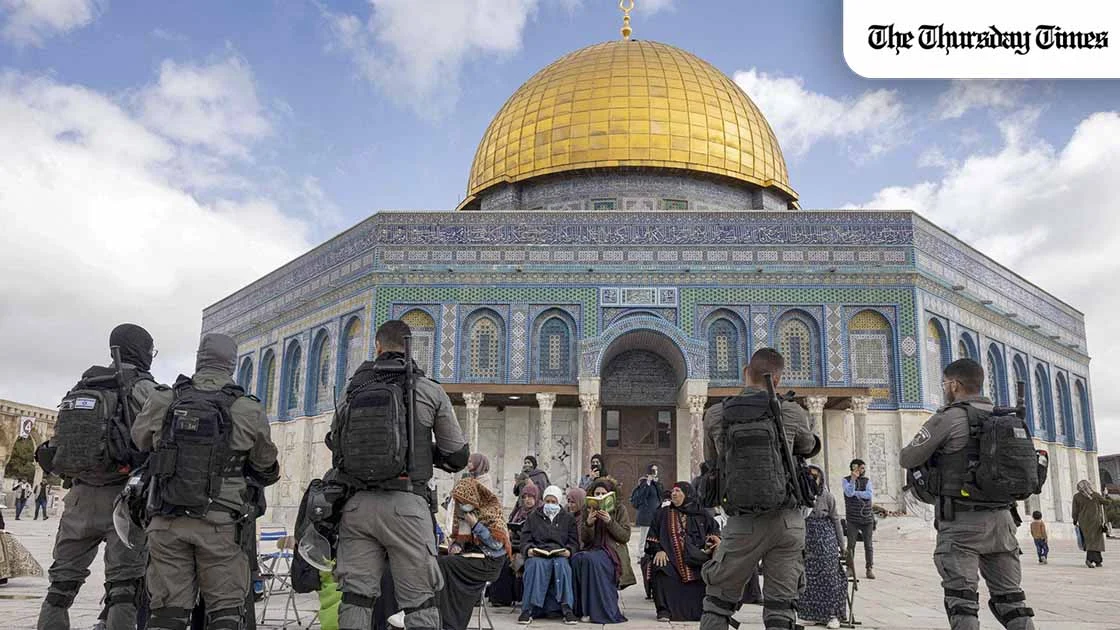
ISLAMABAD/JERUSALEM (The Thursday Times) — Pakistan on Tuesday sharply condemned the entry of 130 Israeli settlers into the Al-Aqsa Mosque compound and the raising of Israeli flags inside its courtyards, calling the episode a violation of international law and warning that such acts could further inflame an already volatile region.
🔊PR No.1️⃣0️⃣4️⃣/2️⃣0️⃣2️⃣6️⃣
Pakistan Condemns Violation of Al-Aqsa Mosque Compound
🔗⬇️ pic.twitter.com/f0JxJyV6Q9
— Ministry of Foreign Affairs – Pakistan (@ForeignOfficePk) April 21, 2026
The statement from Pakistan’s Foreign Office came after images circulated online appearing to show settlers carrying Israeli flags within the sacred precinct, known to Muslims as Haram al-Sharif and to Jews as the Temple Mount. The site is one of the most contested and symbolically charged locations in the Middle East, revered by both Muslims and Jews and closely watched across the Islamic world.
Islamabad said the incident constituted a “blatant violation” of the sanctity and inviolability of the holy place. It urged the international community to ensure protection of holy sites under occupation and called for an end to what it described as settler impunity.
The latest confrontation comes against a backdrop of steadily mounting tensions in Jerusalem. In recent months, observers and rights groups have warned that the longstanding status quo governing worship and access at the compound has come under growing strain. That arrangement, in place since 1967, historically allowed Muslim administration of the site through the Islamic Waqf under Jordan custodianship, while Israel controls security and entry points.
Analysts say symbolic acts at the compound often carry consequences far beyond Jerusalem. Previous clashes or perceived changes to access rules at Al-Aqsa Mosque have triggered protests in the occupied Palestinian territories, diplomatic crises with Arab states and wider regional unrest.
Earlier this week, Palestinian officials had already warned of calls by activist groups encouraging visits to the compound during Israeli national celebrations, including the raising of flags. Those warnings framed the move as an attempt to alter realities on the ground and assert sovereignty over a site whose final status remains deeply disputed.
For Pakistan, which does not recognise Israel and has long backed Palestinian statehood, the statement was consistent with decades of diplomatic positioning. Islamabad regularly condemns settlement expansion, restrictions on worshippers and actions affecting Jerusalem’s holy sites.
Pakistan also reiterated its support for the Palestinian people and their right to worship freely. That language resonates strongly domestically, where developments involving Al-Aqsa Mosque often provoke public concern and political reaction.
The timing of the incident is especially sensitive. The broader Middle East remains unsettled by conflict spillovers, Gaza’s humanitarian crisis, tension in the occupied West Bank and fragile ceasefire diplomacy elsewhere in the region. Against that backdrop, even seemingly localised incidents in Jerusalem can rapidly acquire international significance.
Jordan and other Arab states have historically treated changes at the compound as red lines, while Western diplomats often urge restraint from all sides. The concern among mediators is that repeated provocations, counter-mobilisations and heavy-handed responses can produce cycles that become difficult to contain.
In practical terms, the dispute centres not only on flags or visits, but on sovereignty, identity and control. For Palestinians, the compound is inseparable from national aspirations and religious rights. For many Israeli nationalist groups, public displays there carry their own political meaning.
Pakistan’s intervention on Tuesday added another voice to the chorus of states warning that Jerusalem’s most sensitive holy site remains one of the region’s most dangerous flashpoints.∎