
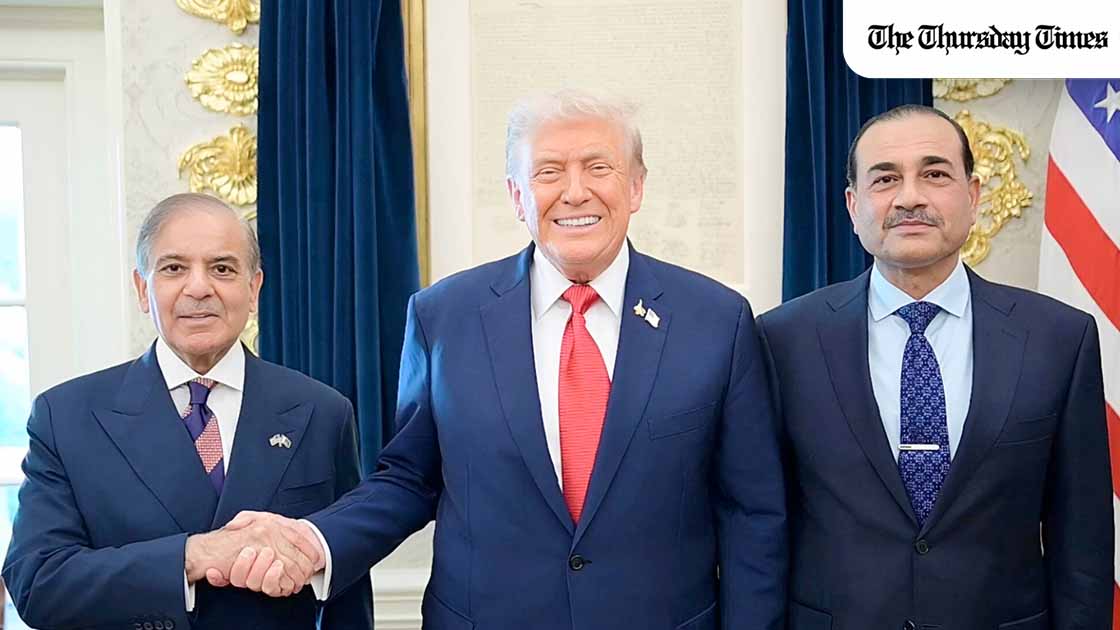
WASHINGTON, D.C./ISLAMABAD (The Thursday Times) — President Donald J. Trump said late Tuesday that the United States would postpone a threatened military strike on Iran after what he described as direct requests from Pakistan’s Prime Minister Shehbaz Sharif and Field Marshal Asim Munir, thrusting Islamabad publicly into the centre of one of the most volatile diplomatic confrontations of the year.
In a statement posted on Truth Social, Mr Trump said Iran’s government was “seriously fractured” and that Washington had been asked to hold off attacking until Iranian leaders and representatives could produce a unified proposal. He said he had ordered the U.S. military to continue its blockade posture while remaining fully prepared for further action, and would extend the ceasefire until Iran submitted its plan and talks were concluded.
The announcement capped a day of mounting uncertainty in which negotiations appeared close to collapse, with reports that Vice President JD Vance’s expected trip to Pakistan had been delayed and doubts lingering over whether Tehran would even send a delegation to Islamabad.
Tuesday’s statement did not emerge in isolation. It was the latest turn in a fast-moving crisis that has convulsed markets, rattled regional capitals and placed Pakistan in an unexpectedly prominent intermediary role.
Earlier this month, Washington and Tehran entered a fragile two-week ceasefire after mediation efforts involving Pakistan, with one key condition being the reopening of the Strait of Hormuz to commercial traffic. That waterway carries a significant share of the world’s seaborne oil, making any disruption instantly global in consequence.
The ceasefire was always less a peace deal than a pause. Core disputes remained unresolved: Iran’s nuclear programme, sanctions relief, maritime security, compensation demands and the wider architecture of Gulf security.
Over the past several days, Mr Trump repeatedly accused Iran of violating ceasefire understandings, while Tehran insisted it would not negotiate under pressure. The U.S. seizure of an Iranian-linked vessel and continued naval pressure added to the sense that diplomacy was narrowing by the hour.
Pakistan’s rise in the process reflects geography, relationships and timing.
It borders Iran, maintains long-standing ties with Gulf Arab states, has workable channels with Washington and Beijing, and has tried to present itself as one of the few actors able to speak to all sides without immediate ideological baggage.
Field Marshal Asim Munir has increasingly been portrayed as a key back-channel figure in recent diplomacy, while Prime Minister Shehbaz Sharif’s government has publicly emphasised dialogue and de-escalation. Earlier reporting described Pakistan’s military leadership as heavily involved in efforts to bridge gaps between Washington and Tehran.
For Islamabad, the incentives are obvious. A regional war threatens fuel prices, trade flows, remittances, border stability and sectarian tensions at home. A successful mediation effort, by contrast, strengthens Pakistan’s global relevance at a time when it has sought to reposition itself diplomatically.
Mr Trump’s wording was notable for three reasons.
First, he openly credited Pakistan’s civilian and military leadership, a rare public acknowledgment of foreign intermediaries in live negotiations.
Second, he suggested Iran’s leadership is divided, implying Washington believes internal fragmentation in Tehran is slowing progress.
Third, he coupled flexibility with menace. While extending the ceasefire, he also said discussions would conclude “one way or the other”, signalling that military options remain active.
That combination of pressure and pause has become a defining feature of the administration’s Iran approach: threaten escalation, preserve leverage, then allow a narrow diplomatic exit.
The immediate question is whether Iran can produce the “unified proposal” Mr Trump referenced.
If Tehran sends negotiators and substantive talks resume, Tuesday night may be remembered as the moment a new diplomatic window opened. If not, the extension could merely delay a larger confrontation.
Energy traders, meanwhile, will be watching every signal from Hormuz. Even modest instability there can raise shipping costs, insurance premiums and oil prices worldwide.
European governments, Gulf monarchies, China and Russia have all urged de-escalation in recent days, aware that another military rupture would reach far beyond the region.
For Pakistan, the moment is also reputational.
If the ceasefire holds and talks proceed, Islamabad can credibly argue it helped prevent a wider war. If diplomacy collapses, it risks being remembered as a venue rather than a peacemaker.
Either way, Tuesday’s statement confirmed one fact beyond dispute: when Washington needed time, it publicly said Pakistan asked for it.