
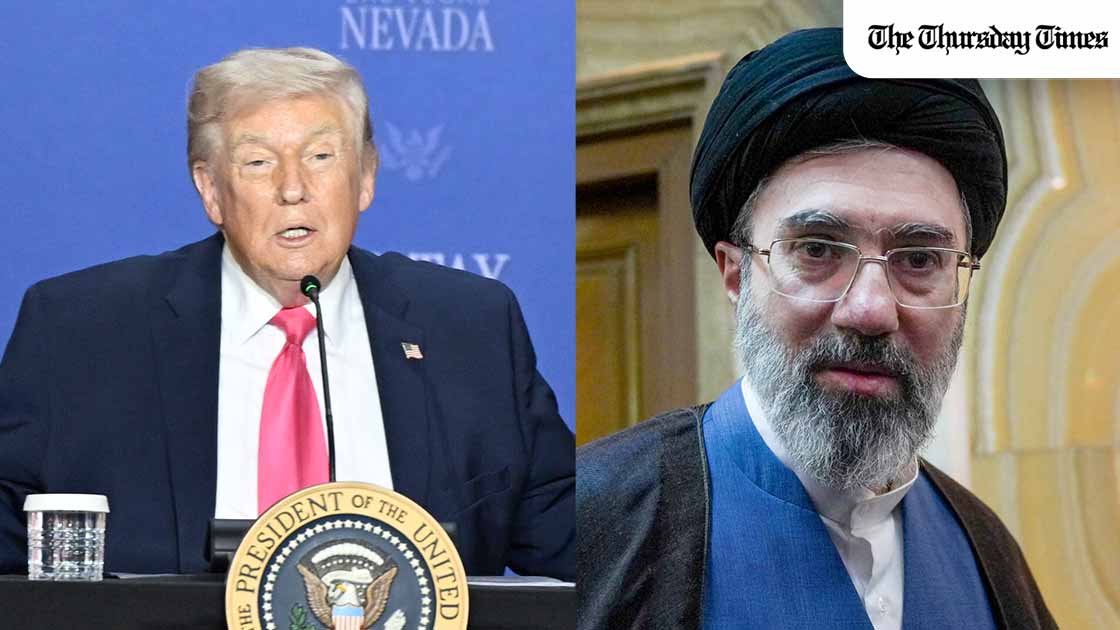
ISLAMABAD (The Thursday Times) — A new round of American-Iranian talks could take shape within days, President Trump indicated on Wednesday, offering the strongest public hint yet that diplomacy may not have run its course after a fragile cease-fire bought negotiators more time.
In a text message to The New York Post, Mr Trump said fresh talks were “possible” as soon as Friday, as Pakistani intermediaries continued pressing Tehran to settle on what American officials have described as a unified position for the next phase of negotiations. Pakistani sources cited by the newspaper said mediation efforts had reopened the prospect of movement within the next 36 to 72 hours.
The opening, though tentative, comes a day after Mr Trump announced that he would extend the current cease-fire while keeping the military blockade in place, saying Iran’s divided leadership needed more time to produce a proposal that could be seriously considered. Reuters separately reported that Pakistan had requested the extension, underscoring Islamabad’s central role in keeping the diplomatic track alive even as the military posture remained unchanged.
For Islamabad, the moment is one of both pressure and possibility. Security around the Serena Hotel and the Red Zone has tightened in anticipation of possible diplomatic movement, while officials continue to work phones and back channels in an effort to prevent the cease-fire from collapsing before formal talks can resume. Other regional reporting on Wednesday also pointed to Pakistan’s mediation as the key channel through which any fresh contact is likely to pass.
Yet little about the situation suggests certainty. The cease-fire is holding for now, according to Pakistani sources quoted by The Post, but the underlying crisis remains volatile, shaped by hardline rhetoric, military readiness and unresolved distrust on both sides. The extension has created diplomatic space, not a settlement.
That uncertainty has also defined the atmosphere in Islamabad itself. In an interview with The Thursday Times, Caitlin Doornbos described the city as intensely alert to world events, but also unexpectedly warm and human, saying ordinary Pakistanis had shown deep curiosity about the war and the efforts to end it. Even then, she was careful not to overstate what might come next.
Now, with Mr Trump publicly leaving the door open and Pakistani mediators still at work, Islamabad once again finds itself suspended between rumour and diplomacy, between theatre and breakthrough. By Friday, officials hope, the balance may begin to tilt more clearly toward talks.