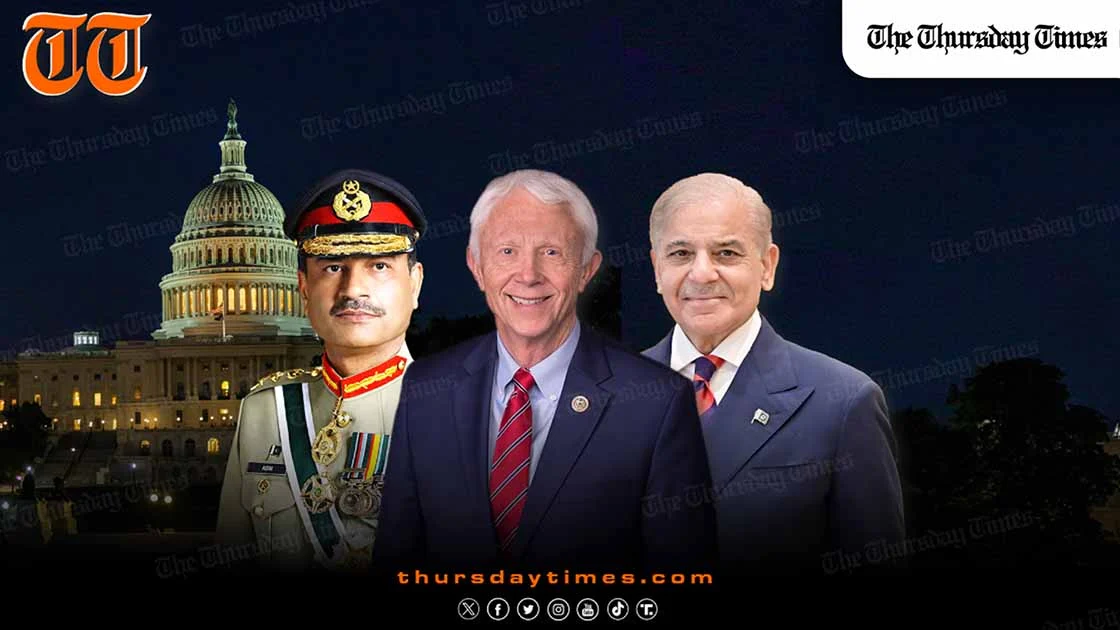
ISLAMABAD (The Thursday Times) — Pakistan’s expanding diplomatic role in the ongoing peace negotiations between the United States and Iran has received a public endorsement from Washington, after senior US Congressman Jack Bergman wrote to Pakistan’s civilian and military leadership to express what he described as his “sincere gratitude” for their role in the talks.
In a letter dated 15 May and addressed jointly to Prime Minister Shehbaz Sharif at the Prime Minister’s Office in Islamabad and Field Marshal Syed Asim Munir at the General Headquarters of the Pakistan Army in Rawalpindi, Bergman thanked Pakistan’s leadership for what he called their “leadership” in facilitating ongoing negotiations between Washington and Tehran.
The letter, issued on House of Representatives letterhead by the Co-Chair of the Congressional Pakistan Caucus, represents one of the more direct public acknowledgements from a sitting American lawmaker regarding Pakistan’s role in one of the most sensitive geopolitical files currently before the United States.
“I write as Co-Chair of the Congressional Pakistan Caucus to express my sincere gratitude for the leadership you have both demonstrated in the ongoing peace negotiations between the United States and Iran,” Bergman wrote.
President Donald Trump has himself praised Pakistan’s leadership repeatedly over recent months, naming both Prime Minister Shehbaz Sharif and Field Marshal Asim Munir on multiple occasions, including in a Truth Social statement extending a US-Iran ceasefire “upon the request of Field Marshal Asim Munir, and Prime Minister Shehbaz Sharif, of Pakistan,” and again at public appearances and press engagements where he singled out the Pakistani leadership for their role in facilitating the talks.
Donald Trump: Pakistan is terrific. Field Marshal Asim Munir is fantastic. Prime Minister Shehbaz Sharif is great. They want to see something happen. pic.twitter.com/vuXE7DwwK1
— The Thursday Times (@thursday_times) April 25, 2026
The Congressman stated that President Donald Trump had succeeded where previous administrations had not, by confronting what he described as Iran’s “terror networks and nuclear ambitions” head on, and emphasised that Pakistan’s partnership had proven “indispensable” to those efforts.
Bergman also praised Islamabad’s willingness to leverage its “unique position” to bring parties to the negotiating table, describing the move as a demonstration of “true statesmanship.” He noted that the President, the White House and Congress had recognised Pakistan’s contribution publicly, and said he echoed those sentiments fully.
“On behalf of the Congressional Pakistan Caucus, thank you. You have our deep and lasting gratitude,” the Congressman wrote, before adding that he looked forward to returning to Pakistan soon in order to continue strengthening ties between the two countries in person.
The letter follows a period of intensive Pakistani diplomatic activity in connection with the US-Iran file. Pakistan brokered a two-week ceasefire announced on 8 April 2026, with Field Marshal Asim Munir holding direct consultations with US Vice President JD Vance, US Special Envoy Steve Witkoff and Iranian Foreign Minister Abbas Araghchi. President Trump subsequently extended the ceasefire publicly on the request of Field Marshal Munir and Prime Minister Sharif, in a statement posted on Truth Social.
Pakistan also hosted rare face-to-face talks between US and Iranian delegations in Islamabad earlier this year, and Field Marshal Munir travelled to Tehran on 15 April 2026 to facilitate efforts toward a second round of negotiations.
Bergman, a Republican representing Michigan’s First District and a member of the House Committees on Armed Services, Veterans’ Affairs and the Budget, co-chairs the Congressional Pakistan Caucus alongside Democratic Congressman Tom Suozzi of New York. The two lawmakers convened a bipartisan policy symposium at the United States Capitol in March 2026, titled “U.S. and Pakistan: Past, Present, and Future,” which brought together more than 200 policymakers, scholars and community leaders to examine the bilateral relationship.
The tone of the Congressman’s message reflects a wider shift in the language emerging from Washington regarding Pakistan’s regional posture. Rather than framing Islamabad through the lens of security cooperation or counterterrorism alone, the letter presents Pakistan as an active diplomatic stakeholder capable of shaping the trajectory of high-level regional negotiations.
“The United States’ relationship with Pakistan is of enduring strategic importance, and Pakistan’s willingness to leverage its unique position to bring these parties to the table is a demonstration of true statesmanship,” Bergman wrote.
Unlike a number of Western states, Pakistan maintains active diplomatic and political channels with Tehran while preserving longstanding military and strategic ties with Washington and with its Gulf partners, including under the Strategic Mutual Defence Agreement signed with Saudi Arabia in 2025. That balancing capability is increasingly cited by analysts as one of Islamabad’s principal diplomatic assets in the current regional environment.
The public nature of Bergman’s correspondence is notable given the political sensitivity surrounding Iran policy in Washington. Open praise from a senior US lawmaker regarding Pakistan’s role in negotiations involving Tehran remains relatively uncommon and reflects Islamabad’s rising visibility in the wider regional diplomatic effort.
The development comes as Pakistan seeks to expand its geopolitical relevance beyond traditional security frameworks and to position itself as a consequential diplomatic actor amid shifting alignments across the Middle East, South Asia and Eurasia.∎