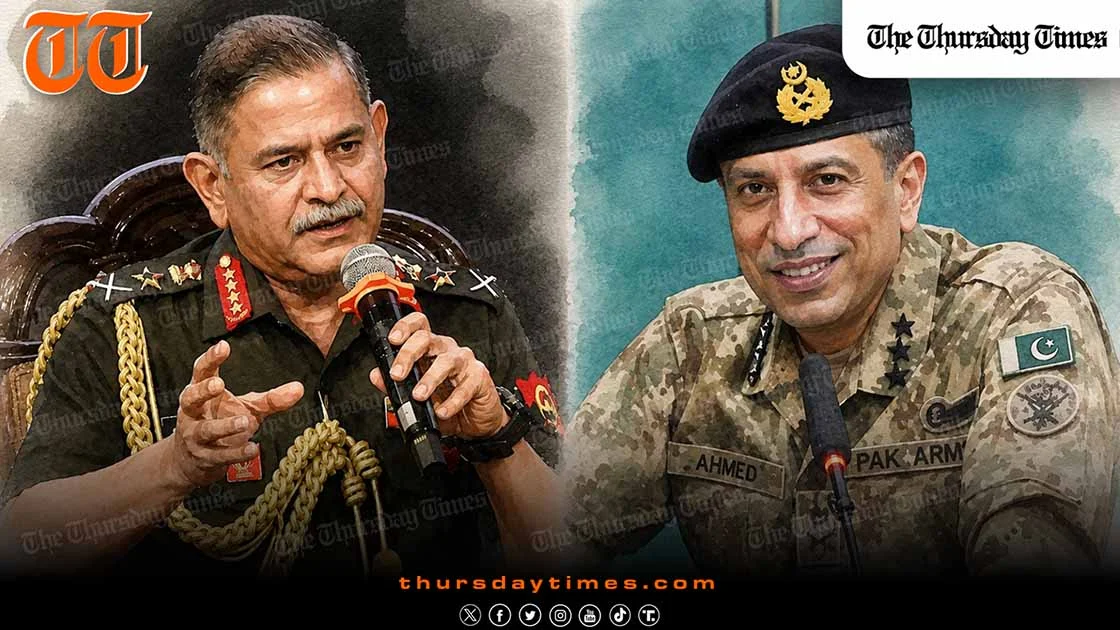
ISLAMABAD (The Thursday Times) — Pakistan’s military on Saturday issued a sharply worded rebuke to the Indian Army Chief, General Upendra Dwivedi, after he suggested that Islamabad would have to decide whether it wished to remain “part of geography or history”.
Speaking at the Sena Samvad civil-military interaction at the Manekshaw Centre in New Delhi, General Dwivedi was asked how the Indian Army would respond if circumstances similar to those India invoked to launch Operation Sindoor in May 2025 were to recur. “Pakistan, if it continues to harbour terrorists and operate against India,” he replied, “then they have to decide whether they want to be part of geography or history or not.”
The remarks landed in Islamabad as deliberate provocation, coming on the first anniversary of Marka-e-Haq, the 88-hour engagement during which the Pakistan Armed Forces repelled Indian strikes before the two sides reached an understanding on the evening of 10 May 2025.
In a statement released by the Inter-Services Public Relations, Pakistan’s military media wing said the comments reflected what it called a “delusional and hallucinational belief system” prevailing in what it described as “Hindutva-led India”. Pakistan, the statement said, was “a country of consequence at global level, a declared nuclear power and an indelible part of South Asia’s geography and history”.
The ISPR said the Indian leadership had, even after eight decades, “neither been able to reconcile with the very idea of Pakistan, nor has it learnt the right lessons”, adding that what it called a “hubristic, jingoistic and myopic mindset” had repeatedly pushed the region towards crisis.
Threatening a sovereign nuclear neighbour with elimination from “geography”, the statement continued, was “not strategic signalling or brinkmanship”, but reflected a “bankruptcy of cognitive capacities, madness and warmongering”, given that such an outcome would be “mutual and comprehensive”. Responsible nuclear states, it said, demonstrated “restraint, maturity, and strategic sobriety”, and did not speak the language of “civilisational supremacy or national erasure”.
The Pakistani military went further in its political framing, accusing India of being a “harbinger of terrorism in the region”, a “state sponsor of terrorism”, and a practitioner of “transnational assassinations”, a charge that echoes findings published in recent years by Canadian and United States investigators into Indian operations on foreign soil. Delhi’s posture, the statement argued, stemmed “less from confidence and more from frustration”, which it said had been “brutally exposed during Marka-e-Haq”.
The statement closed with a warning of its own. India, it said, “needs to reconcile with Pakistan’s salience and learn to peacefully co-exist with it”, and any attempt to target Pakistan could trigger consequences “that shall neither be geographically confined nor strategically or politically palatable for India”.
General Dwivedi’s choice of forum, and the timing, sit uneasily with signals that have come from other quarters in New Delhi. Earlier in the week, Pakistan’s foreign office spokesperson, Tahir Andrabi, had publicly welcomed remarks by a former Indian Army Chief, General M.M. Naravane, who had supported a call from a senior Rashtriya Swayamsevak Sangh figure, Dattatreya Hosabale, for the channels of dialogue between the two countries to remain open. Mr Andrabi described the intervention as a “positive development”, and said Islamabad was waiting to see whether there would be any official response from New Delhi.∎