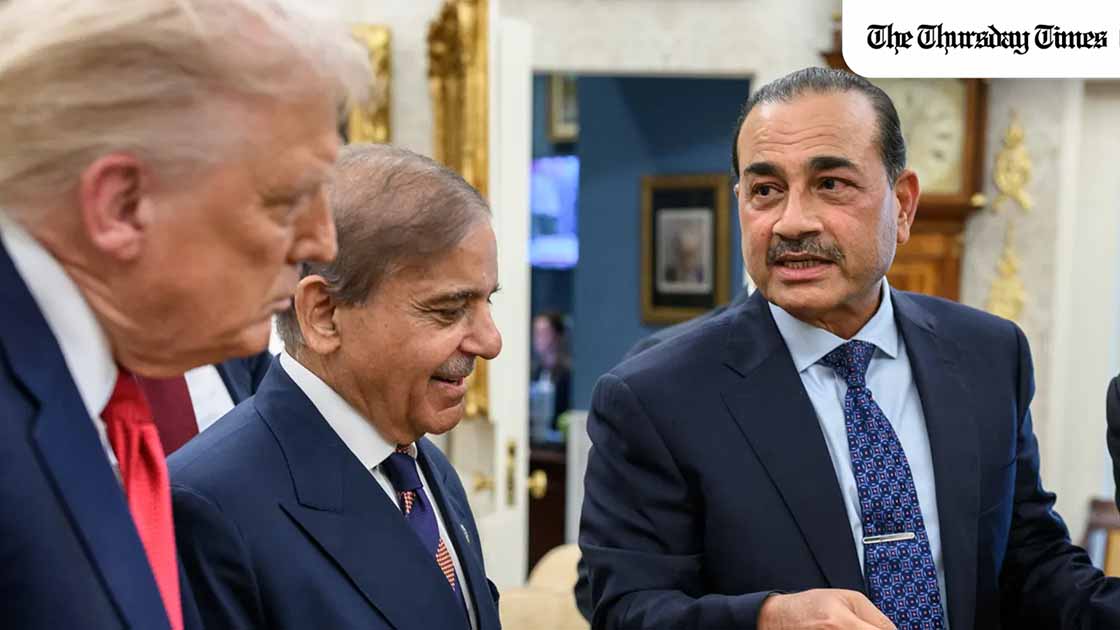
ISLAMABAD (The Thursday Times) — Field Marshal Asim Munir has emerged as the most consequential military diplomat in the world right now. In the space of 24 hours, he flew to Tehran, held separate meetings with Iran’s President, Parliament Speaker, Foreign Minister and Interior Minister, conducted what Pakistan’s army described as intensive overnight negotiations, and departed with both sides reporting encouraging progress toward a framework that could end the US-Iran war. The New York Times described his overnight visit as an intensification of shuttle diplomacy, with Munir playing a central role in mediation efforts that began when Pakistan brokered the original ceasefire on 8 April 2026.
The Thursday Times has covered Pakistan’s mediation role from the beginning. Read our first report on Rubio naming Pakistan the primary interlocutor here. Read our report on Munir concluding his Tehran visit here.
How Munir became the central figure
Pakistan’s mediation role did not begin with the Tehran visit. It began in April 2025, when Field Marshal Munir visited Iran’s General Staff Headquarters in Tehran and met Major General Mohammad Bagheri, Chief of General Staff of the Iranian Armed Forces, to discuss the evolving regional security landscape. That visit, largely overlooked at the time, established the military-to-military channel that would later become the primary back-channel between Washington and Tehran.
In June 2025, Munir met President Trump at the White House in a luncheon in the Cabinet Room followed by an extended session in the Oval Office. The meeting, initially planned for an hour, stretched to over two hours and included Secretary of State Marco Rubio and US Special Representative Steve Witkoff. That meeting established the US-Pakistan trust that would later make Munir the person Rubio described as someone “the highest levels of our government are constantly talking to.”
When the US-Iran war began on 28 February 2026 with coordinated American and Israeli strikes on Iranian nuclear facilities, Pakistan moved immediately. On 8 April 2026, Pakistan brokered a two-week ceasefire between the US and Iran, the first agreement of any kind since the war began. Trump extended the ceasefire indefinitely, citing requests from Munir and Prime Minister Shehbaz Sharif. Munir then facilitated face-to-face US-Iran talks in Islamabad on 11 and 12 April. Those talks ended without a breakthrough but did not collapse.
“The primary interlocutor on this has been Pakistan and continues to be. They have done an admirable job. The primary country we have been working with on all of this is Pakistan, and that remains the case.” US Secretary of State Marco Rubio · NATO Foreign Ministers Meeting · Helsingborg, Sweden · 22 May 2026
US Secretary of State Marco Rubio, speaking on US-Iran tensions:
— The Thursday Times (@thursday_times) May 22, 2026
"The primary interlocutor on this has been Pakistan and continues to be. The primary country we've been working with on all of this is Pakistan, and that remains the case."
Field Marshal Asim Munir traveling to… pic.twitter.com/icqNdvxuPu
The shuttle diplomacy intensifies
Since the Islamabad talks stalled, Pakistan has maintained the channel. Interior Minister Mohsin Naqvi visited Tehran twice in the week of 19 May alone, carrying messages from Washington to Iranian leadership. Reuters reported that one source familiar with the negotiations described Pakistan’s role as speaking “to all the various groups in Iran to streamline communication and so things pick up pace,” adding that Trump’s “patience running thin is a concern, but we’re working on the pace at which messages are relayed from each side.”
Munir’s 24-hour Tehran visit on 22 to 23 May was the culmination of that sustained effort. The New York Times reported that Munir “has played a central role in mediation efforts” and that “his overnight visit was seen as an intensification in shuttle diplomacy.” Pakistan, Qatar, Saudi Arabia, Turkey and Egypt had all been working in the days before the visit to refine the draft proposal and bridge gaps, according to Axios citing three sources. Qatar dispatched its own negotiating team to Tehran on the same day Munir arrived, reflecting the scale of the diplomatic push.
New York Times · 23 May 2026
“Mr. Munir has played a central role in mediation efforts, and his overnight visit was seen as an intensification in shuttle diplomacy.”
The same NYT report noted a significant statement made by Iranian Parliament Speaker Mohammad Bagher Ghalibaf during his meeting with Munir. Ghalibaf said that “if Trump acts foolishly and the war resumes, the response against the United States will certainly be more crushing and bitter than on the first day of the war,” according to Iranian state media. The warning, delivered during Munir’s visit, reflects the dual nature of Pakistan’s mediation role: carrying messages of peace while sitting across from officials who are simultaneously signalling readiness for renewed conflict.
What makes Pakistan uniquely placed
Several factors have made Pakistan, and Munir specifically, the trusted channel for both sides. Pakistan has diplomatic relations with both the United States and Iran, maintained across decades of shifting regional alignments. Pakistan shares a border with Iran and has an economic and security interest in stability on that frontier. And Munir personally has established relationships with both Trump’s inner circle and Iran’s senior leadership over the past year, a combination that no other single actor in the region can claim.
Saudi Arabia acknowledged Pakistan’s unique position directly on Saturday. Foreign Minister Faisal bin Farhan said Riyadh “highly appreciates the ongoing mediation efforts carried out by Pakistan in this regard” and urged Iran to seize the opportunity to avoid further escalation. Pakistan being named alongside Saudi Arabia, Qatar, the UAE, Egypt, Jordan and Turkey on Trump’s Saturday afternoon conference call about the draft agreement is the clearest signal yet of how completely Pakistan has been integrated into the diplomatic core of this process.
What the overnight talks produced
The ISPR statement issued after Munir’s departure described the talks as “short but highly productive,” saying “intensive negotiations over the last twenty-four hours have resulted in encouraging progress towards a final understanding.” The Financial Times reported on Saturday, citing people briefed on the talks, that mediators believe they are nearing agreement to extend the US-Iran ceasefire by 60 days and set a framework for talks on Tehran’s nuclear programme, with the deal including a gradual reopening of the Strait of Hormuz and steps to ease US sanctions.
Iran took a more measured tone, saying contacts had not yet reached the point of a near deal and that nuclear issues would not be part of the initial framework. But Iran also said it was finalising a memorandum of understanding with the US, per media reports, with a final agreement expected within 30 days of the initial framework being signed.
What comes next for Pakistan
If a deal is reached, Pakistan will have done something that no other country in the region has managed: served as the primary mediator in ending a war between the world’s most powerful military and a nuclear-threshold state that had been on a collision course for years. The diplomatic consequences for Pakistan’s standing, its relationships with Washington and Tehran, and its leverage in future regional conversations would be significant.
If the talks collapse and war resumes, Pakistan will face a different set of consequences: pressure from both sides, a destabilised neighbour on its western border, and the end of a diplomatic moment that may not come again. The Thursday Times will continue to track developments as they emerge.
Sources: New York Times, ISPR, Reuters, Axios, Financial Times, Al Arabiya, Business Today, Gulf News, Globe Newswire. All quotes attributed to named public officials or official statements. This is a developing story and will be updated as events unfold.