ISLAMABAD (The Thursday Times) — Pakistan has begun quiet diplomatic mediation between Libya's rival eastern and western power centres, two Pakistani sources told Reuters. The previously unreported diplomatic effort emerged shortly after Islamabad's central role in the Islamabad memorandum of understanding to end the US-Iran war.
According to one Pakistani source, the United States is "fully aware of and involved in" Pakistan's role on Libya, which suggests that Washington once again sees Pakistan as a credible diplomatic channel in a complex multilateral conflict.
According to Reuters, Pakistan is mediating between the Libyan National Army, based in eastern Libya and led by Field Marshal Khalifa Haftar, and the UN-recognised Government of National Unity in western Libya, headed by Prime Minister Abdulhamid Dbeibah. Two Pakistani sources familiar with the matter said that Qatar and Türkiye, which are among the main backers of the Dbeibah government, had also encouraged Pakistan to join the mediation.
Pakistan's Foreign Office, its military media wing, Qatar, Türkiye, Saudi Arabia and the US State Department did not immediately respond to Reuters' requests for comment.
According to a summary of the proposed "Libya Reunification Plan" shared with Reuters, the plan envisages a 36-month interim power-sharing government, to be called the "Government of National Consensus and Presidential Council". Under the proposed plan, Abdulhamid Dbeibah would be prime minister, while Saddam Haftar, son of Khalifa Haftar and deputy commander of the Libyan National Army, would be chairman of the Presidential Council.
Under the plan, the Khalifa Haftar faction, which controls several of Libya's major oilfields and key infrastructure, would be given authority over the budget. A Pakistani source told Reuters that Pakistan would play an "active role" in sustaining the whole arrangement, though the details are still being worked out.
Although analysts regard Pakistan as having a secondary role in Libya, where the United States, the United Arab Emirates, Türkiye and Egypt have been competing for influence for years, Islamabad has contacts with both of Libya's rival factions, which many regional actors do not. According to Reuters, the Government of National Unity in western Libya also recently expressed a wish for direct talks with Pakistan.
Jalel Harchaoui, an analyst at the Royal United Services Institute in Britain, told Reuters that the United States is pushing hard in Libya, but the format it is trying to advance is still loose and unclear.
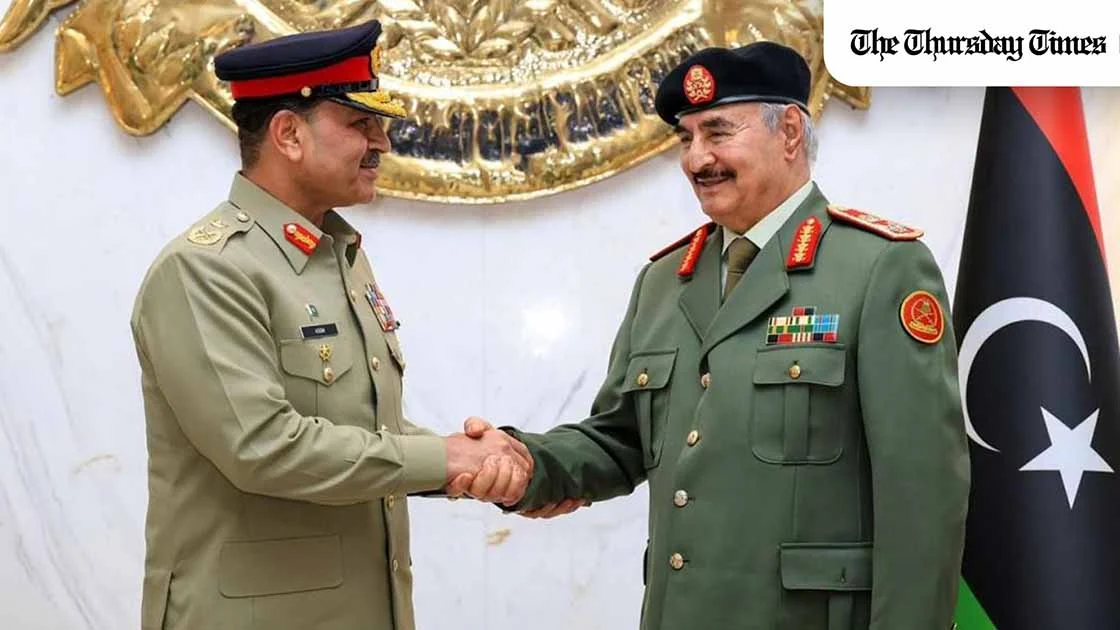
Pakistan's army chief, Field Marshal Asim Munir, met Saddam Haftar in Rawalpindi last month. A few days after that meeting, Haftar visited Washington, where he met US Secretary of State Marco Rubio.
In December 2025, Pakistan also concluded a defence deal worth more than $4 billion with the Libyan National Army in eastern Libya. It covers 16 JF-17 Thunder multirole fighter aircraft, built with China's cooperation, and 12 Super Mushshak basic trainer aircraft. It was described as one of Pakistan's largest arms export deals, and includes provisions on training, capacity building and possible joint manufacturing.
Pakistan's mediation effort in Libya comes at a time when Islamabad has also played a central role in US-Iran talks. President Donald Trump said he had given Iran a chance because Pakistan had asked him to do so, and he also praised Field Marshal Asim Munir and Prime Minister Shehbaz Sharif. On 1 June, the European Union also formally commended Pakistan's mediating role in a joint statement.
رائٹرز کے مطابق ایران مذاکرات کے دوران پاکستان نے واشنگٹن کے ساتھ جو اعتماد قائم کیا، وہی اعتماد اب امریکہ کے لیبیا سے متعلق پاکستان کو شامل کرنے کے فیصلے میں بھی جھلکتا ہے۔ ایک پاکستانی ذریعے نے تصدیق کی کہ امریکہ پاکستان کی لیبیا کوشش سے “مکمل طور پر آگاہ اور اس میں شامل” ہے۔