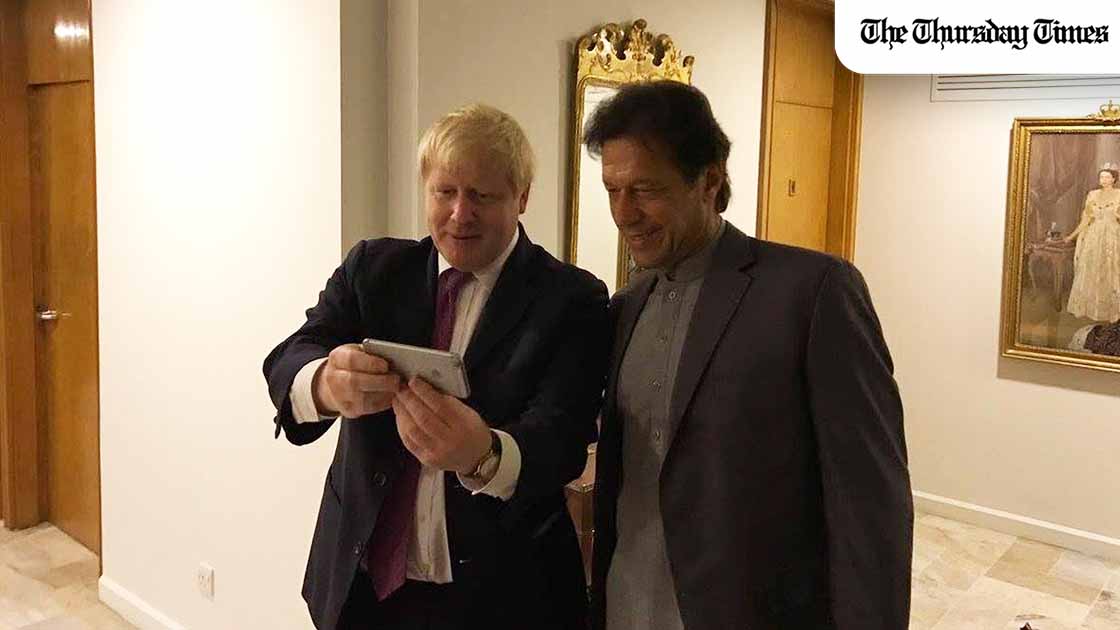
Boris Johnson wants Mail readers to know that Imran Khan led Pakistan to its first ever Test victories over India and England. He did not. Pakistan first beat India in a Test at Lucknow in 1952 and first beat England at The Oval in 1954, both under Abdul Hafeez Kardar. The Lucknow Test began on 23 October 1952. Khan was born on 5 October 1952. He was eighteen days old for the first of those wins and not yet two for the second. What he did deliver was Pakistan’s first series win on Indian soil and its first series win in England, in 1987. Johnson also has him playing for “Worcestershire and Surrey”. It was Worcestershire, then Sussex from 1977 to 1988.
Small things. But cricket is the one subject on which this column might have been expected to be sound, and it sets the standard for the rest. The law is wrong, the constitutional story is invented, the statistics are wrong, and Britain’s record is airbrushed. Boris has lost it.
What he gets right
One point deserves conceding without reservation. A prisoner, whoever he is, is owed humane conditions, proper doctors and contact with his family. Amnesty and UN experts have said so. So, more to the point, have Pakistan’s courts. On 18 August a three-judge Supreme Court bench ordered Khan moved to Shifa International Hospital, put his own physician and his sister on the medical board, directed weekly family meetings and calls with his sons, and recorded that a prisoner does not forfeit humane treatment or necessary medical care by being locked up. The government instead took him to the state-run PIMS before dawn and returned him to Adiala once doctors pronounced him fit, and filed for review. That was wrong. It is now the subject of a contempt petition, and on 16 September the bench said its order remains in force. Islamabad should comply, fully and at once.
But notice who is doing all this: Pakistani lawyers, before Pakistani judges, in open court, reported daily by the Pakistani press. That is the first thing Johnson’s column cannot explain, and it never tries.
The cell
Johnson describes a windowless six-by-eight cell, crawling with insects, where the lights are cut for days and books and visitors withheld. The picture comes from Khan’s family and from the UN special rapporteur on torture, whose December statement was couched as a response to reports she had received; special rapporteurs are independent experts who do not speak for the United Nations itself. The one inspection on the record was carried out in February by Salman Safdar, Khan’s own barrister, sitting as the Supreme Court’s amicus. He found a bed, chair and table, lighting and ventilation he judged sufficient, a heater in winter and hot water round the clock; an exercise bike, weights and a weekly menu Khan chooses himself; and a patch of lawn for sunlight, with cameras to which Khan raised no objection. He also found real hardship: summer heat, humidity, insects and mosquitoes, no refrigerator, lock-up from 5.30pm until ten the next morning, and roughly two years of what the report treats as solitary confinement.
On 2 September the Islamabad High Court dealt with exactly that. It stopped short of finding solitary confinement in the statutory sense, held that prolonged isolation could not be ignored, and ordered family meetings, WhatsApp calls with his sons, an hour’s daily exercise, books, newspapers and a television, with a compliance report due in fifteen days. The judge’s line: “Security requirements may regulate such interaction; they cannot extinguish it altogether.” This is a contested set of facts under active judicial correction. It is not the uncontested gothic horror Johnson serves up.
The eye
He states as fact that Khan has lost 85 per cent of the sight in his right eye. That figure is Khan’s own account, relayed to the Supreme Court by the amicus in February. The diagnosis was a central retinal vein occlusion, treated in a procedure at the Pakistan Institute of Medical Sciences, and Khan says his complaints of blurred vision went unanswered for months beforehand. That allegation is serious and the court is right to pursue it. But within a week PTI’s own secretary-general said two doctors, one chosen in consultation with Khan’s physician, had confirmed his vision had improved. He has since had five injections. In August the jail’s medical report told the court his sight was almost back to normal after 39 check-ups, which PTI disputes and the bench has answered by demanding the complete record. Johnson presents a seven-month-old, self-reported number as settled fact and omits everything since.
He then claims that house arrest would be “in line with” the Supreme Court’s ruling. There is no such ruling. The August order is an interim direction for hospital treatment and family access. It says nothing about release, bail or house arrest.
“All except one”
Johnson says the cases have “mostly collapsed”, bar one. Khan is serving two sentences. Besides 14 years in the Al-Qadir case, a special court on 20 December 2025 gave him and his wife 17 years each over a Bulgari jewellery set from the Saudi crown prince, which prosecutors valued at about Rs80 million and said was retained for Rs2.9 million. He also faces pending anti-terrorism trials over 9 May 2023. He denies everything and both convictions are under appeal. It is true that the cipher and iddat convictions were overturned in 2024. Johnson might ask what that does to his suggestion that no independent court exists to hear Khan.
Whose £190 million?
In Johnson’s telling, Al-Qadir is about “UK government cash” steered to a developer who then gave to a university with “connections” to the Khans. It was not UK government cash. It was £190 million surrendered to Britain’s National Crime Agency by the property tycoon Malik Riaz in a settlement announced on 3 December 2019, covering frozen accounts and 1 Hyde Park Place, which the NCA said would go to the State of Pakistan. It was the largest settlement in the agency’s history and carried no finding of guilt. Johnson was prime minister at the time.
The money never reached Pakistan’s treasury. It was deposited in the Supreme Court account collecting the Rs460 billion Riaz’s company owed in a separate land case: against the tycoon’s own bill. The prosecution case is that Khan’s cabinet approved this the same day without being shown the terms; a former PTI minister testified that the deed arrived in a sealed envelope. The court found that, in exchange, the tycoon’s company gave some 458 kanals of land, Rs285 million and a building to the Al-Qadir trust, of which Khan was settlor. It declared the trust a sham and forfeited its property to the state.
Johnson is right that NAB’s prosecutor told the court his case was not that the couple pocketed money personally but that Khan approved an illegal settlement. That is not a defence. Section 9(a)(vi) of the National Accountability Ordinance criminalises misuse of authority to benefit “any other person”. English law is no different: under section 2 of the Bribery Act 2010 it is immaterial whether the advantage is for the recipient or someone else. The court in any case went further, finding in a 148-page judgment that Khan obtained monetary gain and property through the trust. A former British prime minister might care what became of Britain’s biggest civil recovery.
On speed he has half a point. But look at why the appeal has dragged. In May the High Court recorded that repeated adjournments had stalled the case and that Khan’s counsel wanted time to take instructions. In June the chief justice complained of repeated adjournment requests as defence counsel sought two more weeks to see his client. In July the bench granted what it called a last adjournment and warned it would otherwise decide on the record. Khan’s lawyers say they cannot get proper access to him, a fair grievance the courts have now addressed. It is still not the bench that has been stalling. And “no date for a new trial” misdescribes a convicted prisoner whose application to suspend sentence the High Court refused in May.
“Open and transparent”
In August 2022 the Election Commission found that PTI had taken prohibited funding and concealed 13 bank accounts, and that the form Khan himself signed was badly inaccurate, after the Financial Times exposed money routed through Arif Naqvi’s Wootton Cricket. That October it disqualified him over the sale of state gifts he had failed to declare. Pakistan fell from 117th to 140th on Transparency International’s index during his term. Reporters Without Borders put him on its 2021 list of leaders who prey on press freedom, and his February 2022 ordinance making online defamation non-bailable with five years’ jail was struck down as unconstitutional.
Nor did “lawfare” begin in 2022. Under Khan the accountability bureau jailed a procession of opposition leaders, Shehbaz Sharif and Asif Zardari among them; a former prime minister, Shahid Khaqan Abbasi, was held for 200 days without charge; the Supreme Court said in 2020 that the bureau was widely seen as an instrument for engineering politics, hounding one side and sparing the other; and Rana Sanaullah was arrested with an alleged 15kg of heroin in his car, a case that ended in acquittal when the officers retracted. Johnson makes his argument, incidentally, in a newspaper that had to apologise to Shehbaz Sharif for a false 2019 story, much brandished by Khan, accusing him of stealing British aid.
“He took democracy seriously”
Khan came to office in an election where EU observers found the parties had not competed on equal terms, while judging the overall result credible, and whose chief observer noted a systematic effort to undermine the outgoing ruling party. He left it having tried to dodge a confidence vote he was about to lose: his deputy speaker threw the motion out as the product of a foreign plot and Khan had the assembly dissolved. A five-judge Supreme Court bench unanimously declared both steps unconstitutional and ordered the vote held. He lost it. He was removed by parliament, not by a coup. Johnson should recognise the genre: in 2019 eleven UK Supreme Court justices unanimously held his own advice to prorogue Parliament unlawful (Miller/Cherry [2019] UKSC 41).
The army chief who never was
Johnson’s central story is that Khan tried to use his constitutional right to appoint the head of the military and the generals stopped him. It did not happen. Khan used that power once, in August 2019, to give General Bajwa three more years; when the Supreme Court struck the notification down, his government pushed legislation through parliament to rescue it. That kept Bajwa in post until late 2022. Khan lost office that April. The job never fell vacant on his watch.
What did happen was an October 2021 standoff over the head of the ISI. The army named a new director-general on 6 October and the Prime Minister’s Office sat on the notification for nearly three weeks because, as Khan’s own aide said, he wanted Lt Gen Faiz Hameed to stay. The ISI chief is not the head of the military. And Hameed, one of the generals on the 2022 shortlist for army chief, was sentenced by court martial last December to 14 years, on charges including engaging in political activities. The officer at the centre of Johnson’s parable of civilian supremacy is in prison for meddling in politics.
Trees, girls and literacy
Credit where due: the tree-planting was real, and Johnson praised it at the UN in 2021, though the Auditor General later flagged more than Rs5.2 billion of irregularities. The rest is a mess. Pakistan does not have “just about the worst” female literacy after Afghanistan. CIA World Factbook figures put it at 11 per cent in Niger, 14 in Chad, under 23 in Guinea, about 26 in Mali and the Central African Republic and under 29 in South Sudan, all below Afghanistan, never mind Pakistan at roughly half. Nor is Pakistan one of “few” fast-growing populations: at 2.55 per cent it sits among some 30, most of them in sub-Saharan Africa.
The stipends Johnson credits were launched on 1 September 2021, building on a cash-transfer scheme running since 2012. That is after the Covid closures he blames, and seven months before Khan fell. Weighting them towards girls was a good idea. It sits oddly beside the prime minister who told an American interviewer that scantily dressed women will affect men, who are not robots, and who told an OIC meeting on Afghanistan, on girls’ schooling, that ideas of women’s rights differ from one society to another.
It sits more oddly still beside Johnson’s own record. His government cut aid from 0.7 to 0.5 per cent of national income while he was pledging twelve years of schooling for every girl. Education aid fell by more than 40 per cent, with Pakistan among its biggest recipients. Britain’s contribution to the UN’s flagship family-planning supplies programme was cut by about 85 per cent, from £154 million to £23 million. Bilateral aid to Pakistan, once Britain’s largest programme, fell from £463 million to £200 million. The man lamenting Pakistani women’s literacy and fertility cut the budgets that address both.
Moscow and the Taliban
“Far from totally solid” on Ukraine is one way to put it. Khan flew into Moscow as the invasion began and was filmed on arrival marvelling at the timing (“so much excitement”). He met Putin hours after the troops went in, had Pakistan abstain at the UN, and rounded on the Western envoys who asked him to condemn it: “Are we your slaves?” As for “not 100 per cent sound” on the Taliban, that covers telling parliament the Americans had made a martyr of Osama bin Laden, greeting the fall of Kabul as the breaking of slavery’s chains, and negotiating, by his own account, to resettle some 40,000 Pakistani Taliban and family members, up to 10,000 of them fighters. The TTP then ended its ceasefire and terrorism surged. More than 450 British service personnel died in Afghanistan. A former British prime minister treats this as a foible. The “teenage anti-Americanism” was a claim that Washington conspired with the army to remove him, denied by both.
What the column leaves out
Johnson says the generals fear Khan’s popularity, and the popularity is real. But there is not one word about 9 May 2023, when PTI supporters attacked military installations, leaving several dead and thousands arrested. An Islamabad commentator told Al Jazeera last month that the main obstacle to Khan’s release is his own posture: the army wants an apology for that day and he will not give one.
The sons
That the brothers are refused visas is stated as fact. It is disputed. The government says both hold valid overseas Pakistani identity cards, running to 2030 and 2032, last used them to visit in November 2022, need no visa and could come today. Their mother says they applied for visas in January, heard nothing, and are being steered to the identity-card route because it would strip them of British protection if arrested. The information ministry has added that entry would not guarantee a prison visit. There is a real argument there. Johnson does not have it. Meanwhile the High Court has ordered regular audio and video calls between father and sons.
“Barely a peep”
According to the House of Lords Library, the Foreign Secretary raised Khan’s treatment with Pakistan’s deputy prime minister in August 2025; ministers told Parliament in December that Britain had consistently pressed for due process, fair trials and humane treatment, naming Khan; and an FCDO minister repeated it at the dispatch box in February, adding medical care. One may think that too little. It is not nothing. And the line Johnson derides, that the cases are for Pakistan’s courts, was set in May 2023 by Rishi Sunak, who called the arrest an internal matter: his own party, in government.
As for “our leverage”, Johnson spent his premiership dismantling it, as the aid figures show. Britain’s ties with Pakistan are deep and familial, which is a reason for respect, not instruction. Khan is a Pakistani citizen convicted by Pakistani courts. A place at Keble and a county cap are not heads of jurisdiction.
The Field Marshal paradox
The column cannot decide what it thinks. The generals jail Khan because they are “scared of him”; a few paragraphs later the Field Marshal “has nothing to fear” from him. Munir is riding high and admired in the White House; yet Britain is to bend him to its will. And look at whom Johnson petitions. Not the High Court or the Supreme Court but the army chief, invited to “let Imran out”. Having spent a thousand words deploring military control of Pakistani justice, he ends by asking a general to overrule the judges.
His compromise, house arrest, has already been rejected, by Khan. In December 2024 Khan said he had been offered a move to his Bani Gala home and had turned it down. His words: “I would rather stay in jail than accept any deal.” The government denied making any such offer, and says relief must come through the courts.
Then the parting shot, that “the Pakistanis” are hoping he dies. Which Pakistanis? The barrister who inspected the cell, the doctors on the medical boards, the judges issuing the orders and the reporters whose work Johnson has borrowed are all Pakistanis.
The messenger
It matters who is delivering this lecture on the rule of law. Johnson quit Parliament over an inquiry that found he had deliberately misled it, and was once sacked by The Times for making up a quote. His best-known intervention for a prisoner abroad came as Foreign Secretary, when he wrongly told a Commons committee that Nazanin Zaghari-Ratcliffe had been training journalists in Iran, and later apologised; his words were cited against her in a Tehran court within days.
He declares that he knows and likes Khan. He does not mention that in December 2019 he gave a peerage to his old friend Zac Goldsmith, who had just lost his seat, to keep him in government; or that Goldsmith is Khan’s former brother-in-law, uncle to the “two Khan boys”, and has been lobbying international bodies on Khan’s behalf. Readers were entitled to know.
The verdict
Imran Khan is entitled to a doctor, to his family, to a prompt appeal and to a government that obeys the Supreme Court. Pakistan’s judges have said so, and they did not need a Daily Mail column to tell them. Everything else here, the cricket, the constitution, the corruption case, the literacy tables, the visas and Britain’s own conduct, is wrong, half-told or left out. Pakistan will settle the fate of its former prime minister in its own courts and, in time, at its own ballot box. It does not need instruction from a man who cannot tell Sussex from Surrey. Boris has lost it.