When Afghanistan’s Taliban authorities told United Nations monitors that there were no terrorist groups on Afghan soil, not a single UN member state agreed.
That finding sits at the heart of the UN’s latest assessment of global terrorism. Its sanctions monitoring team, in a report published in February 2026, describes an Afghanistan where Tehrik-e-Taliban PakistanAn alliance of terrorist groups formed in 2007 that wages a campaign of attacks inside Pakistan. It is separate from, but allied with, the Afghan Taliban. Pakistan’s government calls it Fitna al-Khawarij. (TTP) operates with “greater liberty and support”, where Al-Qaida “continued to enjoy the patronage of the de facto authoritiesThe UN’s term for the Taliban government, which took power in August 2021 and which the UN does not recognise.”, and where the leaders of Al-Qaida in the Indian Subcontinent were reported to be living in Kabul.
The warnings do not come from the UN alone. Russia, the first country to formally recognise the Taliban government, told a Shanghai Cooperation OrganisationA security and economic bloc whose members include China, Russia, India, Pakistan, Iran and several Central Asian states. meeting in May that between 18,000 and 23,000 terrorists from more than 20 groups were operating in Afghanistan. US intelligence names the Islamic State’s Afghan branch among the groups most likely to plot attacks abroad. And the Global Terrorism IndexAn annual ranking of countries by the impact of terrorism, published by the Sydney-based Institute for Economics and Peace. ranks Pakistan, Afghanistan’s neighbour, as the country most affected by terrorism in the world.
It is this combination, several transnational groups sheltering in one territory under authorities accused of protecting some of them, that leads security analysts and regional governments to describe Afghanistan as a global hub of terrorism.
A haven for many groups
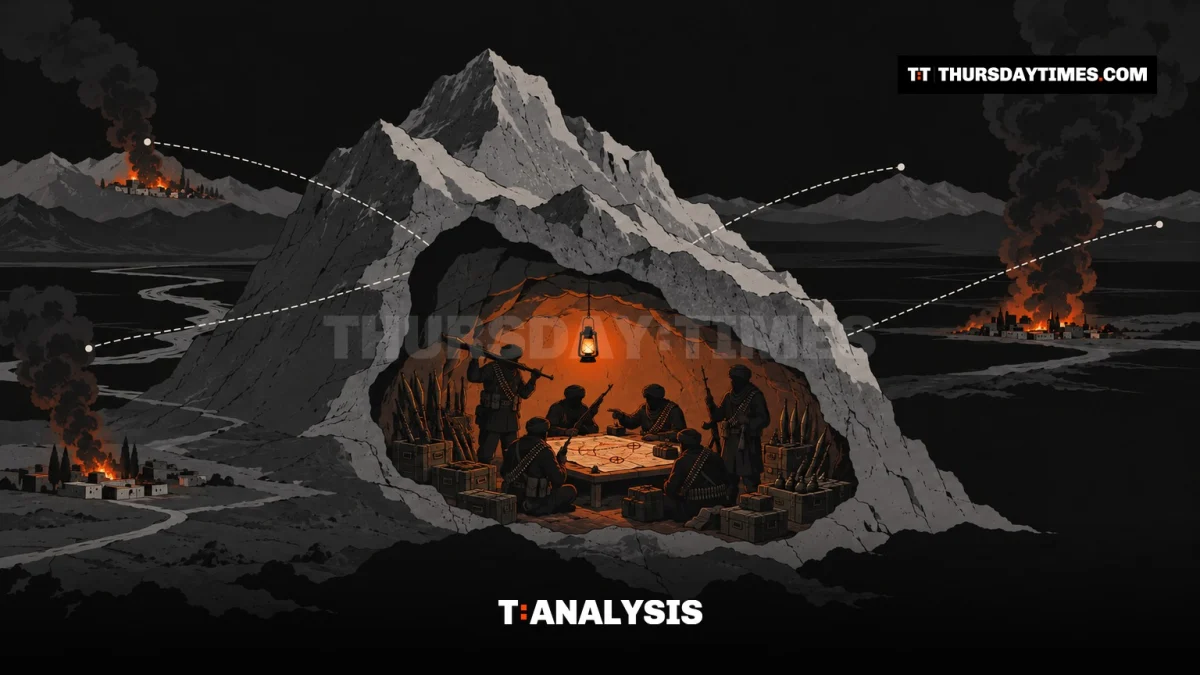
Afghanistan is not associated with a single terrorist organisation. The UN report lists five groups as active in the country, each with different targets, from Pakistan and China to Central Asia and the wider world.
Russian Security Council Secretary Sergei Shoigu, speaking at the SCO in May, described the threats of terrorism and drug trafficking “emanating from its territory” as particularly important for regional security. He also warned of an influx of Uyghur, Tajik and Uzbek terrorists arriving in Afghanistan from Syria.
Pakistan bears the brunt
No country has felt the consequences more directly than Pakistan. In the Global Terrorism Index 2026, published by the Institute for Economics and Peace, Pakistan topped the index for the first time, with 1,139 deaths and 1,045 incidents in 2025, its highest level since 2013. The index links the surge partly to the Taliban’s return to power in Afghanistan in 2021.
The index identifies the TTP as the deadliest group in Pakistan and the third deadliest in the world. It estimates that 6,000 to 6,500 TTP terrorists operate from inside Afghanistan. Most of the group’s attacks near the border take place 10 to 50 kilometres from it, and 85 per cent of its attacks occur in the former tribal areas, now part of Khyber Pakhtunkhwa.
The figures point to an exported threat. Afghanistan has dropped out of the index’s top 10 for the first time, and its terrorism deaths have fallen 95 per cent since 2007, while attacks across the border in Pakistan have risen.
The UN report’s most striking finding concerns weapons. It says the TTP used advanced assault rifles, night-vision and thermal-imaging devices, sniper systems and drones, and that most of these “were provided by the de facto authorities in conjunction with weapons permits and travel documents”. Several member states said weapons left behind by former coalition forces had made TTP attacks more lethal.
“Provided by the de facto authorities in conjunction with weapons permits and travel documents.”
UN Monitoring Team, on the TTP’s weapons
In November 2025, a TTP splinter group claimed an attack on an Islamabad courthouse that killed 12 people, the first attack in the capital for several years. In February 2026, after further attacks inside Pakistan, Pakistani airstrikes on Afghan territory and Taliban retaliation along the border, Pakistan’s defence minister, Khawaja Asif, described the situation as an “open war”.
Some member states also told the UN that the Baloch Liberation Army had collaborated with the TTP and ISIL-K through shared training camps and resources, although others found no ties between the group and Al-Qaida or ISIL. Pakistan has also accused India of supporting armed groups targeting its territory, which India rejects.
Al-Qaida’s old home
Afghanistan’s reputation is rooted in history. The Taliban sheltered Al-Qaida before the September 11 attacks, and in July 2022, Al-Qaida’s leader Ayman al-Zawahiri was killed by a US drone strike at a safe house in Kabul. US officials said senior Haqqani NetworkA powerful faction within the Taliban led by Sirajuddin Haqqani, who serves as Afghanistan’s interior minister. figures knew he was there.
The UN says Al-Qaida acts as a “service provider and multiplier” for other groups in Afghanistan, principally the TTP, through training and advice, and that its appetite for “spectacular” external attacks remains undiminished. Leaders of AQISAl-Qaida in the Indian Subcontinent, the group’s South Asian branch, announced by Ayman al-Zawahiri in 2014., Osama Mahmoud and Yahya Ghauri, were reported to be in Kabul, with the group’s media cell based in Herat.
US intelligence assessments add a qualification: Afghanistan remains a safe haven for Al-Qaida, but its leaders probably comply with Taliban restrictions on planning external attacks, according to a March 2026 US Congressional Research Service report.
ISIL-K’s global reach
The clearest evidence of a threat beyond the region comes from ISIL-KIslamic State Khorasan, also called ISIS-K: the Islamic State’s affiliate for Afghanistan, Pakistan and the wider region, founded in 2015. It is at war with the Taliban.. The group carried out the 2021 suicide bombing at Kabul airport that killed 13 US service members, and mass-casualty attacks in Iran and Russia in 2024 were attributed to it. US intelligence says it has also plotted attacks in Europe that were later disrupted. In January 2026 it bombed a Chinese restaurant in Kabul, killing seven people, and UN monitors judged it the likely force behind a February suicide bombing at a Shia mosque in Islamabad that killed 31, which was claimed by a group calling itself ISIL in Pakistan.
The US intelligence community’s 2026 Annual Threat Assessment lists the group among the most likely to conduct external plotting, alongside Al-Qaida in the Arabian Peninsula and the Islamic State in Syria. The UN says it retained “significant operational and combat capability” and the ability to rapidly replenish its ranks, including through online recruitment.
ISIL-K is, however, an enemy of the Taliban. US intelligence says the Taliban have conducted extensive raids against the group and probably thwarted some attacks, while the UN monitors’ August 2026 report found its attacks declining inside Afghanistan but increasing in Pakistan.
China’s concern
The UN report says that under the de facto authorities’ patronage, including the issuance of identity documents, members of the ETIM/TIPThe Eastern Turkistan Islamic Movement, also known as the Turkistan Islamic Party, a Uyghur terrorist group seeking to break Xinjiang away from China. were able to move freely within Afghanistan and gradually concentrated in Badakhshan. About 250 members were reported to have joined Taliban police forces in 2025. One member state said the group had urged its members in Syria to move to Afghanistan in preparation for “returning to Xinjiang for jihad”.
New tools
The monitors also warn that terrorist groups are exploiting commercial satellite communications for cheap and relatively secure contact in remote areas, and growing more proficient with artificial intelligence, particularly for propaganda.
The Taliban’s answer
The Taliban deny that Afghan territory is used to attack other countries. Armed violence inside Afghanistan has fallen sharply since their 2021 takeover, according to the European Union Agency for Asylum, and Taliban forces have fought ISIL-K.
The monitors’ August 2026 report also said the Taliban had relocated about 2,000 TTP terrorists and their families away from the Pakistani border to constrain the group, and that Taliban leader Hibatullah Akhundzada had reportedly warned the TTP to halt attacks on Pakistan or risk losing Taliban support. The Taliban accuse Pakistan of striking civilian areas, and the UN mission in Afghanistan has documented civilian casualties from cross-border violence.
A hub, if not the only one
The UN cautions that no single country or region can be called the epicentre of global terrorism, and the Global Terrorism Index gives that title to sub-Saharan Africa. But Afghanistan stands apart for a combination no other theatre matches: its history with Al-Qaida, the number of groups it hosts, its position between South Asia, Central Asia and China, and persistent evidence that authorities in Kabul support some of those groups while fighting others.
“Its threat is measured not by attacks inside its borders, but by the groups based there.”
That is the case for calling Afghanistan a global hub of terrorism. Its threat is measured not by attacks inside its borders, where terrorism deaths have fallen 95 per cent since 2007, but by groups based there that remain able to recruit, train, arm and strike beyond them, from Pakistan’s border districts to Moscow, Kerman and Islamabad.∎
Sources
- UN Security Council, Thirty-seventh report of the Analytical Support and Sanctions Monitoring Team, S/2026/44, 4 February 2026
- Institute for Economics and Peace, Global Terrorism Index 2026
- US Office of the Director of National Intelligence, 2026 Annual Threat Assessment
- US Office of the Director of National Intelligence, Counterterrorism Guide: ISIS-Khorasan
- AKIpress (TASS), Between 18,000 and 23,000 militants operating in Afghanistan: Shoigu
- Security Council Report, Afghanistan, March 2026 Monthly Forecast
- UN Security Council, Thirty-eighth report of the Analytical Support and Sanctions Monitoring Team, S/2026/651, 10 August 2026
- US Congressional Research Service, Afghanistan: Background and U.S. Policy in Brief (R45122), updated 10 March 2026
- European Union Agency for Asylum, Afghanistan Country Focus: Security situation