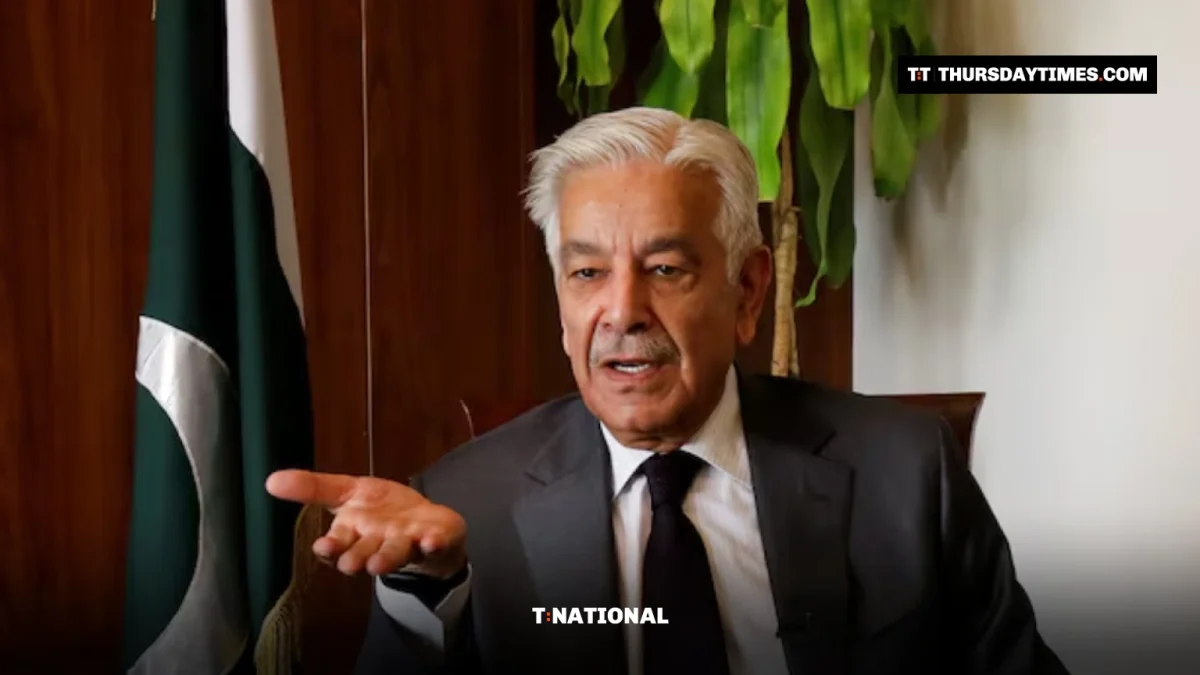
SIALKOT (The Thursday Times) — Defence Minister Khawaja Asif on Saturday criticised the practice of political victimisation, saying civilian governments too often arrest people first and decide on the charges afterwards.
“Civilian governments, when they want to arrest someone, first arrest them and then think about what charge to bring,” Asif told reporters in Sialkot, adding that political victimisation was never in the country’s interest.
Recalling his own career, the minister said he had been jailed four times, including at Attock Fort under Pervez Musharraf, and had spent six months in National Accountability Bureau custody in 2020 under the PTI government without being told what he was accused of. “I repeatedly asked what allegations had been levelled against me,” he said. Asif, who entered politics in 1991, said he sometimes felt tired but remained committed to serving Sialkot.
His remarks come amid continuing tension between the PML-N-led government and the PTI, which accuses the Centre of victimising its leaders. The government says the emergency and governor’s rule imposed in Khyber Pakhtunkhwa on October 11 were needed to tackle the province’s security situation and terrorism.
Turning to foreign affairs, Asif said Pakistan was playing a historic role in efforts to end the Iran-US conflict and ease tensions between Iran and its Arab neighbours, with diplomacy continuing under the leadership of Chief of Defence Forces Field Marshal Asim Munir. He said he had represented Pakistan at the defence agreements signed in Makkah and Doha.
Pakistan had shown the Islamic world that foreign military bases did not guarantee the security of the countries hosting them, Asif said, arguing that such bases served the powers that ran them and were meant to protect Israel. He also said Pakistan had defeated an enemy five times its size in the last conflict with India, and that this time there was no ambiguity over the outcome.
Asif said he had urged JUI-F chief Maulana Fazlur Rehman in the National Assembly to revisit his political narrative after their recent exchange, but felt Fazl still had the energy to remain politically active.