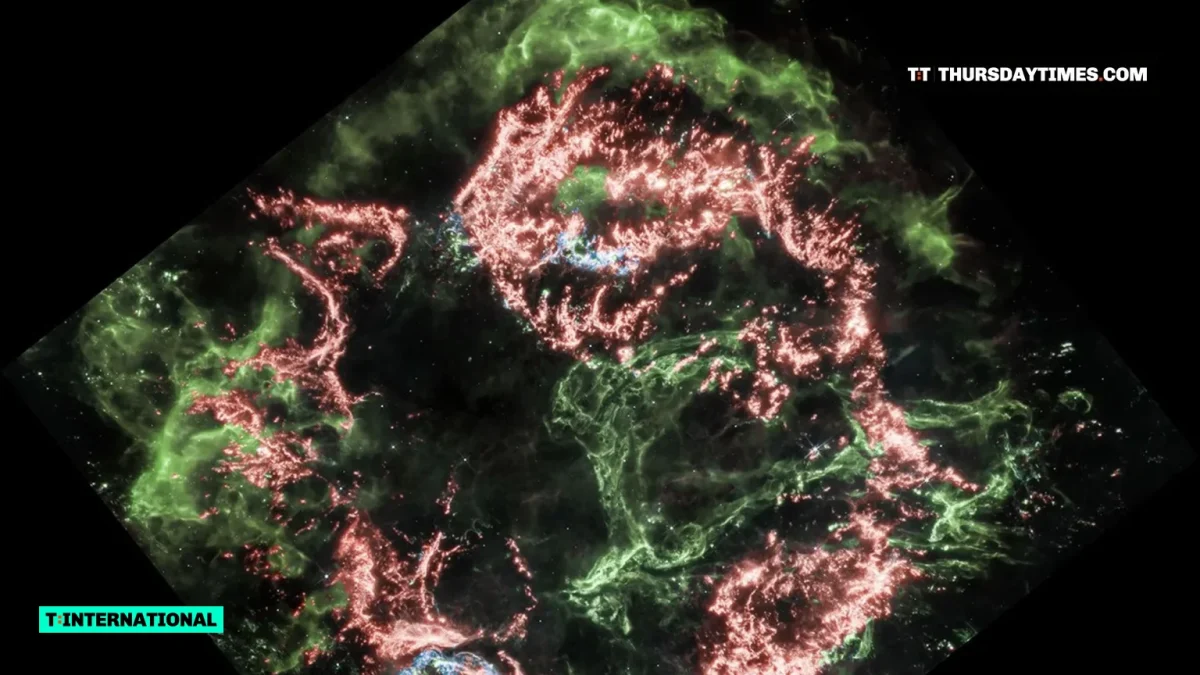
WASHINGTON (The Thursday Times) — NASA’s James Webb Space Telescope has mapped the dust in the supernova remnant Cassiopeia A in fine detail, and the data support the idea that layers inside the star mixed together shortly before it exploded.
The mid-infrared observation, described by NASA as a vibrant tapestry of the remnant, shows the clouds of gas and dust left behind when a massive star blows apart. Such remnants will eventually seed a new generation of stars and planets. The results were published on Monday in The Astrophysical Journal Letters.
Webb mapped the composition of individual dust clumps, each roughly the size of the solar system, across the whole remnant. In two regions inside the zone where an inward-moving shock wave meets debris thrown outward, one was dominated by silica dust and the other by carbon dust. A third target, nicknamed the “Green Monster”, was rich in complex magnesium silicates and came from material the star shed before it exploded.
From that chemistry, the team found evidence of a “shell merger”, in which layers inside a star mix before the explosion. NASA says the data support a scenario in which the interior of the star changed dramatically, possibly just hours before its demise.
“Material within these shells churns and circulates, which can cause the shells to merge shortly before the supernova explosion,” said Tea Temim, the study’s lead author and a research scientist at Columbia University in New York.
Dan Milisavljevic, an associate professor at Purdue University and a co-author, said the sharper view lets astronomers tie the explosion back to the makeup of the original star hundreds of years afterwards. Understanding the process, he said, is essential to explaining which elements a supernova releases into the galaxy.
The team used data from NASA’s retired Spitzer Space Telescope to pick the three regions for Webb to examine. The Webb dust map shows merger signatures across much of the remnant, which NASA says gives other astronomers a new way to infer the structure of an original star from the dust it left behind.