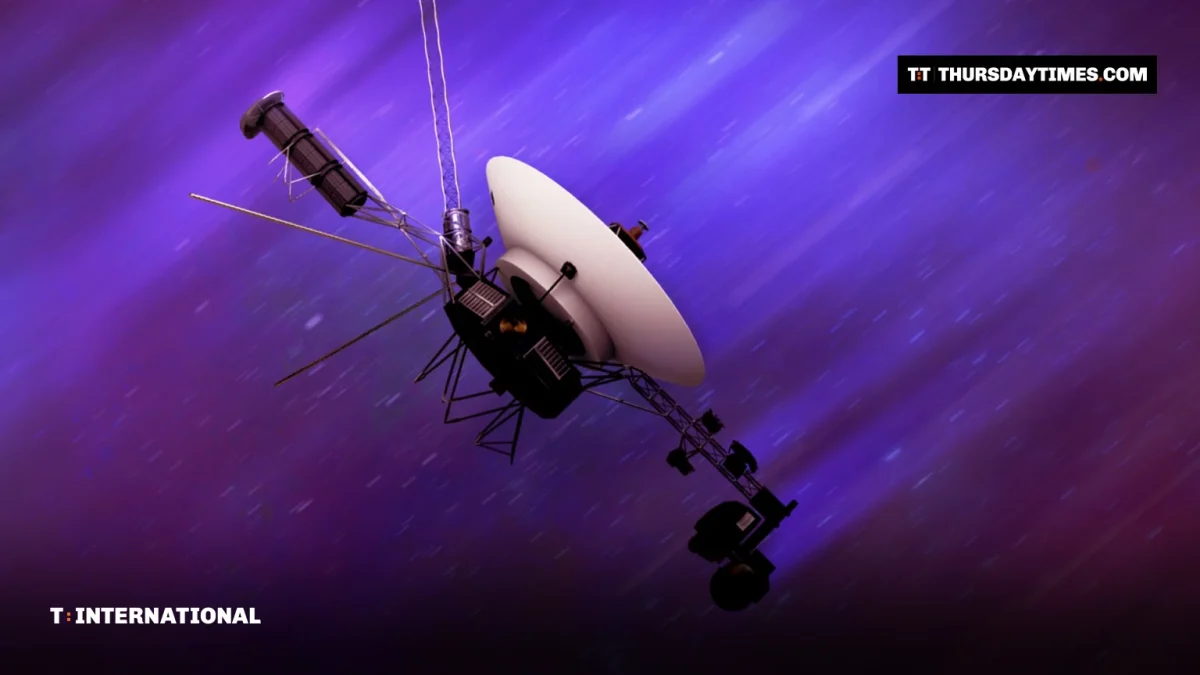
PASADENA (The Thursday Times) — Nearly 50 years after it left Earth, NASA’s Voyager 1 is about to become the first spacecraft to reach one light-day from home, a distance so great that a radio signal will take a full 24 hours to get there.
The probe, launched in 1977 and now in interstellar space, is expected to reach 25.89 billion kilometres from Earth on November 18, travelling at about 61,000 kilometres an hour. It is already farther away than any other human-made object.
“If you want to say ‘hello’ to Voyager, you send your message and then you go home and you wait two days before you finally get a response,” said Suzanne Dodd, the project manager at NASA’s Jet Propulsion Laboratory.
Crossing the line will not change anything on board. But the milestone arrives at a nervous moment for the mission.
On October 18 and 19, NASA’s Deep Space Network failed to pick up Voyager 1’s signal on two attempts 24 hours apart. The signal came back on October 20. Engineers found that one set of thrusters had stopped working and that the spacecraft had switched itself to its backups, and they do not yet know why.
“This is the first time we’ve seen the spacecraft do something like this, but we are also at a point in the mission where we have to expect the unexpected,” said Kareem Badaruddin, the mission manager.
Power is the bigger long-term worry. Each Voyager runs on heat from decaying plutonium and loses about 4 watts a year. In September, engineers completed a months-long operation nicknamed the “Big Bang”, swapping three devices that help keep the spacecraft warm for ones that use less electricity. Without it, NASA said, another Voyager 1 instrument might have had to be switched off as early as next summer.
The two Voyagers are the only spacecraft to have directly studied the region beyond the bubble of particles and magnetic fields that the Sun blows around itself, and no other mission can currently take those measurements.