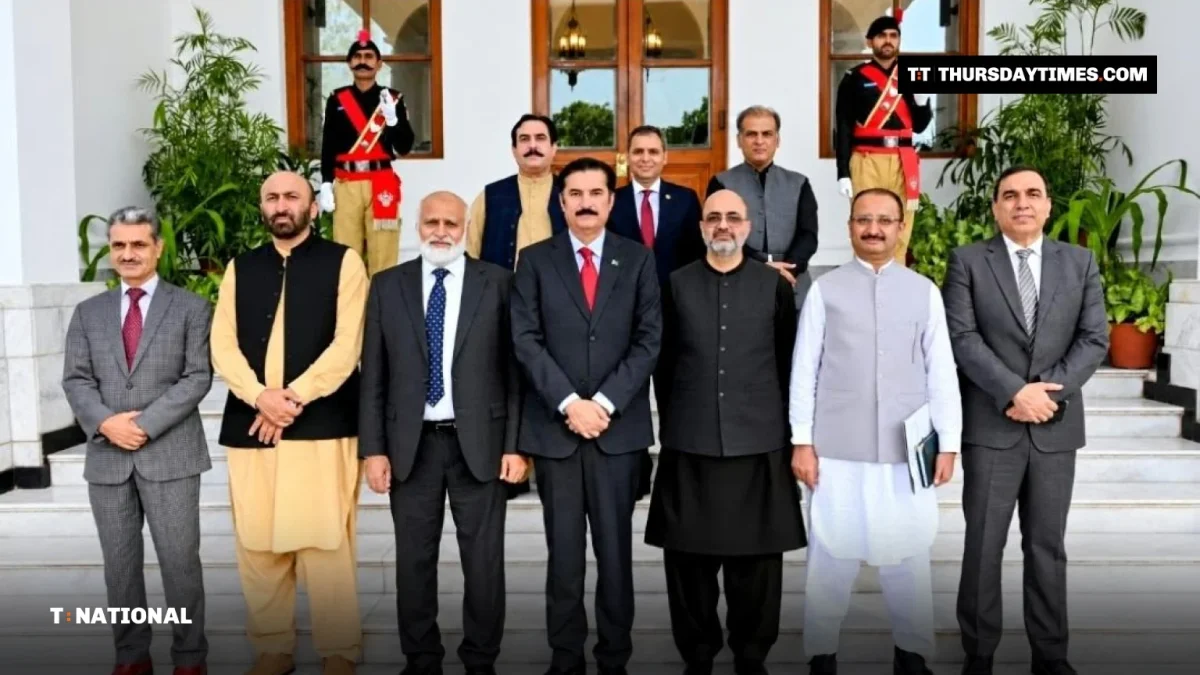
PESHAWAR (The Thursday Times) — Khyber Pakhtunkhwa will set up faceless anti-terrorism courts to protect the identities of witnesses, prosecutors and judges in terrorism cases, and will spend Rs70 billion a year on the police and the Counter-Terrorism Department, the province’s home secretary said on Sunday.
“Witnesses in terrorism cases are afraid to come forward due to their identity. So we have recently sent the amendment for these faceless courts,” Home Secretary Amjad Ali Khan told a briefing in Peshawar attended by Governor Faisal Karim Kundi. “Through this measure, witnesses, prosecutors, and judges will have their protection ensured.”
Where the money goes: the police will get Rs59.8 billion, of which Rs33.4 billion is for infrastructure and Rs26.4 billion for equipment, and the CTD will get Rs10.3 billion. Khan said police surveillance capacity would rise from 15 per cent to 60 per cent, the police’s capacity to counter aerial threats from 1 per cent to 50 per cent, and counter-drone capability from 52 per cent to 60 per cent. Anti-drone systems will be installed in Dera Ismail Khan, Lakki Marwat and Bannu, district nerve centres will start working in 10 districts, the Safe City project will be extended, and satellite communications will reach areas with no signal. The administration is also using AI tools to monitor social media and counter the terrorists’ narrative.
The gaps: Khan said the police were short of more than 10,000 personnel, that the merged districts received only 3.2 per cent of the budget for security and still depended largely on former Khasadars and Levies, and that terrorists were using drones, “due to which we are suffering considerable losses”. Over the past two or three years, he said, 1,003 personnel of the armed forces and 627 police personnel had been martyred and there had been 808 civilian casualties. Earlier this month, terrorists killed two policemen on polio duty in Mohmand.
Intelligence-based operations will be stepped up, he said, facilitators of terrorists will be arrested and people on the Fourth Schedule will be re-verified. A Rapid Response Force will be mobilised, more check posts built, and police trained in anti-drone systems and sniping with the help of the armed forces. Regular jirgas and tribal liaison committees will be set up, and action taken against smuggling, narcotics and extortion.
‘Not our war’: Kundi said the police could not fight “using just one Kalashnikov and a few bullets”, and that not a single police lines had been built in the former tribal districts. He blamed a past “lack of political ownership” of the fight. “When something happened here, voices always came from the assemblies saying that this is ‘not our war’,” he said. Decisions and policies would now be made in Islamabad, he said, not in “Kabul, Kandahar or Jalalabad”. He accused Afghanistan of facilitating India and Israel in using its soil against Pakistan. “Anyone who takes up arms against the state cannot be offered dialogue; they will be responded to accordingly.”
The federal government imposed governor’s rule and an emergency in the province on October 11, citing the PTI-led provincial government’s “deliberate disengagement” from the fight against terrorism. Khan said the province and the Centre were on the same page over a Rs160 billion federal package for Khyber Pakhtunkhwa.