ISLAMABAD (The Thursday Times) — The International Monetary Fund (IMF) Executive Board is expected to meet on 11 December to consider about $1.21 billion for Pakistan: roughly $1 billion under the Extended Fund Facility and about $210 million under the Resilience and Sustainability Facility. Approval would take total disbursements under the two arrangements to about $5.7 billion. Board approval usually follows a staff-level agreement, but it is not final until the board votes. What the next quarter will test is whether the numbers the programme rests on are moving the right way: revenue above all, then prices, reserves, and the policy rate.
What the board is being asked to approve
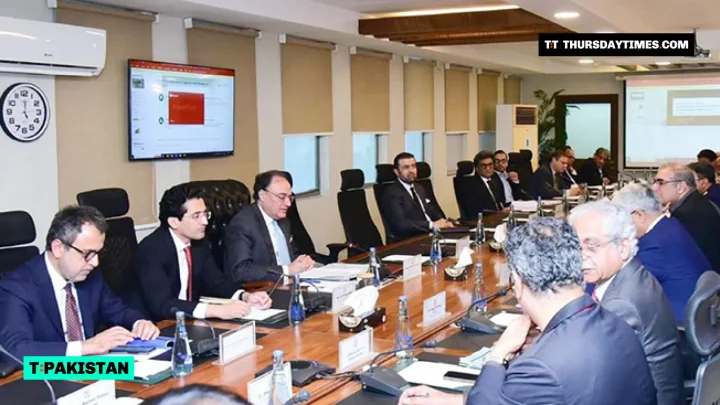
IMF staff and the Pakistani authorities reached a staff-level agreementA deal between IMF staff and a government on what a review should conclude. It is not final until the Executive Board approves it. on 7 October, after talks in Karachi and Islamabad that began on 23 September. It covers the fourth review of the 37-month Extended Fund Facility (EFF) and the third review of the 28-month Resilience and Sustainability Facility (RSF), and the staff also completed the 2026 Article IV consultation. The money is 760 million Special Drawing Rights under the EFF, about $1 billion, and 154 million under the RSF, about $210 million.
The programme moves in roughly half-yearly steps. The board completed the second EFF review on 8 December 2025 and the third on 8 May 2026, so an 11 December date fits the rhythm. The IMF described implementation as broadly on track. What it asked for in return is more instructive than the amount: the FY27 budget implemented around an underlying primary surplusThe budget balance before interest payments on debt. A surplus means revenue exceeds spending on everything except interest. of 2.0 per cent of GDP, stronger revenue administration through risk-based audits and digital invoicing, a tight State Bank stance until inflation returns durably to target, continued reserve accumulation, and a prompt end to the fuel support scheme, which staff called costly and too broadly targeted.
“The board vote is a date on the calendar. The revenue gap is a trend.”
Prices: lower in October, but the base is about to turn
Headline inflation, measured by the Consumer Price Index (CPI), was 9.61 per cent year on year in October, according to the Pakistan Bureau of Statistics (PBS), down from 10.3 per cent in September and the lowest since July. The peak, as the IMF notes, came in May, at 11.7 per cent on the bureau’s table. Urban core inflation, measured as non-food non-energyCore inflation strips out food and energy, whose prices swing with harvests and oil. It shows how much of the rise is broad-based and likely to last. prices, eased from 8.6 per cent to 7.8 per cent. That is the better sign, because it is the part the State Bank can influence.
Headline CPI inflation, per cent year on year
Source: Pakistan Bureau of Statistics, Monthly Review on Price Indices, October 2026. The State Bank’s medium-term target range is 5 to 7 per cent.
The composition explains why the fall may stall. Over the year to October, transport prices rose 28.6 per cent and housing, water, electricity, gas, and fuels rose 11.0 per cent, while the bureau’s urban tables show motor fuel up 41.3 per cent and wheat flour up 34.3 per cent. Wholesale prices rose 13.8 per cent, well ahead of the 9.6 per cent in the shops, which can mean more pass-through to come. The Finance Division expects November inflation between 9 and 10 per cent.
Then there is the base effectAnnual inflation compares prices with the same month a year earlier. If prices fell in that month last year, this year’s annual rate is pushed up even if prices are only flat now.. On the bureau’s table, prices rose 0.4 per cent in November 2025 and fell 0.4 per cent in December 2025. If prices rise by the same 0.4 per cent this November and are flat in December, the annual rate would be about 10 per cent in December with no new shock. This is simple arithmetic on rounded figures, but the annual rate can drift back up in the December reading, due in early January, even as monthly price rises slow.
The State Bank has already moved
The Monetary Policy Committee raised the policy rate by 50 basis points to 12 per cent on 26 October, with nine of its ten members in favour. Against October’s 9.6 per cent, that leaves a real interest rateThe policy rate minus inflation. A positive real rate means borrowing costs exceed the pace of price rises, which is how a central bank leans against inflation. of about 2.4 percentage points, in line with the committee’s stated aim of keeping it positive. The governor said inflation would take longer than expected to return to the roughly 7 per cent level previously anticipated for year-end. The IMF’s October outlook puts average FY27 inflation at 9.9 per cent and growth at 3.5 per cent, and economists at Standard Chartered have said they expect the policy rate to reach 13 per cent by June 2027.
The next scheduled decisions are on 14 December, three days after the board date, and 25 January. Neither date implies a move. Both are the points at which the State Bank will show how it reads the November and December figures.
Revenue is where the programme is tested
The Federal Board of Revenue (FBR) collected Rs4.089 trillion in July to October against a target of Rs4.185 trillion, a shortfall of Rs96 billion on provisional figures, with growth of about 6 per cent on a year earlier. The first quarter beat its target; the gap opened in October, when the FBR collected about Rs1.003 trillion against a monthly target of Rs1.132 trillion.
Against target, July to October, Rs billion
Source: Federal Board of Revenue, provisional figures for July to October FY27. Bar length shows the size of the gap, not its direction.
Income tax is Rs148 billion short, customs is Rs22 billion short, and sales tax is Rs76 billion ahead. Sales tax rises with prices, so part of that surplus is likely to be inflation doing the FBR’s work. Income tax is the head that is lagging, and the IMF’s revenue-administration asks, risk-based audits and digital invoicing among them, are aimed at improving that kind of compliance. Refunds and rebates also rose to Rs265 billion, from Rs206 billion a year earlier, which takes more out of the net figure.
“A Rs96 billion shortfall is small. The pace needed to close it is not.”
The annual target is Rs15.264 trillion. After Rs4.089 trillion in four months, that leaves Rs11.175 trillion for the other eight, or about Rs1.40 trillion a month, against about Rs1.02 trillion a month so far. The required pace is roughly 37 per cent above the average to date. Collections are uneven across a year, so this is a guide to the scale of the climb and not a forecast of a miss. The FBR collected a little over Rs13 trillion in FY26, so the FY27 target needs growth of about 17 per cent, against the 6 per cent seen so far.
FBR monthly pace, Rs trillion
Source: Federal Board of Revenue; arithmetic by The Thursday Times on the Rs15.264 trillion annual target.
The IMF release frames the budget around a primary surplus of 2.0 per cent of GDP, and a collection shortfall puts pressure on that surplus. The pressure can be met with lower spending, other receipts, or new measures, and the staff report that normally follows board approval is where the treatment of the gap is set out. That is why revenue is the number to watch.
Reserves and the market: waiting
The IMF put gross reserves at about $21.5 billion at the end of September. The State Bank’s weekly figures have barely moved since: $21.57 billion on 6 November and $21.595 billion on 20 November, with total liquid reserves, including commercial banks, at $26.75 billion. The wider external picture is in our analysis of the trade gap. The tranche would add about 5.6 per cent to the State Bank’s holdings, all else equal, which is welcome but not transformative.
Reserves held by the State Bank, $ billion
Sources: IMF press release of 7 October 2026 (about $21½ billion); State Bank of Pakistan weekly statements. The last bar is an illustration, not a forecast: $21.595 billion plus $1.21 billion.
The stock market is waiting too. The KSE-100 closed on Friday 27 November at 177,664, up 281 points on the week, after falling 397 points on the day. On 28 August it closed at 177,697. Over three months that included the staff-level agreement and a rate rise, the benchmark ended almost exactly where it began. Brokerages cited geopolitical uncertainty, political tension, and profit-taking, and named the board meeting as the event they are watching. If approval is widely expected, it may give the market little new to price.
“The index is where it was in August. The board date alone may not move it.”
The quarter ahead, in order
First days of December: prices and revenue
The bureau’s November CPI and the FBR’s five-month collection are due. They show whether inflation stays within 9 to 10 per cent, and whether October was a dip or a pattern.
11 December: the board
The board is expected to take the two reviews and the Article IV consultation together. The IMF’s press release afterwards, and the staff report that follows, would set out any change to the programme’s targets.
14 December: the State Bank
The Monetary Policy Committee meets with November inflation in front of it. Its own stated test is a positive real rate.
Mid-December: external accounts
The State Bank’s November balance-of-payments figures are normally out around mid-month, and the weekly reserves figures will show when any disbursement lands.
25 January: the next rate decision
By then the December inflation reading, which carries the base effect, and the FBR’s half-year collection will both be known.
What would change the picture
Oil is the first risk. Brent closed last week in the high $90s, and the State Bank cited crude near $100 a barrel when it raised the rate. Fuel feeds straight into transport and food costs, which is why the IMF wants the fuel support scheme ended and says any future support should be limited, time-bound, and targeted.
Revenue is the second. If November and December collections close the gap, October will look like timing. If they widen it, the question for the staff is whether income tax is on a path the primary surplus can rely on. The policy rate is the third: a real rate near 2.4 points is comfortable only while inflation is falling, and the base effect may interrupt the fall in December.
Nothing in the figures above is by itself a reason to expect the board to hold back: the staff have agreed, and the board completed each of the last two reviews. What deserves attention is the stretch between the vote and the next review: the revenue numbers, the December inflation reading, and the January rate decision.