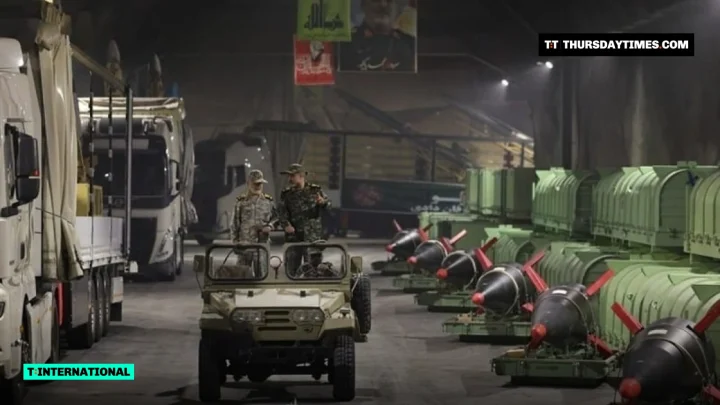
In Muzak village, on the southern edge of Mir Ali, there were two mosques where the faithful should have been praying. Instead, according to the military, terrorists had turned them into stores for bombs and rooms for torture. Security forces cleared both hideouts this week and carried out a large haul of prepared explosive devices, bomb-making material, weapons and ammunition. Pakistan should be grateful to the soldiers who did it, and clear-eyed about what it means. Men who hide explosives under a mihrab and torture prisoners beside a prayer hall have told the country exactly who they are. They are not soldiers of any faith. They are terrorists, and the mosques they defiled must be returned to worship as fast as the state can manage.
The Inter-Services Public RelationsThe media wing of Pakistan’s armed forces, known as the ISPR. It issues statements on military operations. said the intelligence-based operationA raid planned on specific information about a target, rather than a wide sweep of an area. Most of Pakistan’s counter-terrorism operations in Khyber Pakhtunkhwa now take this form. in Muzak was aimed at hideouts of the Fitna al-KhawarijThe state’s name for the banned Tehreek-i-Taliban Pakistan, or TTP. It likens the group to the Khawarij, an early sect that rebelled against the fourth caliph and declared other Muslims unbelievers., the name the state uses for the banned Tehreek-i-Taliban Pakistan. It said the terrorists had deliberately set up their hideouts inside the mosques to store explosives, and were running torture cells there too. It called this a “reprehensible desecration of places of worship”. A clearance operation is continuing to find anything else hidden in the area.
President Asif Ali Zardari and Prime Minister Shehbaz Sharif both commended the troops, and both made the point that matters most: that using mosques to store explosives and as centres of violence is a blatant violation of the most basic teachings of Islam. The prime minister promised that operations would go on with full force until terrorism is wiped out. Khyber Pakhtunkhwa’s governor, Faisal Karim Kundi, said intelligence-based operations would be stepped up further.
They are right, and the country should say so with one voice.
Terrorists who hide behind mosques
The choice of a mosque was not an accident. A terrorist group that stores its bombs in a house risks a raid. One that stores them under a mosque is betting on two things. The first is that soldiers will hesitate to enter a place of worship. The second is that if they do, the group can tell the world that the army attacked a mosque. It is the oldest trick of those who wage war on civilians: to hide among the very people and places they claim to defend, and then to blame the defenders for the damage.
Pakistan’s security forces have refused to fall for it. Going into a mosque in Mir Ali to dig out explosives is slow, dangerous work. It means clearing rooms where a device may be wired to a door, in a village where the terrorists know every lane. Done carelessly, it would hand the enemy the propaganda it wants. By the military’s account, the men who went into Muzak found the cache and kept the operation going to finish the job. They deserve the country’s thanks and its support, not its second-guessing.
“Men who hide explosives under a mihrab have told the country exactly who they are.”
The mosques themselves deserve something too. Every day a defiled mosque stands empty is a small victory for the people who defiled it. The provincial government and the Auqaf department should restore both buildings in Muzak at public expense, quickly and visibly, and hand them back to the village’s worshippers with a Friday prayer that the whole district can see. The message should be simple: the terrorists tried to steal these mosques from the people of Mir Ali, and the state gave them back.
Pakistan has buried too many worshippers
Pakistanis do not need to be told what these men do to mosques. They have buried the victims. On March 4, 2022, a suicide bomber shot the guards at the gate of the Shia mosque in Peshawar’s Kocha Risaldar and blew himself up among worshippers at Friday prayers. Sixty-two people died, among them small children. The so-called Islamic State claimed it.
Less than a year later, on January 30, 2023, a bomber walked into the mosque inside Peshawar’s Police Lines at the afternoon prayer. The roof came down on the men kneeling beneath it. Eighty-four people were killed, almost all of them policemen who had come to pray. The picture at the top of this page shows what was left of that mosque the next morning.
Attacks on Pakistan’s mosques
Sources: Khyber Pakhtunkhwa police and health authorities; Inter-Services Public Relations.
These are not the acts of men with a religious grievance. No religious grievance is served by killing people at prayer. They are the acts of men who have discovered that a mosque is a crowded, open, trusting place, and who use that trust as a weapon. The Mir Ali find belongs to the same story, told from the other side: here, the mosque was not the target but the arsenal.
Pakistan’s religious scholars settled the question of what Islam says about all this years ago. In January 2018, more than 1,800 scholars from every school of thought signed Paigham-e-Pakistan“The Message of Pakistan”: a national decree launched in January 2018 and signed by more than 1,800 religious scholars. It declares suicide attacks forbidden and armed revolt against the state un-Islamic., a national decree that declared suicide bombing forbidden and armed rebellion against the state un-Islamic. The Quran itself teaches that whoever kills a soul unjustly, it is as if he had killed all of mankind. There is no reading of the faith in which a mosque may be turned into a bomb factory.
The numbers behind the fight against terror
The Mir Ali operation is one small part of a long and costly campaign. By the count of the Pakistan Institute for Conflict and Security Studies, an Islamabad think tank, there were 1,376 terrorist attacks in Pakistan in the first ten months of this year, 53 per cent more than in the same period last year. Attacks and operations together left 3,902 people dead.
Deaths in terrorist attacks and operations, January to October 2026
Source: Pakistan Institute for Conflict and Security Studies. The total of 3,902 also includes members of peace committees and others.
The shape of those figures matters. Of the 3,902 dead, 2,597 were terrorists. That is the result of a sustained effort by the army, the Frontier Corps, the police and the Counter-Terrorism Department to take the fight to the hideouts rather than wait for the next bomb. But 645 soldiers and policemen were martyred along the way, and 595 civilians lost their lives. Every one of those numbers is a family.
There are signs that the pressure is working. In October, attacks fell to 143 from 226 the month before, and deaths from attacks fell from 260 to 111. Suicide attacks dropped from three to one, and that one killed no one. One good month is not a trend, and the same figures show kidnappings rising to their highest level in a year. But it is a reminder that the work being done in places like Mir Ali is not in vain.
“Every day a defiled mosque stands empty is a small victory for the people who defiled it.”
What Pakistan should do next
Backing the forces is the first duty, but not the only one. The fight against terrorists who hide in mosques has to be won in the mosques too, and that is a task for the whole of society.
The first step is the pulpit. The country’s religious leadership, from the Council of Islamic Ideology to the imam of the smallest village mosque in Waziristan, should use this Friday’s sermons to say plainly what the scholars said in 2018: that those who store bombs in mosques and torture people in them have placed themselves outside the faith they claim. Paigham-e-Pakistan should not be a document in a drawer. It should be read, explained and repeated, in Pashto and Urdu, in the districts where the terrorists recruit.
The second is the people who run the mosques. Imams, mosque committees and the elders who hold the keys are the first to know when strangers start using a back room. They need a safe way to tell the authorities, and the protection that goes with it. The members of local peace committees who stand up to the terrorists pay a terrible price; five were among the dead in October alone. A village that informs on a hideout must not be left alone to face the revenge.
The third is the courts. A hideout cleared is only half a victory if the men who built it walk free. Khyber Pakhtunkhwa’s new counter-terrorism plan promises courts in which judges and witnesses cannot be identified, so that people dare to testify. It should be put in place quickly, and cases arising from operations like Mir Ali should be among the first it hears.
The fourth is the border. The military says these terrorists are abetted by the Afghan Taliban, and Pakistan has made the same point to Kabul again and again. The weapons and explosives found in Muzak did not appear out of nowhere. Pakistan should keep pressing the Afghan authorities, in public and in private, to stop the use of their soil against Pakistan, and should keep making that case to every country that deals with Kabul.
A mosque is a place of peace
In every town and village of Pakistan the mosque is the place where neighbours meet, where children learn to read, where the poor are fed and where the dead are prayed over. It belongs to the people who pray in it. The terrorists in Mir Ali tried to take that away from the people of Muzak, as their kind took it from the worshippers of Kocha Risaldar and the policemen of Peshawar.
They failed. Soldiers walked in, carried out the bombs and handed the buildings back to the state. Now the state should hand them back to the people, restored and full. And the whole country, from the pulpit to Parliament, should say what the scholars said and the soldiers showed: a mosque is a place of peace, and those who turn it into a weapon have no claim on Islam or on Pakistan.