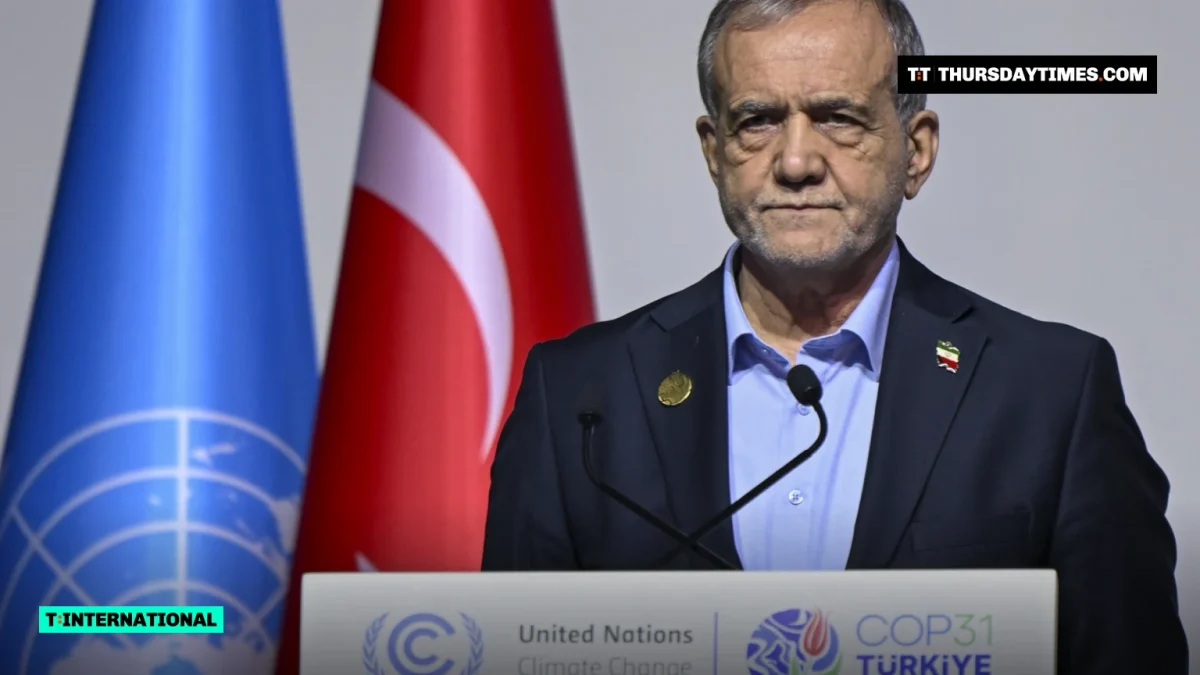
ANTALYA (The Thursday Times) — Iran’s President Masoud Pezeshkian has told the COP31 climate summit that his country wants compensation for environmental damage caused by US and Israeli strikes, and called for the harm that war does to the environment to be documented and assessed.
Speaking on Wednesday during the leaders’ segment of the summit in Antalya, Pezeshkian said attacks on fuel facilities in Asaluyeh had released “500,000 tons of carbon dioxide” and that strikes on fuel storage tanks near Tehran had produced “another 1 million tons”. Iran’s figures have not been independently verified.
Israeli strikes hit oil storage facilities in Tehran on March 7 and gas processing facilities in Asaluyeh, in southern Iran, on March 18, during the US-Israeli offensive against Iran that began on February 28.
Pezeshkian said the attacks exposed “a contradiction between international efforts to reduce greenhouse gas emissions and military operations”. He urged international organisations to document the environmental damage caused by US and Israeli operations in Iran and Gaza, and to develop mechanisms to compensate for it.
He said Gaza faced a “humanitarian and environmental catastrophe” from damage to its infrastructure, water resources, and ecosystems, and that attacks on protected areas and environmental ranger stations in Iran had damaged natural resources and threatened future generations. Peace and the protection of the environment could not be separated, he said.
A gap in the climate rules
International climate agreements commit wealthy countries to billions of dollars to help developing nations adapt to climate change and cope with its effects. They contain no provisions for the environmental consequences of military strikes.
The war has spread to Lebanon and the Gulf, with repeated strikes on energy infrastructure and attacks on shipping, and has left oil in the region’s waters. Ras Al Khaimah has reopened seven beaches after a spill from a supertanker struck near the Strait of Hormuz, and Iran’s Revolutionary Guards said this week that two supertankers had been disabled by explosions in the strait.
Pezeshkian also told the summit that Iran’s installed renewable energy capacity had risen from 1,250 megawatts to more than 6,150 megawatts over the past two years. He said Iran had generated more than 4.5 billion kilowatt-hours of clean electricity this year, which he said had avoided 2.5 million tonnes of carbon dioxide emissions.
Meetings in Antalya
Pezeshkian was among the leaders who arrived for the summit on Wednesday. On the sidelines he met Prime Minister Shehbaz Sharif, who also held talks with Syria’s Ahmad al-Sharaa, as well as Turkish President Recep Tayyip Erdogan.
Speaking to Iranian state media afterwards, Pezeshkian described his meetings with world leaders as “constructive” and said Washington’s efforts to isolate Iran had failed. Iranian diplomacy remained “highly active” despite the war, he said.
The two-week summit runs until November 20. UN Secretary-General António Guterres has called for a near-zero benchmark for methane from oil and gas, and Greta Thunberg told the gathering that the planet is “being killed”.