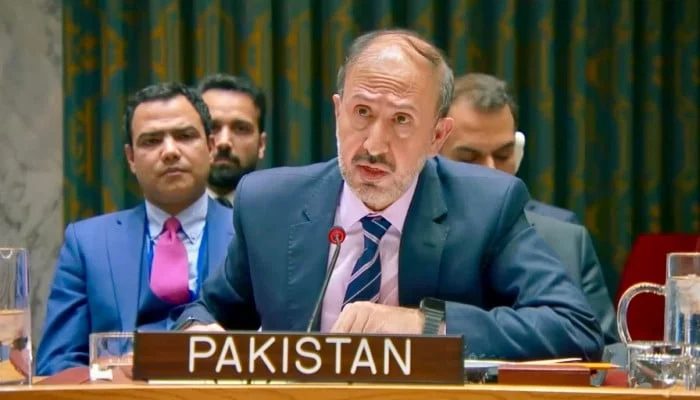
UNITED NATIONS (The Thursday Times) — Pakistan has called for an immediate end to military provocations and unlawful attacks in the Gulf, telling a UN Security Council meeting on Friday that the security of Gulf states was of immense importance to it, as the United States, Iran, and the Gulf Cooperation Council traded sharply conflicting accounts of the crisis.
Pakistan’s permanent representative to the UN, Ambassador Syed Haider Shah, condemned attacks on the six GCC countries and expressed Pakistan’s full solidarity with their governments and people. He also condemned attacks and threats by the Houthis against Saudi Arabia, including on civilian infrastructure and on ships engaged in lawful trade, and said strikes on airports and energy installations were unacceptable.
Shah said threats to shipping in the Strait of Hormuz and the Bab el-Mandeb endangered seafarers, disrupted world trade, and worsened energy and food insecurity, particularly in vulnerable economies. He called for respect for freedom of navigation, protection of commercial vessels and their crews, a return to normal passage, and the safe, unimpeded delivery of humanitarian supplies.
Lasting peace, he said, required tackling the root causes of the region’s conflicts through a framework built on common security, peaceful coexistence, and shared prosperity. He urged all sides to stop attacks, keep channels of communication open, and back regional initiatives and the UN secretary-general’s good offices.
Pakistan named as a mediator
Speaking for the GCC, Bahrain’s ambassador, Jamal Fares Alrowaiei, welcomed mediation efforts by Oman, Qatar, and Pakistan, and said the bloc remained committed to diplomacy and de-escalation. “The security of the GCC states is indivisible,” he said, adding that Gulf countries must take part in any negotiations on regional security.
The GCC’s secretary-general, Jasem Mohamed Albudaiwi, told the council that Gulf states had faced more than 7,000 Iranian missiles and drones since February 28, hitting airports, ports, oil and gas facilities, power stations, desalination plants, and residential areas.
Washington and Tehran trade blame
The US representative, Ambassador Jennifer Locetta, accused Iran of attacking its neighbours, firing on commercial ships, and arming terrorist proxies. “Iran ignores this council. It ignores the overwhelming opinion of the international community,” she said, citing Resolution 2817, which demands that Tehran stop attacks on shipping and neighbouring states and had 136 co-sponsors. She also accused the Houthis of attacking Saudi airports and energy sites with Iranian backing.
Iran’s ambassador, Gholamhossein Darzi, said the insecurity around Hormuz was “a direct consequence” of the US and Israeli attacks on Iran in June 2025 and on February 28 this year, which he said had killed 5,000 people in Iran, including 254 children. He rejected Resolution 2817 as politically motivated and said Tehran had not closed the door to diplomacy, but that Washington must halt its military action and give credible guarantees that it would not be repeated.
A day earlier, Pakistan backed the council’s renewal of sanctions on the Houthis. The Makkah Joint Defence Agreement between Pakistan, Saudi Arabia, and Türkiye took effect this week, and Pakistan and Saudi Arabia signed a bilateral defence pact in September 2025.