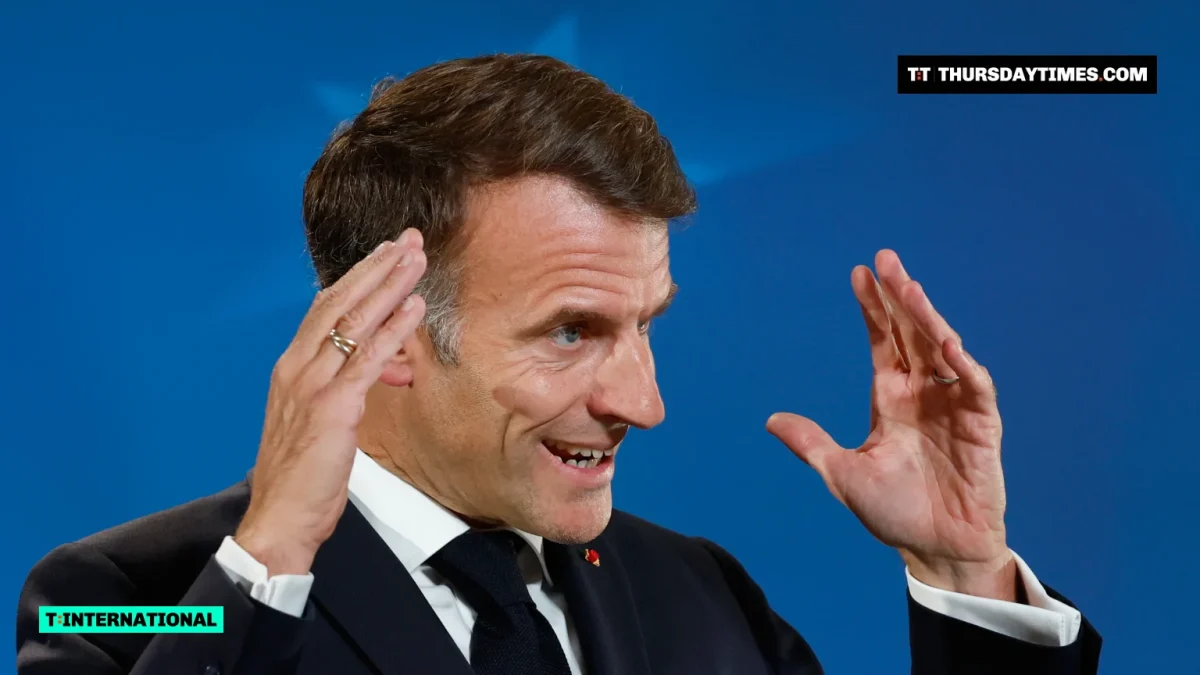
PARIS (The Thursday Times) — French President Emmanuel Macron said on Saturday that those who want to ration aid to Ukraine are trying to force an “unjust peace” on Kyiv, warning that such a course would be “a recipe for another war”, as the United States pushes ahead with efforts to broker an end to Russia’s invasion.
“Those who want to ration aid to Ukraine wish underneath it all to force an unjust peace on it,” Macron wrote in a long post on X, adding that the same would hold for the whole of Europe. “That is the spirit of defeat. That is a recipe for another war. That cannot be France’s position.”
He said Europe “must take full part” in the work towards a “fair and lasting peace”, and that Ukraine’s allies must set out clearly, including to Russia, what they want for the period after the war. “We must also detail what we expect of the United States for Europe’s long-term security,” he wrote.
Macron said he believed that “Vladimir Putin does not want to negotiate” and was trying to break Ukraine by stepping up drone and missile strikes on civilians and energy infrastructure as winter sets in. “That means we must keep up our financial backing and helping Ukraine protect its population, its power plants and its grids,” he said. He added that Ukraine, which has Europe’s largest conventional army, would have a central role in the continent’s security after the war, alongside NATO, where it “fully belongs”.
Kushner looks to bring Europe in
US envoy Jared Kushner told reporters on Saturday that he was working with Russia, Ukraine, and Europe to move the talks to their next stage, including by helping to set up direct contact between European governments and Moscow. He said “both sides” knew that compromises would be needed to end the war, and that he and fellow envoy Steve Witkoff were now working on the next steps.
European leaders agreed on Friday to send representatives of the European Union and of the United Kingdom, France, Germany, Italy, and Poland to future rounds of talks, as The Thursday Times reported. Kremlin spokesman Dmitry Peskov has said Moscow is open to European participation and would accept whichever representatives Europe chose to send.
The talks in Abu Dhabi earlier this week ended without a breakthrough but produced an agreement on a large prisoner exchange. President Volodymyr Zelenskyy said the swap would involve more than 1,000 prisoners of war on each side, probably between 1,200 and 1,300, with the exact number still being settled.
Zelenskyy wary of a wider security deal
In remarks to reporters on Friday that were released on Saturday, Zelenskyy said the United States had raised the idea of a new security framework for Europe as part of the peace effort, and warned that Moscow could use such talks to weaken NATO and redraw borders. “In my view, this can be dangerous,” he said. “This should not be the main agenda.”
“Putin’s desire to change borders in Europe is a fact,” Zelenskyy said, predicting that the Russian leader would raise Finland, Sweden, Hungary, and the presence of American troops in the Baltic states. Any change to Europe’s security arrangements, he said, must be decided by European NATO members, and only after the war ends. “The sequence should be as follows: a ceasefire, an end to the war in Ukraine, and security guarantees for Ukraine,” he said. “There can be no security guarantees in Europe, or for Europe, without Ukraine.”
Zelenskyy has also said that US negotiators asked for the first time whether Ukraine would withdraw from the part of the Donbas it still holds in exchange for NATO membership, as The Thursday Times reported. He has ruled out recognising any occupied land as Russian and rejected neutrality, saying it would require changing Ukraine’s constitution.
The fighting went on as the diplomats talked. Ukraine’s General Staff said its forces struck an oil pipeline station in Russia’s Samara region on Friday, setting storage tanks on fire, while 22 people, three of them children, were injured in a Russian attack on the southeastern city of Zaporizhzhia, Ukraine’s emergency service said.