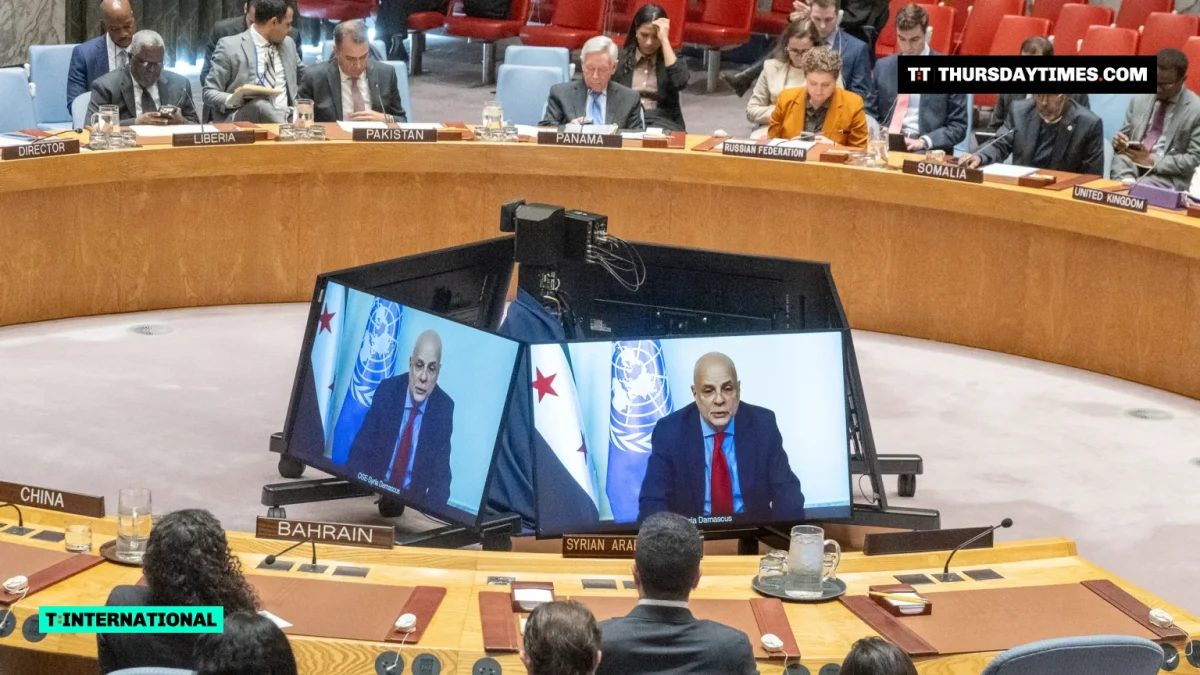
NEW YORK (The Thursday Times) — Syria’s ambassador to the United Nations, Ibrahim Olabi, told the Security Council on Monday that “Syrians and the entire world have had enough of Israel’s attacks and baseless pretexts and attempts to justify them,” as a senior UN official said Israeli military activity in the south of the country was continuing “relentlessly”.
Olabi accused Israel of using political considerations to obstruct Syria’s recovery and called for a return to international law. “It is high time for the region to breathe a sigh of relief, for the peoples of the region to enjoy security,” he said. He thanked council members for standing beside Syria and thanked US President Donald Trump for his mediation efforts.
What the UN official said
Claudio Cordone, the UN’s deputy special envoy for Syria, briefed the council from Damascus. “Israeli military activities continued relentlessly in violation of Syria’s sovereignty and territorial integrity, including incursions and temporary checkpoints,” he said, listing detentions, shelling, land clearance, and damage to agricultural and water infrastructure.
He said Israeli activity near the Al-Mantara Dam in Quneitra and in Wadi al-Ruqqad in western Deraa had raised concerns about access to water and farmland. The Thursday Times has reported on the string of Israeli incursions in Quneitra in recent weeks.
Cordone repeated a call by UN Secretary-General Antonio Guterres for an end to violations of the 1974 Disengagement of Forces Agreement between Israel and Syria, for full respect for Syria’s sovereignty, and for the cases of Syrians detained in Israel to be resolved.
In the southern province of Sweida, he said, there was a “tense security and political stalemate”, and the Syrian government had sent additional forces “amid reports of continued Israeli support to local armed actors”.
Background
Israeli troops moved into the UN-patrolled buffer zone along the Golan Heights after Bashar al-Assad was overthrown on 8 December 2024, and Israel said the 1974 agreement had collapsed. A UN Commission of Inquiry report published in March found that Israeli forces had taken control of water resources, farmland, and roads in parts of Quneitra and western Deraa.
Humanitarian needs
Mohamed Yahya, the UN’s assistant secretary-general for humanitarian affairs, told the council that nearly 4 million Syrians displaced by the civil war have returned home voluntarily since December 2024. “Yet returns do not mean humanitarian needs have ended,” he said, adding that more than 730,000 people are still living in camps.
Yahya said at least 30 people, 19 of them children, had been killed by explosive remnants of war since the council last met on Syria in October. An estimated 2.4 million people will need extra help over the winter, he said, but the UN plan to reach the 970,000 most at risk is only 40 percent funded.
Cordone also welcomed the submission of a draft transitional justice law to Syria’s interim People’s Assembly and said the justice it delivers must not be selective. He said the World Bank estimates it would cost about $216 billion to rebuild Syria’s damaged physical assets.