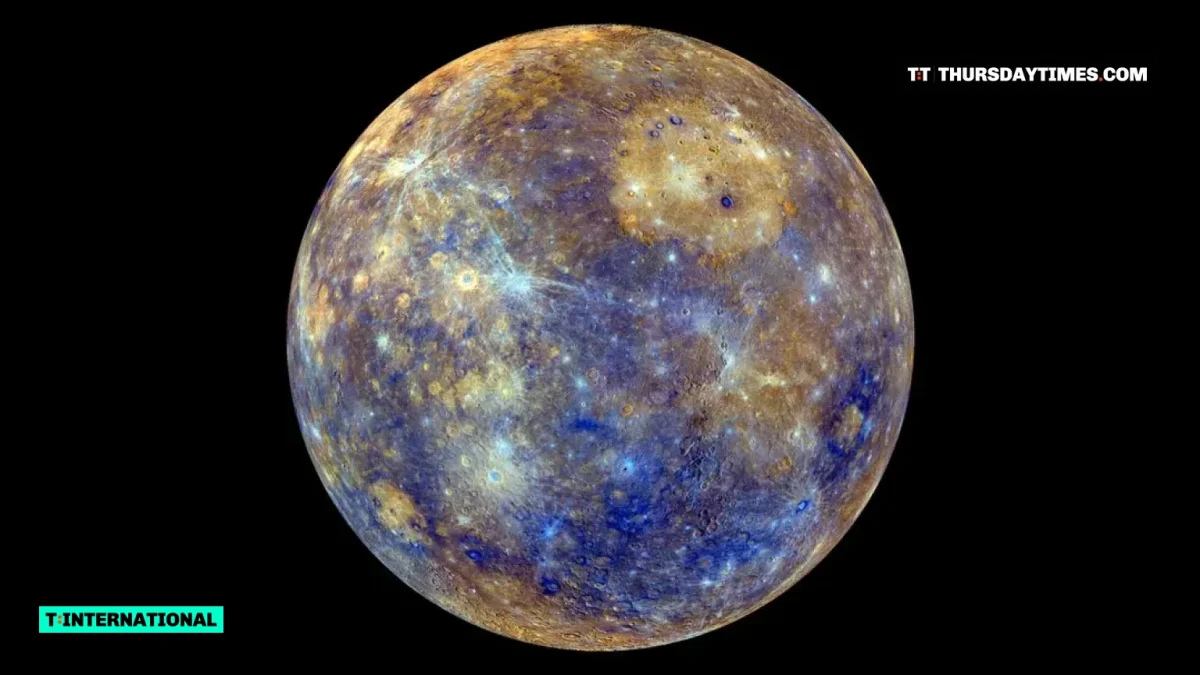
PARIS (The Thursday Times) — The European-Japanese BepiColombo mission is due to be captured by Mercury’s gravity on Saturday 21 November, ending an eight-year journey of about 10 billion kilometres that began in 2018.
BepiColombo is a joint mission of the European Space Agency (ESA) and the Japan Aerospace Exploration Agency (JAXA). It launched from French Guiana and had to loop once around Earth, twice around Venus, and six times around Mercury to shed enough speed to be caught by the planet. The trip was meant to take seven years, but a problem with the propulsion system added a year.
Two orbiters, one stack
The craft carries two orbiters: ESA’s Mercury Planetary Orbiter and JAXA’s Mercury Magnetospheric Orbiter, known as Mio. The mission entered its arrival phase on 3 September, when the transfer module that had carried them released the pair. They are still joined together and will be captured as one on 21 November.
On 9 December, once they have reached Mio’s science orbit, the two spacecraft will separate. ESA says that separation marks the official arrival. The planetary orbiter will then move to its own orbit closer to the planet. It is more than twice the size of Mio and carries 11 instruments, including spectrometers to map the surface and a laser altimeter to chart its terrain. Mio will watch from a more distant orbit, studying Mercury’s magnetic field, its thin atmosphere, and the solar wind.
What scientists want to know
Mercury is the closest planet to the Sun, with temperatures that swing from about 430C to minus 180C. Only two spacecraft have visited before: Mariner 10, which made three flybys in the 1970s, and NASA’s Messenger, which orbited the planet from 2011 for four years.
Researchers hope BepiColombo will explain why there is ice in craters near Mercury’s poles despite the heat, and what formed the thousands of shallow, steep-sided hollows across its surface, which are geologically young at about 100,000 years old. It will also look into the planet’s unusually large metal core and a magnetic field that should have faded long ago.
“I think it’s a little bit of an under-loved planet in the inner Solar System, but I think that’s one of the reasons why it is so compelling,” said Professor Emma Bunce of the University of Leicester, a principal investigator on the mission.
The main mission is expected to last one Earth year, a little more than four Mercury years, and could be extended for a second.