JAKARTA (The Thursday Times) — Indonesia wants its new trade agreement with the European Union to take effect on 1 January 2027, Coordinating Minister for Economic Affairs Airlangga Hartarto said on Sunday, a day after the pact was signed in Brussels.
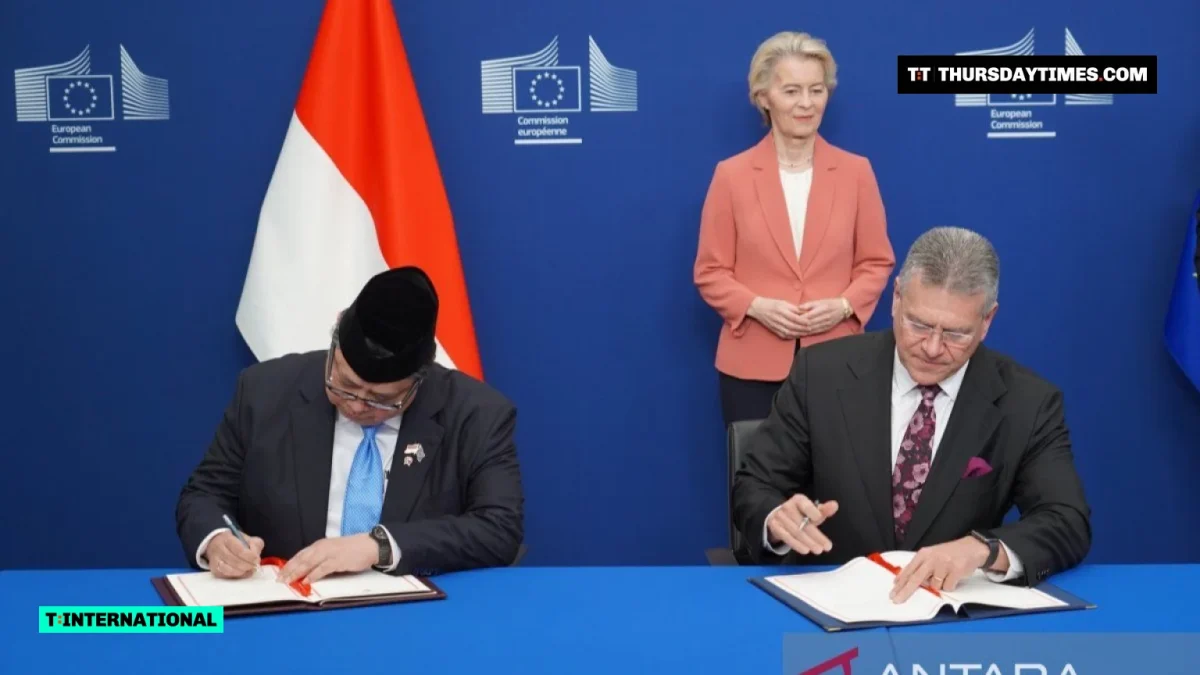
The Comprehensive Economic Partnership Agreement (CEPA) and a companion Investment Protection Agreement were signed on Saturday 21 November, according to the European Commission. Talks began in 2016 and were finalised in September 2025. Airlangga said the January start depends on rapid ratification by both sides, which are racing to finish before Indonesia’s preferential tariff access under the EU’s Generalised Scheme of Preferences expires at the end of 2026.
Brussels scheduled the signing so the pact could enter internal EU procedures on Monday 23 November, he said. Jakarta has consulted parliament and plans to ratify through a presidential regulation.
What changes for exporters
Airlangga said the agreement will remove duties on more than 90 percent of goods traded between the two sides and could save up to €600 million a year in trade costs. Indonesian textiles, footwear, clothing, food products and crude palm oil, which now face EU tariffs of 7 to 12 percent, will move to zero. Jakarta says tariffs on 90.4 percent of Indonesian exports to the EU fall to zero immediately, with a further 8.37 percent of tariff lines phased down over three to 15 years through tariff-rate quotas.
The Commission says Indonesia will remove 98.5 percent of its tariffs on EU goods, saving European exporters more than €650 million a year in customs duties. Cuts include the current 50 percent duty on cars. The EU points to a market of 280 million consumers, steadier access to nickel and cobalt, and 100 percent foreign ownership in Indonesian telecommunications and computer services for the first time. Sensitive EU farm products such as rice, sugar, eggs, fresh bananas and ethanol get no new access.
On palm oil and deforestation, Airlangga said Indonesia has enforced a deforestation moratorium for several years and is ready to supply products that meet agreed sustainability standards, after the EU postponed its deforestation regulation by two years. “I believe the right momentum has finally been achieved, even amidst a challenging geopolitical and geoeconomic landscape,” he said.