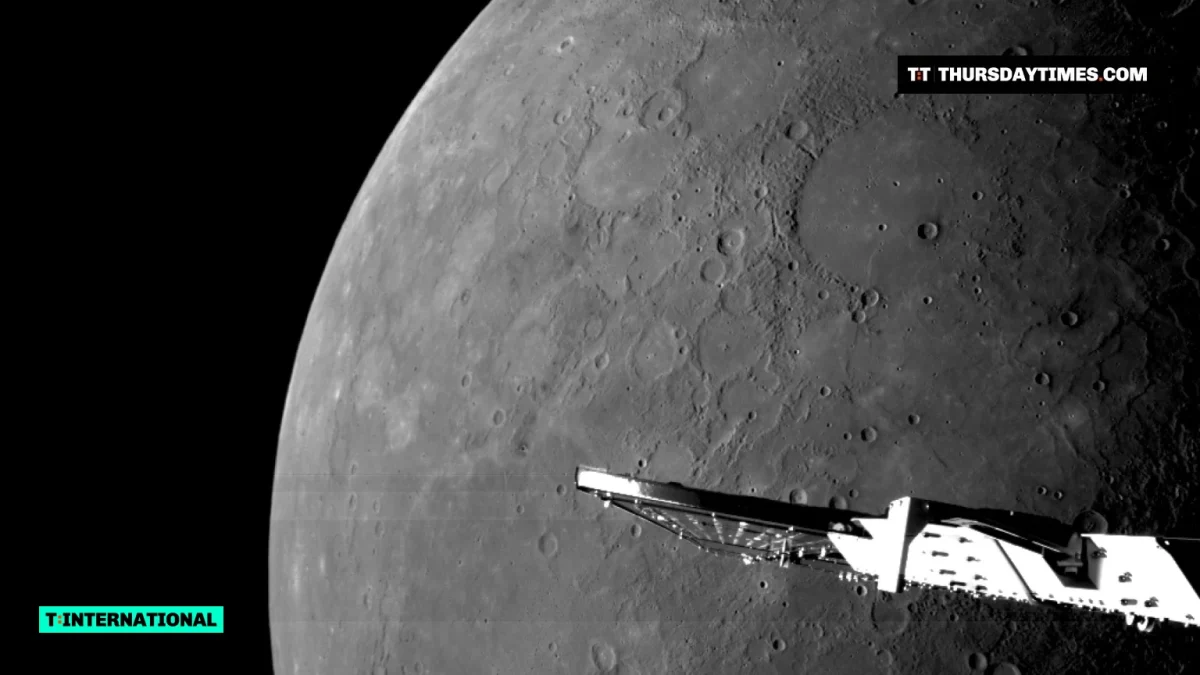
PARIS (The Thursday Times) — The European-Japanese BepiColombo spacecraft has begun orbiting Mercury after an eight-year journey, but the European Space Agency (ESA) said on Sunday that the thruster burn it needed to enter orbit was “shorter than planned following a software issue”.
ESA confirmed on Saturday that BepiColombo had begun its orbit. In a social media post on Sunday, the agency described the entry into orbit as successful but said the burn had fallen short. “The spacecraft is safe and teams at ESOC are working to understand what happened,” ESA said, adding that updates would be provided on Monday. ESOC is the agency’s European Space Operations Centre in Germany.
ESA has not said how the shortened burn could affect the schedule. As The Thursday Times reported before the manoeuvre, the spacecraft was due to be captured by Mercury’s gravity after a journey that was meant to take seven years but was extended by a year because of a propulsion problem.
Two orbiters, one stack
BepiColombo is a joint mission of ESA and the Japan Aerospace Exploration Agency (JAXA). It is a composite of ESA’s Mercury Planetary Orbiter and JAXA’s Mercury Magnetospheric Orbiter, which have different scientific goals. The two are due to separate on 9 and 10 December, and routine science operations are scheduled to begin in April 2027.
The spacecraft, launched in 2018, is only the third to visit Mercury and the second to orbit it. The mission aims to answer why the planet has a magnetic field, why ice exists in the polar craters of a sun-scorched world, and what the enigmatic depressions known as hollows on its surface are.